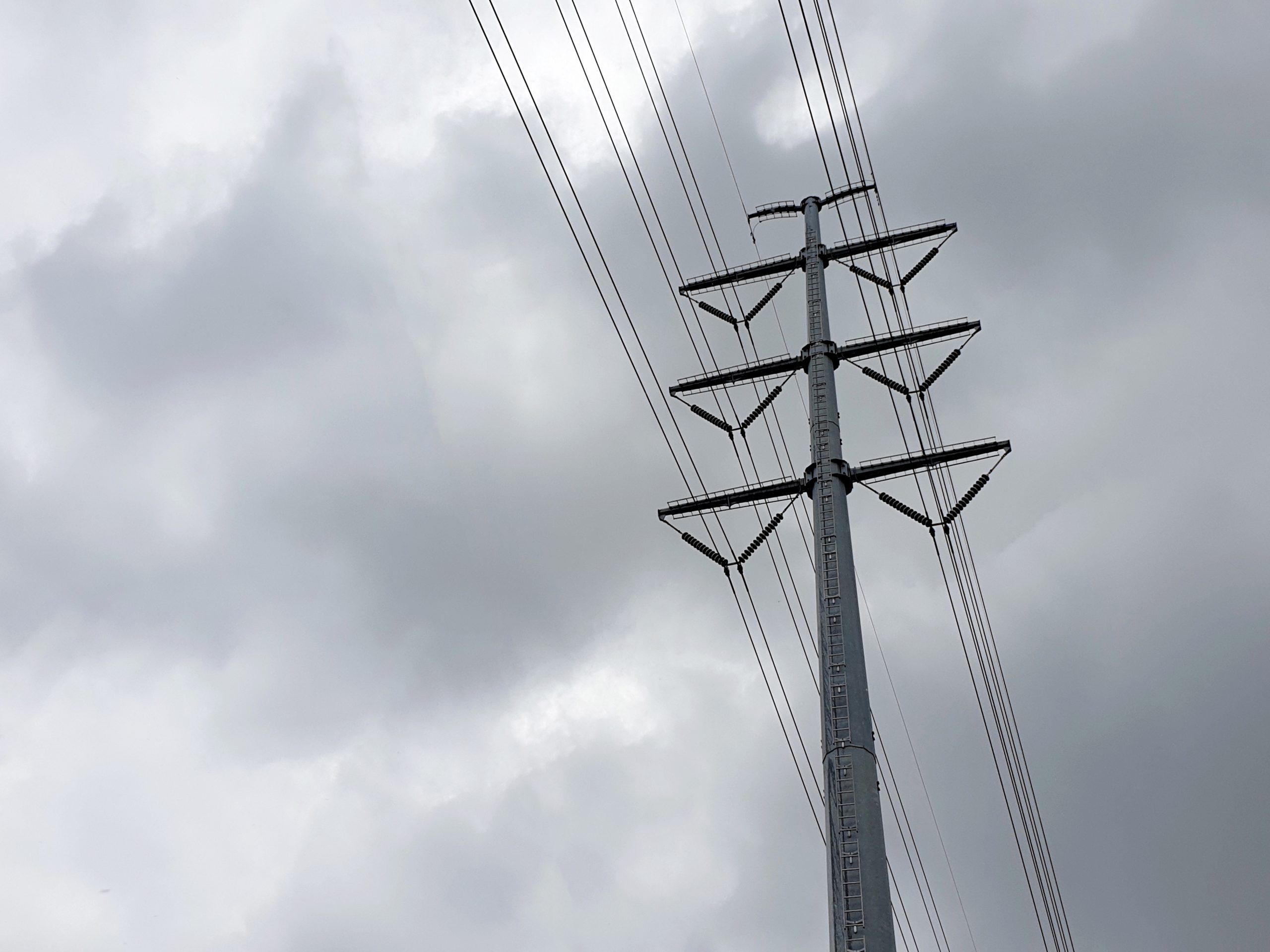
Silicon Valley Power’s (SVP) expansion is slated to ensure that Santa Clara can double its power load in the upcoming years.
Part of that expansion is the construction of a 115 kV transmission line that will run 2.24 miles along Bassett Street.
However, the fly in the ointment is that the city needs to secure 23 parcels of privately owned land standing in the line’s way. To secure the parcels, the Santa Clara City Council has given city employees the go-ahead to enact eminent domain.
The action allows the city to seize the properties if it is unable to reach an agreement.

“So many people are surprised that government has this power,” said Peggy O’Laughlin, a lawyer who handles lots of eminent domain cases for Matteoni, O’Laughlin & Hechtman. “It is a pretty awesome power of the government.”
At a council meeting in August last year, the council approved eminent domain on the latest slew of properties.
At that meeting, Emily Brough, an attorney representing some of the property owners, characterized the city’s description of what parts of the property were necessary for the line as “lacking in detail.”

Brough contended there was no evidence that SVP needed the properties for the line or that the utility even intended to build it once eminent domain had been enacted.
In order to justify using eminent domain to seize property, the city needs to establish that the transmission line serves the public use in a way that causes the most benefit and the least private harm. Eminent domain is used for a wide range of actions, ranging from electric and water utilities to transportation.
Often, what is at issue is what constitutes “public use.”
“It is so broadly defined, basically anything the government says is a public use,” O’Laughlin said. “The goal, the motivation, the purpose is that the government exists to provide benefits within their jurisdiction.”
Most contention, O’Laughlin said, stems from whether the agency is offering the property owner fair market value for the property it seeks to acquire.
Although the council has begun the process, it does not include establishing the property’s value, which is handled in court.
The transmission line drew ire from residents who worried its presence would devalue their properties — citing how the line looks and health concerns from electromagnetic frequency (EMF). But O’Laughlin said perception isn’t enough.
“What you would have to show is that the perception plays out in the marketplace,” she said.
Challenges to eminent domain frequently focus on whether taking the property mostly benefits the public as opposed to a private party, such as a developer. However, a 2005 U.S. Supreme Court case — Kelo vs. the City of New London — determined that economic growth was in the public interest. The lawyers opposing the action argued that reason was a pretext.
The case caused many states, including California, to enact stronger eminent domain laws. The state’s 2006 Assembly Bill 1162 restricted eminent domain for economic purposes. It prevents the use of eminent domain to secure private property primarily intended for economic development unless the property is deemed blighted.
In addition to the issue of just compensation, another common argument against enacting eminent domain is a lack of necessity. Cities must prove taking a property is the only viable option to complete a project.
SVP employees will continue to negotiate with the property owners throughout the eminent domain process. That process typically takes about two years.
Contact David Alexander at d.todd.alexander@gmail.com
Related Posts:
SVP Contract Sparks Debate About System Expansion
Tariffs Could Add $50+ Million to Santa Clara’s Electrical Infrastructure Costs
Santa Clara Enacts Eminent Domain on Yet Another Property for SVP Expansion








Instead of using “Eminent Domain” on Bassett Street to get/confiscate/steal/appropriator a route for power lines, use that same “Eminent Domain” to route the power lines over the railroad tracks.
If the city buys a property at market rate, thereby enabling the homeowner(s) to buy a similar property, and they’ve owned the previous property for a few years, they’ll be hammered with the new property taxes. This is the curse that comes with the blessing of Prop. 13. Were I one of those homeowners, I’d fight, too.
Generally, subject to some limits, the property tax base on the acquired property can transfer to the replacement property in Eminent Domain cases. California Property Tax Rule 462.500.