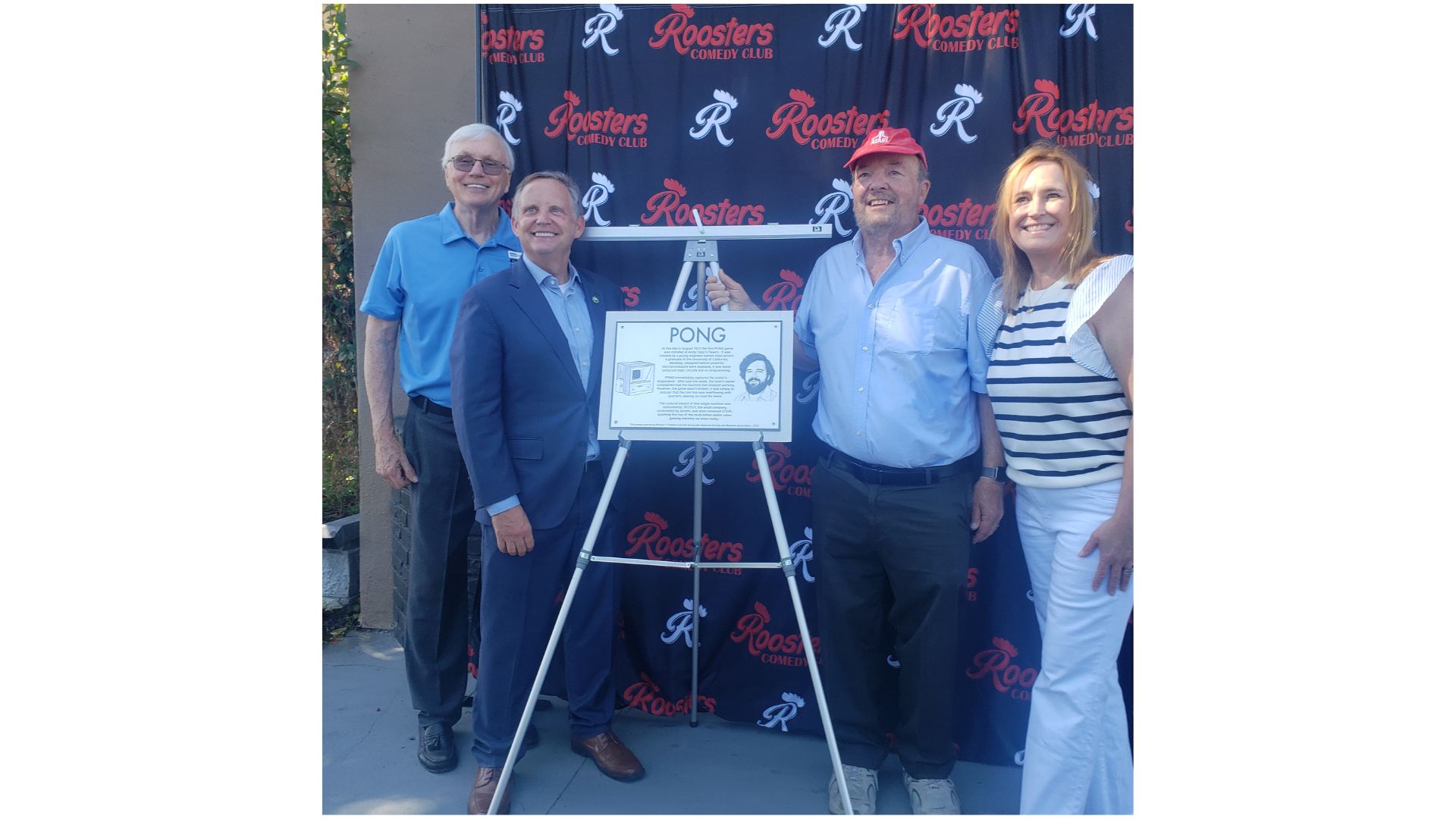
The year was 1972. Lockheed was the biggest employer in Sunnyvale, and its 16,500 employees were about to have their annual raises trimmed by 5% thanks to the Nixon administration’s wage and price controls. The city was holding a hearing about annexing 100 homes in Fremont Manor.
But over on El Camino, 25-year-old Al Alcorn was thinking about something that would end up being more consequential to the Valley’s history — figuring out why a simple video game installed at a Sunnyvale bar had stopped working.
It was an experiment, just to see if anyone would even bother to play a video game like they played pinball. Things were going fine until suddenly the game stopped working. Alcorn, then an engineer at a startup called Atari, drove over after work to fix it.
“The screen was up, but it wouldn’t take any money,” he remembered at an event last month honoring that first installation with a plaque, sponsored by the Sunnyvale Historical Society and Museum at the Rooster T. Feathers comedy club, formerly Andy Capp’s.

“I opened the cash box to give myself a free play and all these quarters poured out,” Alcorn said. “The cash box was so stuffed with coins that the mechanism jammed.” The game was a victim of its own popularity. He hadn’t expected that many people would play it, and it turned out that everybody wanted to.
The next day, Alcorn handed a bag of quarters to his boss, Atari co-founder Nolan Bushnell, saying, “I found the problem. The thing’s making too much money.”
The “thing” was the video game Pong: two paddles, a bouncing ball and a score. And it would earn Alcorn his place in Mountain View’s Computer History Museum.

Bushnell had given the project to Alcorn as a training exercise.
“He gave me the simplest thing he could possibly think of,” Alcorn said. “Nobody would play it; it was just a game.”
Bushnell made up a story to justify the assignment: he claimed Atari had a contract with General Electric to develop a consumer product.
“Nobody from GE ever called or came by or wrote a letter,” Alcorn said, laughing. “It didn’t occur to me it was all BS.”
BS or not, the ruse worked.
Alcorn was employee number three at Atari; not a founder, but there from the very beginning. Bushnell had come to the project with a vision born in his college years, when he ran the games at an amusement park arcade and saw firsthand how much money a good game could earn.
But the success of that experiment brought new problems. Bushnell wanted a home version of Pong, and that required a custom silicon chip. The challenge was squeezing all of Pong onto one custom chip right as microprocessors were arriving.
“I didn’t know how to do a chip,” Alcorn said.
But Bushnell kept pushing, and Alcorn kept going. He hired an engineer who knew chip design, contracted with AMI (American Microsystems) to fabricate it, and crossed his fingers.
He’s still surprised that it worked.
“It was like a dog that caught the car. We had no plans.”
When it came time to order chips in volume, Atari had to find someone to produce them in quantity. But, as we now know, those problems were overcome, and the home version of Pong became one of the 1970s’ best-selling consumer electronics products.
There is a coda to the Atari story that Alcorn likes to tell. Around this same period, a young man came in looking for work. The personnel manager described him as a college dropout with a friend at Hewlett-Packard and a lot of enthusiasm.
“He was a hippie,” said Alcorn. “He was young. That means he was cheap. That’s what I needed.”
He hired the kid, whose name was Steve Jobs.
“He went on to do some good things,” Alcorn said, with considerable understatement.
Half a century later, in the city where it all began, Alcorn marveled at the improbability of it: a young engineer, a made-up GE contract, and a bar full of people who couldn’t stop feeding quarters into the first arcade video game. Marking the spot, as Sunnyvale Heritage Park Museum director Laura Babcock put it, was “long overdue.”








0 comments