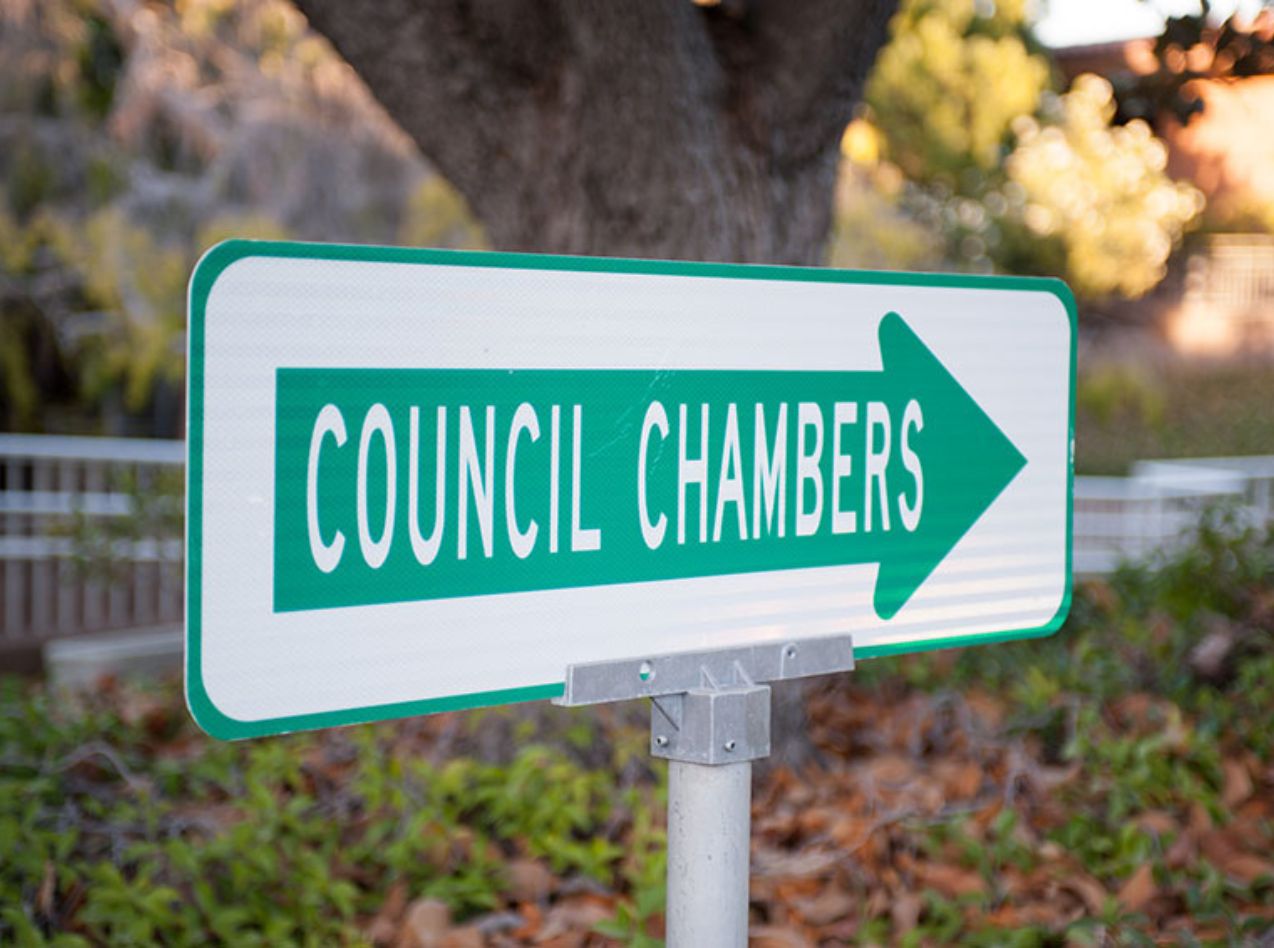
One Santa Clara city councilor wants the city to stabilize utility rates.
At its most recent meeting Jan. 27, Council Member Kevin Park said the city needs to stop hanging its hat on Silicon Valley Power (SVP) being less expensive than Pacific Gas & Electric (PG&E). Instead, he said it needs to focus on doing something to staunch the rapid rate increases.
“If rates go up faster than cost of living increases, then that’s still a net loss for a lot of people,” he said.

Park made his comments as part of SVP’s biannual report, saying he wanted clarity on what rate increases would look like if not for SVP’s comprehensive expansion. He called the increasingly frequent rate increases “raising money on the backs of residents.”
Nico Procos, SVP director, called Santa Clara the “poster child for load growth.” He said the system expansion is “on target so far.”

“We go through an iterative process where we are constantly evaluating what’s coming down the pipeline, not only for our existing customers but also we have new customers,” he said. “We are trying to stay ahead of everything.”
SVP will continue to focus on several projects already in the works, Procos said, adding that SVP is trying to remain “proactive.” Among those projects is battery storage, consultant support, rebuilding receiving stations, as well as upgrading and adding transmission.
In addition to energizing eight other minor projects through 2030, two receiving station projects are already underway.
The upgrade and expansion of the northern receiving station is slated for completion in June 2028. A full rebuild and expansion of the Scott and Kifer receiving stations are set for completion in March and June 2029, respectively.
In addition to updating aging infrastructure through its expansion, SVP is also performing proactive tree trimming and focusing on technology with its new outage management system and risk management software, slated to come online in mid-2026
Additionally, it is ramping up its rebate system and bolstering security, something Procos said will become increasingly important as load growth increases.
“Once you get to that higher level, your level of your expectations of security, not only physical but also cyber, really jump up a lot, so we are really preparing for that in advance,” Procos said.
Council Member Suds Jain said he is concerned with aesthetics.
He encouraged the city to look into underground power lines and ways to hide substations, which he called “really ugly.”
“I don’t want our whole city to be crisscrossed with overhead power lines and feel like we are living inside a substation,” he said.
The council noted and filed the report.
Mills Act Properties Get Reprieve
At the city manager’s suggestion, the council also continued revoking tax-exempt status for two historic properties.
The owners of the properties, located at 1711 Main St. and 906 Monroe St., have faltered on their responsibilities to make improvements on the historic homes.
The designation, called a Mills Act, gives owners of homes on the historic resources inventory a tax break to help cover costs associated with maintaining an older home.
Afshan Hamid, community development director, said the owners must agree to a 10-year maintenance work plan and submit to inspections every five years.
“It is really in the city’s interest to maintain the character of historic homes,” she said.
Despite repeated outreach — via telephone, email, certified mail and hand-delivery — Hamid said the property owners have not complied.
The owner of 1711 Main St., a pioneer Gothic-style with a Mills Act since 2000, replied to emails cryptically telling city employees to “check the permits.” Hamid said such a search yielded nothing noteworthy.
The bank owns 906 Monroe St., which has had a Mills Act since 1998.
If removed from the Mills Act, the owners would incur a fine equal to 12.5% of the fair market value of their home. That money, collected by the Santa Clara County Auditor, would then be distributed to the city.
Since the owner of the Main Street property responded to the city’s email, Park said he was uncomfortable being so stringent.
After hearing the concern, City Manager Jovan Grogan suggested the council continue the topic and allow city employees time to attempt to contact both owners again before considering the removal.
The council unanimously approved the continuance and will hear the item again at its March 10 meeting.
ICE Presence at Super Bowl LX Concerns Many
During a lengthy public comments section, several public members implored the council to agendize an item that would aim to hamstring immigration agents during Super Bowl LX.
Park requested the council take up an item on a future agenda. However, that request ballooned into a slew of public commenters calling for the city to take a stand. Many called for a special meeting ahead of the Super Bowl.
Many called for the council to enact policies that block the U.S. Immigration and Customs Enforcement (ICE) agents from collecting data and that would establish “ICE-free zones.”
“Whether we like it or not, violent, untrained, armed ICE agents are coming to terrorize our Santa Clara community,” said Kim Wood, with Services Immigrant Rights and Education Network (SIREN). “Whether we like it or not, ICE is coming to invade our streets and separate our families. And that is exactly why silence is not an option.”
Council Member Kelly Cox said “shame on us” for not taking the item up sooner.
Danni Razik, a San Jose resident with family in Santa Clara, said she was “horrified” and “in shock” over the “constitutional crisis” happening in the country.
“The Overton window is shifting. Younger generations are looking at this as extremely unacceptable behavior,” she said.
No one opposed the motion.
Discussion on the item was supposed to be contained to the merits of adding it to a future agenda. However, Park spoke at length about his position despite repeated admonishments from both City Attorney Glen Googins and Vice Mayor Albert Gonzalez.
“If we are not looking at what else we can do, if we’re satisfied, at any time, with the work we’ve already done, nothing will get better,” Park said.
The council unanimously approved bringing the item back at a special meeting Feb. 3 with the possibility of taking action.
Mayor Lisa Gillmor was absent.
Santa Clara City Council Consent Calendar Spending
The council approved the following spending in one motion via the consent calendar:
- A $6.3 million purchase of a property, located at 3031 Corvin Drive, for use by the public works department.
The council will hold a special meeting on Tuesday, Feb. 3 in the Santa Clara City Council Chambers at City Hall, 1500 Warburton Ave. in Santa Clara. The next regularly scheduled meeting is 7 p.m. Tuesday, Feb. 10.
Members of the public can participate in the Santa Clara City Council meetings on Zoom at https://santaclaraca.zoom.us/j/99706759306; Meeting ID: 997-0675-9306 or call 1 (669) 900-6833, via the City’s eComment (available during the meeting) or by email to PublicComment@santaclaraca.gov
Contact David Alexander at d.todd.alexander@gmail.com
Previous City Council Meetings:
Santa Clara Puts Bond Money to Work
Santa Clara Budget Surplus to Bolster Reserves
NFL to use Soccer Fields During Super Bowl









I propose making the entire stadium and parking an “ICE Free Zone”.
If not the entire city. Assign the police force to implement this.
I propose the opposite. I don’t understand why people are against ICE when they’re going after the worst of the worst. Why do the anti-ICE side support the idea of allowing vicious criminals to stay in our community. I say allow ICE to operate freely with SCPD assistance if they ask for it.
What about the innocent people attacked and hurt? A co-worker was r*ped by an illegal alien several years ago. The creep was let go but my friend has to deal with this every.single.day. She was so vibrant and out-going. Now she’s terrified of going out – yet the creep remains free. Did he think about his actions after being arrested and let go? Hardly. He later robbed a beat up a couple in San Jose.
@Martin – what if this was your daughter? Your sister? Your wife? Your girlfriend? Would you just say “Oh well he’s a member of a marginalized community. He was only voicing his opposition to white supremacy and we need to be more understanding”?
Where do we as a civilization draw the line? When do we say enough is enough. Get the criminals out of the city, county, state and country!
I think you are confusing “criminals” with black/brown people, based on what I’ve just read.
I understand and empathize with the very real trauma that comes from violent crime — no one should have to suffer through that, and accountability matters. But when we talk about public safety policy, we must rely on data and evidence, not fear, anecdotes, or generalizations about entire groups of people.
1. Research consistently shows immigrants commit less crime than native-born Americans
Multiple major studies — including recent analyses — have found that immigrants are less likely to commit crimes overall:
A 2025 study using U.S. Census and incarceration data found that immigrants today are about 60 % less likely to be incarcerated than native-born Americans, and this gap has persisted over decades.
Data from 2010–2023 show that illegal immigrants are incarcerated at about half the rate of native-born Americans and legal immigrants at much lower rates still.
In a cohort followed through age 33, native-born Americans were 267 % more likely to be incarcerated than immigrants of the same age.
National crime-victimization surveys find immigrants are less likely to be victims and, by implication, less likely to be offenders than U.S.-born residents — and immigrant victims are more likely to report crimes.
This is not fringe research — these conclusions come from longstanding, peer-reviewed academic and government data.
2. Even undocumented immigrants do not drive crime spikes
Contrary to the claim that “allowing ICE to operate freely” is necessary because immigrants commit more crime:
Analyses using Texas data — one of the few states that tracks immigration status in arrest records — show that undocumented immigrants have lower homicide rates per 100,000 people than native-born citizens.
Peer-reviewed research also shows undocumented immigrants have lower arrest rates for violent, drug, and property crimes compared to U.S.-born citizens.
In other words: higher enforcement does not equate to a proportional public safety benefit, because the premise that immigrants are more criminal is not supported by the data.
3. ICE enforcement priorities don’t correlate with violent crime reductions
The idea that ICE is “going after the worst of the worst” sounds good rhetorically, but actual enforcement data do not always support that characterization. Recent figures indicate that a large portion of people detained by ICE have no criminal conviction, and many arrests are for administrative immigration violations, not violent offenses.
This doesn’t minimize the harm of individual criminal acts — but it does undermine the argument that broad enforcement is necessary to protect communities.
4. We can’t build public policy on anecdotes alone
The story of someone harmed by a violent crime is devastating and deserves compassion and justice for victims.
But public safety policy should be shaped by evidence, not isolated incidents. If our approach to community safety is based on individual horror stories without contextualizing the overall patterns of criminal behavior, we risk:
stigmatizing entire groups of people, including law-abiding immigrant neighbors who are statistically less likely to commit crimes than the native-born population, and diverting attention and resources from factors that do correlate with crime — such as poverty, lack of opportunity, mental-health services, and substance abuse.
5. Drawing the line responsibly means using data, not fear
If the question is “How do we protect victims and reduce violent crime?”, the answer needs to focus on evidence-based public safety strategies — policing practices, community investment, mental health and prevention programs — not sweeping assumptions about entire populations.
Data from multiple independent sources clearly show:
Immigrants — including undocumented migrants — do not commit crimes at higher rates than native-born Americans.
Immigration status itself is not a reliable predictor of violent crime risk.
Fear-based rhetoric may be compelling in a comment thread, but it should not be the basis for law enforcement policy or how we talk about entire groups of people.
In short: Wanting safer communities is completely reasonable. But that goal is not advanced by inaccurate generalizations about immigrants. Data show the opposite — immigrants are on average less likely to commit crime than the native-born population. Policy grounded in facts, not fear, will better protect all of us.
Why don’t you go out and be the vibrant and out-going person in the world, instead of spreading fear and hate? This is something that your daughter? Your sister? Your wife? Your girlfriend? would rather see in times like this.
Wow.. Gaslight much.
When did I mention anything about race? You know absolutely nothing about the situation but there you go… make it about race because it fits your narrative.
There is so much to unpack here.
Just one point for now… I asked about “vicious criminals.” A point you seem to have glossed over by trying to claim I implicated all immigrants.
Nice gaslighting, but maybe stick to the points I made? Just a thought.
Correct, you didn’t mention race. As mentioned in my previous comment, “I think you are confusing “criminals” with black/brown people, based on what I’ve just read”
‘Think’ means: to have a particular opinion, belief, or idea about someone or something. Opinion is not a fact, in case you didn’t know.
Calling this “gaslighting” doesn’t change the substance of what I said.
You didn’t explicitly mention race — but you did frame the issue as immigrants vs. “vicious criminals,” and then used a single anecdote to justify expanding ICE enforcement broadly. That’s exactly where the logic breaks down.
No one here is defending violent criminals. No one. If someone commits rape, assault, or robbery, they should be arrested, prosecuted, and imprisoned — regardless of immigration status. That’s already how the system works.
But here’s the part you’re glossing over:
Violent crime is not driven by immigration.
Every major study — including from the Cato Institute, the American Immigration Council, and the National Academy of Sciences — shows that native-born Americans commit violent crime at significantly higher rates than immigrants, including undocumented immigrants.
For example:
• Native-born citizens are about twice as likely to be incarcerated for violent crimes as undocumented immigrants.
• Immigrants — legal and undocumented — are less likely to commit violent crime than people born in the U.S.
So when you frame this as an “ICE vs. criminals” issue, what you’re really doing — whether you intend to or not — is treating immigration status as a proxy for danger. And the data does not support that.
Your personal story is tragic. Truly. No one should go through that.
But policy cannot be built on anecdotes — especially when the data shows the broader claim doesn’t hold up.
You asked, “Where do we draw the line?”
We draw the line at behavior, not identity.
• Commit a violent crime → prosecute and imprison.
• Don’t commit a violent crime → you don’t get treated like a suspect because of your immigration status.
That’s not being “soft on crime.”
That’s being accurate, constitutional, and effective.
So yes — let’s get violent criminals off the streets.
But let’s stop pretending immigration enforcement is the same thing as crime prevention — because it isn’t.
“No one here is defending violent criminals. No one. If someone commits rape, assault, or robbery, they should be arrested, prosecuted, and imprisoned — regardless of immigration status. That’s already how the system works.”
No it isn’t.
o Marvin Morales-Ortez. His previous crimes included assault, brandishing a firearm, and a previously dropped murder charge. He was released from custody and the following day, he murdered a man inside a home in Reston, Virginia, and was arrested for homicide.
o José Antonio Ibarra
Ibarra was arrested for “acting in a manner to injure a child less than 17 years” and was released. He was later arrested and charged with the murder of Laken Riley.
o Jose Inez Garcia Zarate
Zarate had multiple deportations & re-entries. He was released by local authorities even though there was an ICE detainer He went on to murder Kate Steinle.
There are many, many more.
And let’s not forget or gloss over my friend’s experience. That’s local. That was real. But it doesn’t fit your narrative so your response is “no one should go through that.” But she did. I’ll let her know you’re going to think about writing a strongly worded letter to the DA. I know that will be just the thing she needs.
While I use cGPT for recipes and sometimes for information about solar flares, I don’t just quote it in my replies.
I’d like to say I’d appreciate your opinion, but apparently you think so low of your own opinion that you just copy and paste.
I really love how you’re willing to forgive some crimes.
Please provide a detailed list of the crimes you’re willing to forgive?
We know illegal entry into the country is at the top of the list.
MAGA Folk are hilarious
It’s honestly pitiful. Truly.
What’s sadder than anything is seeing human beings take the real tragedies of others and twist them into a narrative that promotes more fear, more division, and ultimately more illegal and harmful behavior. Pain becomes a prop. Loss becomes a talking point. And somehow, empathy is the first thing to get sacrificed.
No one is denying that violent crime is real or devastating. But using individual tragedies as fuel to dehumanize entire groups—especially people already being hunted, detained, and torn from their families by ICE—is not justice. It’s exploitation.
What you’re really showing here isn’t concern for victims. It’s anger looking for a target.
If someone truly wants to overcome the hate they have toward people being persecuted by ICE, here are a few real steps:
• Separate criminal behavior from human identity. A crime is a crime. But a person is more than their worst moment, and millions of immigrants are not criminals at all.
• Stop consuming media that profits off outrage. Fear-based narratives train people to see entire groups as threats instead of as humans.
• Actually listen to immigrant stories without trying to “win” an argument. Real lives don’t fit neatly into political scripts.
• Ask yourself what you’d want if you or someone you loved were the one being reduced to a statistic.
• Replace rage with curiosity. Hate thrives on certainty. Compassion starts with humility.
It’s easier to point fingers than to sit with complexity. It’s easier to yell than to understand. And it’s easier to use other people’s suffering than to actually care about it.
But if the goal is justice, safety, and dignity for everyone, then the path forward isn’t through blame and bitterness—it’s through accountability and humanity. Without both, all you’re doing is building a story where more people get hurt.