A Sunnyvale apartment complex will add 110 apartments to the city’s housing stock, a quarter of which will be available at the lowest income bracket.
At its most recent meeting, Feb. 10, the Sunnyvale City Council extended an agreement with area developer MidPen Housing to build the five-story complex, located at 295 S. Mathilda Ave.
Amid concerns over parking and building height, council members, advocates and MidPen executives said the project represents a good compromise, one that balances community input, project viability and council feedback.

Matt Franklin, president and CEO of MidPen, called the proposal “a classic true compromise,” adding that MidPen’s experience leads the company to believe the 65 parking stalls will be adequate.
“There is a bit of something for everyone in here. Like a good compromise, it won’t make everybody completely happy, but we think it strikes a really good balance,” he said. “I do not believe it is going to result in overflow that is going to impact these neighborhoods, and we would not be behind this proposal if we believe that was the case.”

The city purchased the land on the old one-acre Wells Fargo site in September 2023 for $7.3 million. Then, it inked an exclusive negotiating agreement (ENA) with MidPen to develop the property as a below-market-rate complex.
In August 2023, the city allocated $1.5 million for pre-development costs, but none of that money has been dispersed yet. The one-year extension on the 18-month ENA expires March 15, so the city extended it again.
The development earmarks 25% of the apartments for the homeless, and 40% of them are below-market-rate. In the current Regional Housing Needs Allocation (RHNA) cycle — a state-mandated number of housing units each city must build every eight years — Sunnyvale has built 272 of 4,677 required units designated as affordable for the lowest income bracket.
The five-story development will feature 24 studio apartments and cost the city $19.4 million, including money used to purchase the land and already allocated for pre-development costs.
Public members commented primarily on the need for below-market-rate housing and the parking. They said it would provide much-needed housing for the people who need it most.
Saday Cordoba, social affairs advisor for Columbian consulate, urged the council to approve the proposal, saying the city needs a sound investment in a “stronger, more resilient and truly whole community.”
“We are the invisible network that sustains this city,” she said. “We are the people who cultivate and cook the food, who cultivate the gardens and homes, who look after children and who build the homes [that] later we are unable to afford. Because housing is not a commodity. It is a basic human right.”
Many housing advocates lauded the complex’s high density.
Alison Cingolani, director of policy at Silicon Valley At Home, said the development is one that is “equity-focused that maximizes public benefit.”
“As you know, building housing with deep affordability in our high-cost environment requires more than just tax credits,” she said. “Adding complexity now jeopardizes the project by increasing cost and delay, risking loss of access to very scarce state and county gap funding. Every month of delay makes it harder to deliver urgently needed homes.”
While many neighbors opposed the project because of its low parking ratio, others supported it for the same reason.
Tim Oey said the city needs to minimize car parking and maximize bike parking.
“Less parking allows more money for housing for people instead of housing for cars,” he said. “We need to wean ourselves from automatic car addictions.”
Several members of Sunnyvale Community Services spoke in support of the project.
Marie Bernard, director of Sunnyvale Community Services, called the project “wonderful,” adding that it “addresses many needs.”
“Compromises are hard to find these days, in any sector,” she said. “People can’t wait for housing.”
Council Member Murali Srinivasan said he would like to see the development prioritize Sunnyvale residents. He said the need for below-market-rate housing is a given.
“The question is affordable housing for whom? That is the thing. Right now, we have a huge need in Sunnyvale,” he said. “If we continue to build housing without proper intake from Sunnyvale residents, we will not solve the Sunnyvale housing problem at all. We might solve the county’s problem, but that is not the way we should be spending our money at all.”
But given that the city’s typical procedure is to give preference to those who live or work in Sunnyvale, the rest of the council was reluctant to be too prescriptive in its approach.
The council unanimously supported the proposal as-presented.
Council Adjusts Salary Range for Workforce Development Director
The council also approved an increase to the salary range for the director of NOVAworks. The city’s NOVAworks program, workforce development services, is federally funded.
The council had previously adjusted the range from the federal salary range, making the floor 10% below the federal cap and 20% above the federal cap.
Sarah Johnson-Rios, interim human resources director, said the change was to remain consistent with prior council direction, since the federal range changed since last year. Salary above the federal ceiling is not federally funded but is accounted for in the budget, she added.
Finally, the council also postponed discussing a $8.53 million contract for microtransit services.
Sunnyvale Consent Calendar Spending
The council approved the following spending in one motion via the consent calendar:
- A $257,956 contract with TRC Solutions, Inc. to upgrade the fuel station at city hall.
- A $665,620 contract with FBD Vanguard Construction, Inc. for pedestrian and safe routes to school improvements in Sunnyvale Neighbors of Arbor, including La Linda and Braly Corner Neighborhoods.
- A $1.57 million contract with Ray’s Electric for traffic signals at Fair Oaks/Olive and Maude/Pastoria.
- A one-year, $109,617 contract extension with CSG Consultants, Inc. for temporary personnel services. The total contract is now $263,517.
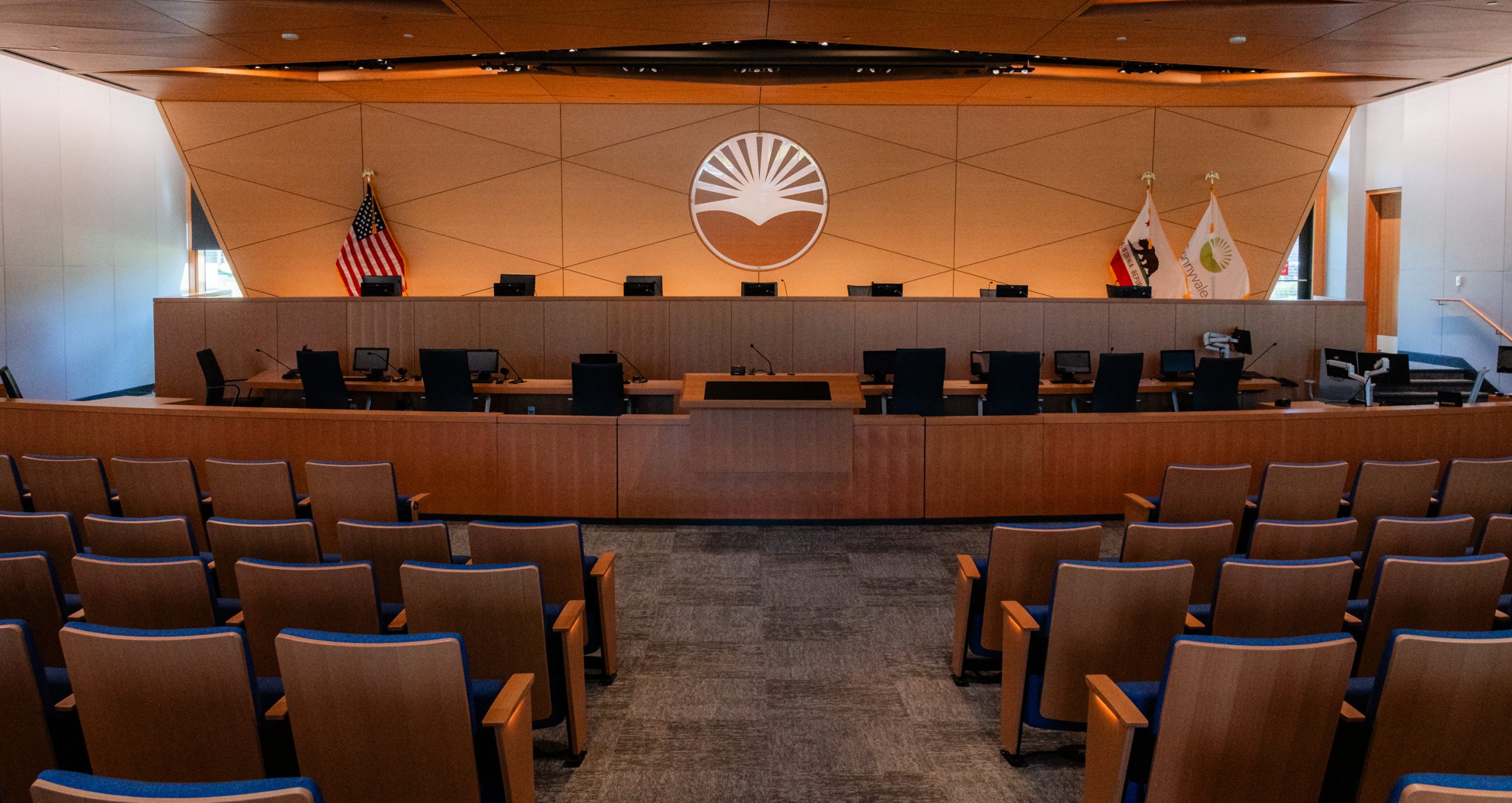
The council meets again at 7 p.m. Tuesday, Feb. 24 in the Council Chambers at City Hall, 456 W. Olive Ave. in Sunnyvale.
To submit public comments ahead of the meeting, visit http://Sunnyvale.ca.gov/PublicComments; Meeting online link: https://sunnyvale-ca-gov.zoom.us/j/96111580540; meeting call-in telephone number: 833-548-0276, meeting ID: 961 1158 0540
Contact David Alexander at d.todd.alexander@gmail.com
Previous Sunnyvale City Council Meetings:
Sunnyvale Grant Program Grows in 2026
Year-end Budget Shows Sunnyvale in the Black
Sunnyvale Bicycling Advocates Score Victory Over Disgruntled Neighbors





0 comments