You might know that Santa Clara’s city charter requires council approval for public works projects over $1,000.
But did you know the charter says the mayor must specify the source of money for budget or policy changes — but not council members? Or that there’s an absolute prohibition on the city manager’s relatives working for the city? Or that the charter lacks a precise definition of city boundaries?
These are just a few items uncovered by the current charter review committee as it proceeds with an active overhaul of Santa Clara’s 1952 charter. At the committee’s Apr. 15 meeting, some concrete recommendations came into view.
Subcommittee 1 proposed consolidating Articles 1–5 — city name, boundaries, rights and powers, form of government — into an “Essential Terms” section; updating outdated language; clarifying city boundaries with a reference to the California Association of Local Agency Formation Commissions; and adding explicit statements on the city’s charter authority and its relationship to other laws.

Subcommittee 2 recommended a clear statement that lifetime council term limits don’t include pre-2016 terms,* and eliminating or modifying the mayor’s budget requirement since city staff now handles feasibility analysis. The subcommittee also drafted language on redistricting, election administration, and vacancy reporting.
Subcommittee 4, based on discussions with the Library Board of Trustees, recommended revising the board’s powers, as it no longer performs some charter-specified functions — such as hiring the city librarian — though trustees want to retain some approval authority. The subcommittee is also considering relaxing eligibility for Library Trustees to include non-citizen residents.
Subcommittee 5 continues to discuss replacements for the term “qualified elector” and to clarify civil service rules with city unions.

Subcommittee 6 proposed updating public works procurement to allow design-build contracts, updating budgeting to allow biannual cycles, revising obsolete public debt provisions and establishing statutory reserve levels.
“We just passed a $400 million bond issue because of all the things we needed to do and hadn’t done,” said subcommittee member and Planning Commission Chair Eric Crutchlow. “I know I’m going to replace the swim center. It’s going to have a life of 30 years. I should be saving money every year, knowing it will need maintenance and replacement.”
The subcommittee also discussed reducing the supermajority requirement to approve budget changes and new appropriations, and removing the outdated $1,000 threshold requiring council approval for using city forces on public works projects. A 2000 charter amendment to raise this to $50,000 was rejected by voters, noted City Attorney Glen Googins.
Squaring the Circle: Who Runs the Police Department?
Subcommittee 3 continues to wrestle with who has ultimate authority over the police department — the elected police chief, who has no direct line of control to anyone in the department, or the city manager, who has a direct line to the assistant police chiefs and the rest of the department. Current practice gives the city manager final authority on disciplinary decisions, while the police chief argues that authority should rest with the chief.
Beyond agreeing that the police chief’s powers as “director” of the department need to be stated in the charter, and that the city manager and police chief should “consult,” little else has been settled.
“The likely recommendation the group is headed towards,” said Googins, “is that whoever ends up having ultimate authority should consult with the other, because there are overlapping responsibilities.”
The next question, of course, is what “consult” actually means.
These discussions included presentations by Police Chief Cory Morgan, City Manager Jovan Grogan, and police union president Jeremy Schmidt.**
It’s possible the final authority question won’t be resolved by this committee at all.
“Given the sensitivity of this area with an elected chief of police, any modifications might be politically sensitive,” said Googins, and the issue “may end up being a level three” — meaning the council might want to consider it separately from the rest of the charter revisions.
The subcommittee also proposed raising the qualifications for the city attorney to seven years with relevant public agency experience, and adding more clarity around hiring relatives of city officials.
*This allowed former council member Teresa O’Neill to run for a third term, and allows Mayor Lisa Gillmor to run for two more council terms despite serving three terms before 2016.
**Former police chief and longtime police union president Pat Nikolai is on this subcommittee. In 2024, the police union PAC ran a negative campaign against a charter change to appoint, rather than elect, the police chief.
Previous Charter Review Committee Meetings:
Charter Review Committee: Clear Direction on Library Board Changes, At Sea on Elected Police Chief Authority
Charter Review Committee: Biggest Recommendation is Charter Reorganization
Charter Review Committee Digs Into Charter Details
Charter Review Subcommittees Raise Transparency Concerns
Santa Clara 2025 Charter Review Committee Gets to Work







Why is Jeremy Schmidt, the officer involved in the 2022 Grand Jury Report leak and creation of a political website on this subcommittee? The same Jeremy Schmidt who deleted evidence related to the grand jury report leak when subpoenaed for the trial of the former convicted Councilmember. Why is Jeremy Schmidt the police officer who tried to intimidate the same Councilmember when they didn’t agree to their protect the chief pledge? Why is the same Jeremy Schmidt on this committee that authorized the use of Robert Haugh blog highlights in his mailers that his same police force arrested in 2020? Why is Jeremy Schmidt the same police union president who tried to intimidate City Council when they were discussing changing chief of police from appointed to elected on this subcommittee?
Between, Jeremy Schmidt, Pat Nikolai, Burt Field, and the former Grand Juror Lauren Diamond one can’t help but think this is so internally corrupt that how this is this even allowed? The Gillmor Machine influence is clear on this Charter Review, and Gillmor is going to use it to empower herself and her allies. Defining term limits and electors tells us she has her conveyer belt of candidates lined up. The City Attorney Glen Googins continues to encourage the changes as the architect when in reality he is helping Gillmor with every step. Googins is clearly compromised. Maybe he has been hanging around too much with Brian Doyle the former disgraced city attorney.
“The Gillmor Machine influence is clear on this Charter Review, and Gillmor is going to use it to empower herself and her allies.”
And the SF 49ers do the same for their team, empowered by big bucks.
It seems everyone that writes or even comments in this Website is a shill for the 49ers. I wish they and there stadium would be teleported to San Francisco–or Oakland.
The truth truly hurts when you call out the corruption. It is a hard truth to swallow that Gillmor is responsible for all this dysfunction. The 49ers, a team helped brought here by Gillmor herself. She realized her big bucks funders from police/fire union and developers had big competition. She realized the 49ers wont do what she wanted, She couldn’t control them and they couldn’t control her. She feels it is her birthright to run this city. Anything that happens in this city she feels it must get her stamp of approval. The over a decade long fued between Gillmor and the 49ers has cost the city a lot and the residents continue to be collateral damage. Gillmor is willing to gamble on the backs of its residents to battle an entity she has personal issues with. She does not use her own money but the taxpayers to fight them.
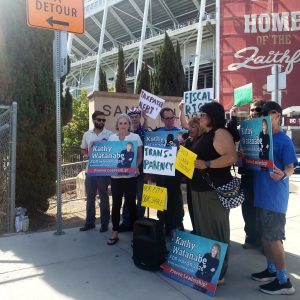
Many after all this drama created by Gillmor want the 49ers to go back to San Francisco. That may be in the cards if she keeps this up and Kathy Watanabe succeeds her as Mayor. The City is on the hook in the contracts for parking, something the city has not delivered on. In theory, this is a breach in the agreements. The 49ers could just leave in the middle of the night like the Baltimore Colts did in 1982. San Francisco will one day lure the team back to the city. It got the Warriors back. Time will tell has the stadium begins its next decade.
One thing is certain, not everyone here is a shill for the 49ers or the Gillmor Machine. Not every member of the City Council is in the pocket of the 49ers (the jury is still out on Albert Gonzalez). If anyone actual does their homework and follow along, the 49ers hold the cards in contracts. This was agreed to by Mayor Gillmor years and years ago. All this drama she creates and 49ers not paying their bills crap is just her projecting her failures on a deal that did not deliver the riches she thought it would. The plus was the taxpayers are covered in what is being paid back. However, Suds Jain and others have mentioned the city gets peanuts of that. Many in the past have called this ‘damage control’ in what the council continues to do with the stadium. Majority of the City Council in the past was against the stadium and warned of how much bandwidth the stadium issues would take from other city business. Having events is important because of the terms of the contracts. Everything relates to legal mumbo jumbo.
Yet the Gillmor Machine and their disciples continue to say everything here and commenters against Gillmor are shills for the 49ers. That’s something exactly a Gillmor shill would say. You can’t deny the influence of Gillmor on anything in the city from the charter review to the city attorney. Anything she wants she gets and if she don’t she will bring city hall down and business to a halt. The 49ers influence in our city is a problem but not as big as the generational problem with the Gillmor Machine influence and trauma on city decisions daily for decades.
The ongoing charter review process in the Santa Clara raises serious governance and ethical concerns, particularly regarding potential conflicts of interest, self-interested policymaking, and structural bias in favor of incumbents.
1. Participation of Former Police Leadership with Union Ties
The inclusion of former Police Chief Pat Nikolai on Subcommittee 3 presents a significant appearance of conflict of interest under well-established public integrity principles.
*As both a former police chief and longtime police union president, Nikolai has a direct professional and institutional interest in:
The governance structure of the police department
The balance of authority between the police chief and city manager
*The same subcommittee is actively shaping recommendations on:
Police oversight authority
Disciplinary control
Charter-defined powers of the police chief
This raises concerns under California’s conflict-of-interest framework, including:
*California Political Reform Act — prohibits public officials from participating in decisions in which they have a financial interest
*The broader “appearance of impropriety” doctrine, recognized in California ethics guidance, which emphasizes that even non-financial interests can undermine public trust
While Nikolai may not have a direct financial stake, his institutional alignment with police union interests, especially given prior involvement in political advocacy (e.g., opposition to changes in police chief selection), creates a reasonable perception of bias.
Courts and ethics bodies have repeatedly emphasized that public confidence is eroded when decision-makers appear to be shaping policy in areas where they have long-standing affiliations or influence.
2. Police Union Influence in Charter Governance
The article notes that a police union PAC previously engaged in political campaigning related to charter governance, specifically opposing changes to how the police chief is selected.
This is significant because:
*The same subject matter (police authority and governance) is now being reviewed by a subcommittee that includes individuals aligned with those interests.
*This creates a closed feedback loop: Advocacy → Committee participation → Policy recommendation
*Such overlap raises concerns about undue influence in quasi-legislative processes, particularly where:
Stakeholders are not merely providing input, but participating in drafting governing rules
3. Term Limit Modifications and Incumbent Advantage
The recommendation to exclude pre-2016 terms from lifetime term limits directly benefits sitting or former officials, including Lisa Gillmor.
This raises classic concerns of self-dealing in governance design, including:
*Changing eligibility rules while current officeholders stand to benefit
*Structuring term limits in a way that effectively resets political tenure
While not per se unlawful, such actions may implicate:
*Principles of equal application of election laws
*Concerns addressed in cases involving retroactive electoral rule changes
Courts have cautioned against midstream rule changes that advantage incumbents, especially when those changes are:
*Drafted or influenced by individuals with a direct political stake
*Lacking clear, neutral policy justification
4. Composition of the Charter Review Committee
The broader concern is not just individual conflicts, but committee composition:
Individuals with aligned political, institutional, or union interests appear to be concentrated in key subcommittees
*This creates the perception that outcomes may be:
*Pre-determined
Politically coordinated
When a charter review body — which is effectively re-writing the city’s constitutional framework — lacks clear safeguards for neutrality, it risks violating core governance principles:
Transparency
Impartiality
Public accountability
5. Legal and Governance Implications
Even if no direct statutory violation is established, the situation raises:
Due Process Concerns
When governing rules are shaped by interested parties, affected stakeholders may argue:
*The process lacks procedural fairness
*Outcomes are tainted by bias
Potential Brown Act Issues
If coordination or influence occurs outside public meetings, it could implicate:
*Ralph M. Brown Act
Grounds for Legal Challenge
Future charter amendments could be challenged on:
*Conflict-of-interest grounds
*Improper influence or bias
*Failure to ensure fair and neutral process
The charter review process presents significant governance risks:
The participation of individuals like Pat Nikolai in matters directly affecting police authority raises credible conflict-of-interest concerns.
Proposed term limit changes benefiting incumbents, including Lisa Gillmor, raise questions of self-interested policymaking.
The overall structure of the committee risks creating a perception — if not the reality — of institutional bias and political favoritism.
At minimum, these issues warrant:
Heightened transparency
Independent oversight
Clear recusal standards
Without such safeguards, the legitimacy of any resulting charter amendments may be subject to both legal challenge and public distrust.
Retroactive term limits were discussed by the 2016 Charter Review Committee — (www.svvoice.com/charter-review-committee-tables-election-system-change-instead-introduces-land-use-policy-by-referendum-term-limits-extending-current-councils-potential-tenure/) — for the reasons you state. However, this is prohibited by state law — Government Code section 36502 — and retroactive term limits would be quickly challenged in court.