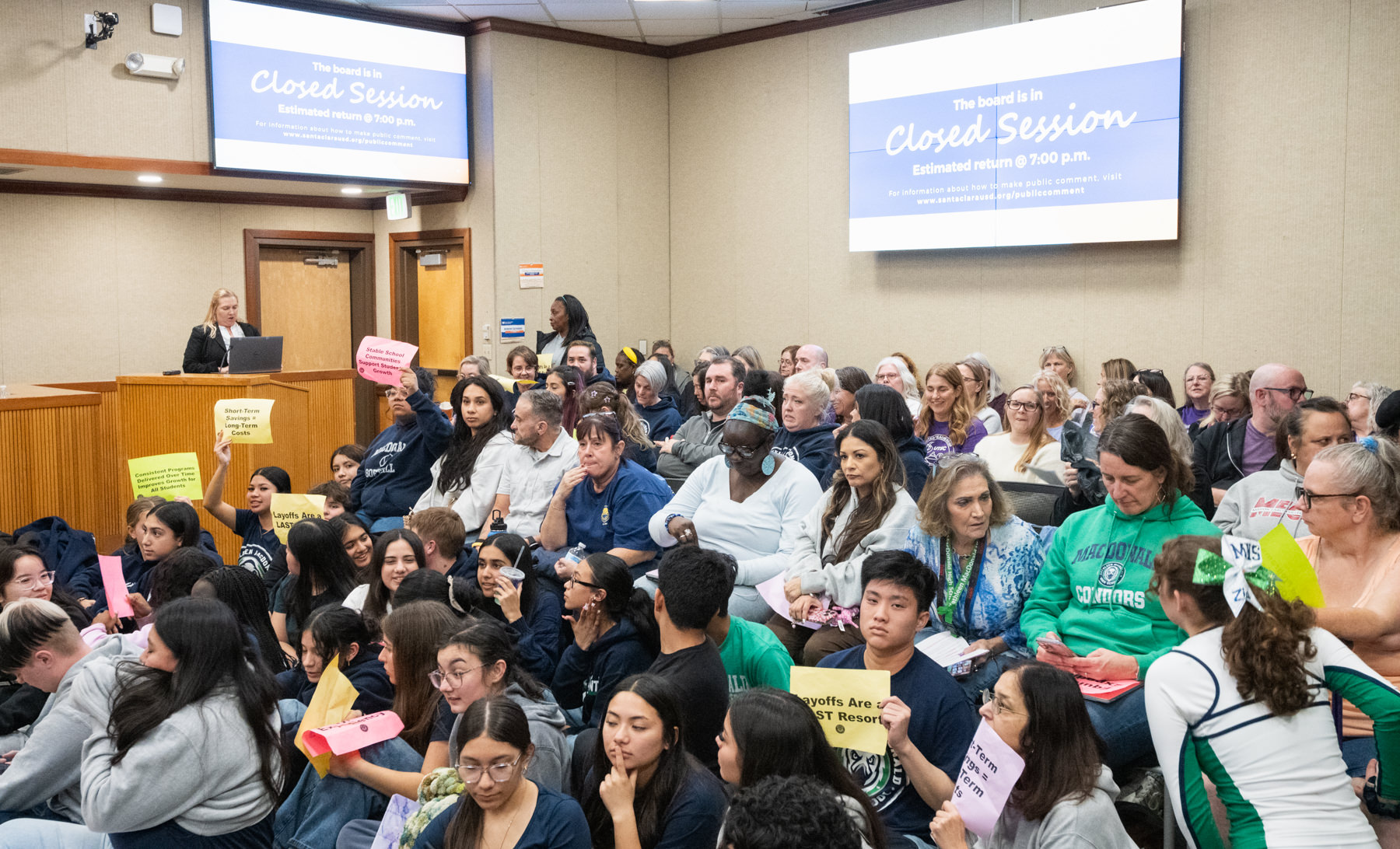
Superintendent Dr. Damon Wright stood before a room full of hurt and frustrated students, staff, and community members to explain his very unpopular layoff plans. The presentation at the Thursday, Feb. 12 Santa Clara Unified Board of Trustees meeting wasn’t the final plan; that will come to the next board meeting. After that, the initial layoff notices will start to roll out.
The Plan
Dr. Wright made it clear that this is his plan, and the plan is to fix a $30 million structural deficit with rightsizing, aka layoffs. It’s not a secret that enrollment is declining and the district is overstaffed. He said they’re trying to be fair and are following California Education Codes and union collective bargaining agreements.
According to Board President Bonnie Lieberman, the district received a letter from the Santa Clara County Office of Education saying they must address their growing pattern of deficit spending. Otherwise, they’ll be put on a fiscal stabilization plan.

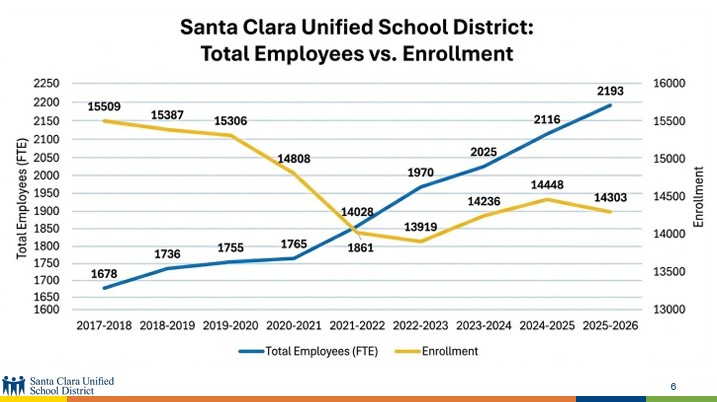
How did we get here? During the COVID-19 pandemic, the district received one-time funding, which was invested in students to help them through that time. There was also a staffing shortage, and the district increased compensation by 17.25% over three years to remain competitive. On the other side of the pandemic, they are faced with a $30 million deficit and declining enrollment while staffing levels remain high. A graph showed that since 2017, the district has increased by 515 staff members but decreased by 1206 students.
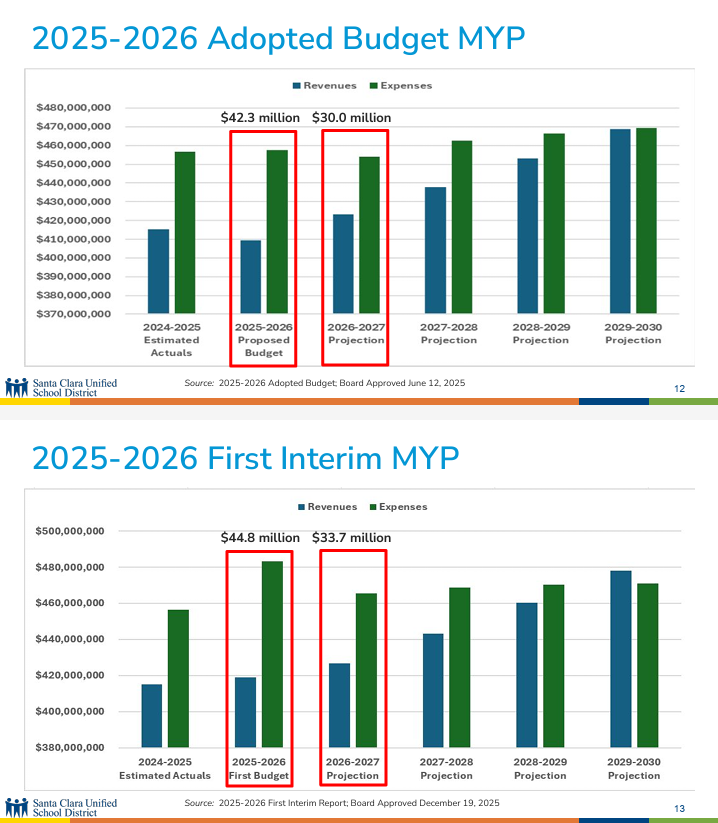
In June 2025, Mark Schiel, Deputy Superintendent / Chief Business Official, projected a $42.3 million deficit for the 2025-2026 school year and a $30 million deficit for the 2026-2027 school year. In December 2025, the first interim multi-year projections showed the deficit increased.

In December 2025, the district met with staff who would likely be impacted by the layoffs. Since then, the Santa Clara Unified community has been desperately advocating to save these people’s jobs.
So, who’s losing their jobs? The district currently has 1,056.95 certificated FTEs (full-time employee equivalent) and, according to the presentation, 113.3 will be cut. There are 1,016.25 classified FTEs, and the plan is to lay off 40. Out of 119.4 FTEs in management, they will lay off 15. These figures are before they consider natural attrition (i.e., resignations, retirements, etc.).
Based on 2026-2027 projected enrollment and staffing ratios, there will be a reduction of 23 FTE elementary teachers, 12.3 FTE middle school teachers, and 20 FTE high school teachers. There will also be a reduction of 27.5 FTE district-level TOSAs, seven FTE counselors, and two FTE psychologists. The list of positions on the chopping block was attached to the meeting agenda.
With the projected enrollment and next year’s staffing, the average districtwide class sizes would be 18.5 TK students per teacher, 21.4 kindergarten students per teacher, 21.9 first – third graders per teacher, and 25.4 fourth and fifth graders per teacher.
Dr. Wright said they have been listening and have already made changes to the plan. For example, they added back 4 FTE elementary teachers to reduce combo classes at Title 1 schools.
The Public Speaks
When the community got its chance to speak, they advocated for positions near and dear to their schools. Young students from Don Callejon Arts and Design School are worried about their kindergarten and middle school teachers. Their art and design teachers are also at risk, and students who picked this school for its art and design focus are concerned.
Joseph Volta, a fifth grader at Sutter Elementary, spoke passionately about his father’s legacy as a PE TOSA (Teacher on Special Assignment) and coach.
“About a year and a half ago, my dad passed away,” said Joseph. “PE is not just about sports or exercise. For me, PE is a place where I feel known, supported, and connected to my dad.”
According to the presentation, seven FTE elementary PE teachers and seven elementary PE paras will be laid off. This means the PE teachers who are left will need to cover more school sites. Joseph’s mom, Diana, recalled when her late husband, Phillip Volta, was responsible for five sites. For the sake of the teachers and students, she asked the board to limit PE teachers to two sites with a home site.
Though the presentation boasts that there will be no layoffs in special education, that same presentation states the district is reducing two FTE special education program specialists, three FTE elementary special education teachers, 11.5 FTE secondary special education teachers, 12 special education paras, and five behavior technicians. Teachers are worried about their most vulnerable students.
The community is still concerned about programs like the Dual Language Immersion (DLI) Program and the Young Parent Center Program. Community members from many schools, including Pomeroy, Montague, and Bowers Elementary schools, came to advocate for their staff and students.
The Superintendent claims they can’t slow down, but the community was not convinced. Many still believe that these cuts don’t have to happen at once and can be spread out over two or three years, like other districts are doing. Dr. Wright says if they don’t act now, the county oversight will increase, and they will relive this trauma year after year.
“Delaying action this year would increase our deficit in outer years, increase the amount of reductions in outer years, and impact our reserves,” said Dr. Wright. “This year we have the opportunity to position ourselves for long-term fiscal health.”
What Next?
Schiel said they will continue to review enrollment projections and adapt based on actual enrollment.
Dr. José González, Assistant Superintendent of Human Resources, said that this cycle, they will be laying off 39.9 FTE elementary staff, 18.5 FTE secondary staff, six FTE elementary PE teachers, six FTE secondary school academic counselors, and one FTE special education psychologist.
The district mainly uses the “last-in, first-out” rule. This means the least senior employee in a specific classification or credential area is laid off first. However, there are bumping rights where senior employees on the chopping block can bump less senior employees in other classifications if they are also qualified/credentialed. Laid-off employees will be added to a preferential rehire list, and they have first right of refusal if a position opens.
According to California Education Code and layoff laws, initial layoff notices must go out by March 15. Within seven days, employees can request a formal hearing, and by May 7, an Administrative Law Judge will make a decision. By May 15, the School Board will make the final call and serve final layoff notices.
The meeting went until one in the morning to give everyone a chance to speak and carry on with the rest of the Board agenda. There will be one more chance to be involved in this process. At the Thursday, Feb. 26 meeting, staff will bring recommendations, including resolutions for approval. Meetings are live-streamed on the District’s YouTube page, and agendas are posted on their website.
You can find the presentation with all the figures at https://santaclarausd.community.highbond.com/Portal/MeetingInformation.aspx?Org=Cal&Id=365
There is more information on the “rightsizing” process on the District’s website: https://www.santaclarausd.org/about-us/departments/fiscal-services/district-financial-reports/what-is-rightsizing









How many jobs could they save by replacing some of their highest earners (Like Mark Shiel and Michelle Healy) with lower salaried employees? They could save costs and acquire much better humans. Win/win. Bet there are others like them.
Mark said no way they could look at pay cuts or raise freezes? Is that because he just doesn’t want a freeze or cut? I’m pretty sure even with a cut it’s still more money than an unemployment check.
Have the unions expressed their support for pay cuts? Maybe if all the unions supported pay cuts, the district would not need to make layoffs.
Why attack people? Should teachers make the same as custodians? All salaries are different. Instead of attacking people, advocate for the positions you think should stay. Being a good human does not include attacking people based on salary. All employees work for the kids no matter their position.
Sometimes facts hurt. These are not people who are there for the kids, that’s truly an issue when they are just there for a salary.
SC has such a high number of employees that commute from long distances because they are known to have some of the highest salaries in the area. You would think it would equate to a higher level of service, but it doesn’t.
As for the great Mr. Shiel, if he was so concerned about the budget, how does he go before the board for a raise at the start of this year, then immediately after in the same meeting bring up the budget issues and the need for rightsizing?
Clearly, you don’t know the actual facts. Departments bring their hiring requests to the Board, not Mr Schiel. The Board has all the documentation and makes their decision. If you want the actual facts, all archives are available, including documents and Board meeting videos. Also there are the contracts that dictate raises. All employees are given raises by the Board, no one else. The Board allowed this to be competitive in the employment market to get the best employees. ALL employees of SCUSD make more than comparable jobs in other Districts, it’s called being competitive.
Mr Schiel has saved taxpayers of SCUSD millions of dollars via the refunding of school bonds – like refinancing your mortgage – so as a taxpayer in the district I am grateful for his work. I agree with Reality. Why attack people? Everyone in SCUSD is there for kids even if you don’t always agree with them.
The district has clearly been overspending and over hiring since the beginning of the pandemic with board and superintendent approval. That’s ok if everyone knows which roles are temporary (based on one time funding).
It’s less responsible for the board (and district staff) to have not pre-planned on how to unwind their spending. Just hoping for more property tax increases was a weak plan.
The currently proposed levels of cuts are still not enough to stop deficit spending for the next few years.
It’s important to make these cuts now and to not spend every single board meeting for the next five year avoiding cuts while spending excessively from reserves.
A board member brought the issue up last night essentially saying Mark Shiel puts job descriptions before them for approval. But hasn’t been transparent about how many people would be hired based on that approval. Appreciated the board member for calling that out.
Salary info https://transparentcalifornia.com/
Thanks for that link! The top salary earners salary increases are astonishing!!!
Especially when it’s the same people saying they have been forecasting these budget issues for a while. Didn’t stop them from taking the largest piece of the pie. What did they admit last night – salaries are accounting for 96% of the budget when other districts are all 80-85%. Who sets the budget? Who proposes hiring more and more staff when enrollment is going down even when they know it’s not fiscally sustainable? Who isn’t transparent with the board when they ask them to approve a job description but not that they are now going to hire 20 more people after that approval?
It’s been obvious to me that labor captures most school boards and city councils. Sometimes it’s subtle, sometimes it’s overt.
It’s possible that the board members are even uncertain as to how much they owe their positions to the unions that endorse them.
It’s just easier to pretend that the budget will grow enough next year to make things better.
I’d like to see a version of that “slide 6” graph with the TK employees and students removed.
You don’t need a website for salary info. It’s on the website, and voted on in public Board sessions. All are recorded and available .
As our community reads this article about the need for significant budget cuts, it’s important to look at the full picture.
This is the same Board that, in the very same meeting where the Chief Business Officer warned of serious financial challenges, approved a salary bonus for Superintendent Stella Kemp. “She has done a good job!” Fast forward a couple of months later and the board was singing a different tune in regard to Kemp.
It is also the same Board that voted to increase their own stipends for positions they actively campaigned to hold — all during the same year they are now describing as a time of financial crisis.
If the message to our educators, staff, and families is that sacrifices must be made, then fiscal responsibility must start at the top. Leadership requires shared accountability — not just difficult decisions for classrooms, but consistent and transparent priorities from those making them.
What the board needs is TERM LIMITS. They are elected by the public and regularly forget that when they are making decisions and voting.
They could also use an auditor to look at who and why they terminate. Why lay someone off that’s fantastic just because they are newer? Incentivize the people that don’t belong there to just go or select them for the layoffs citing their complaints. Surely there are staff who are finding themselves in hot water year after year. The district overpays because they want the best of the best for staffing so weed out who isn’t the best of the best.
We don’t need term limits or a new board.
We need more parents to show up to the meetings and say: “Keep spending below incoming revenue and restore the reserves (with more cuts) to keep our district’s finances strong.”
The board and management referred to “our labor partners”. That’s the teacher and staff union. The contract with the union requires a last in last out layoff process.
When management is subject to layoffs (like this year) they do take into account reviews, costs, etc.
Well now, before we start rearranging the furniture of democracy, let’s make sure we’re at least reading the same instruction manual.
On term limits: I’ve heard one board member did raise the idea of considering them a few years ago. In public. On the record. The rest of the board declined to pursue it, and the unions weren’t inclined to support it either. That’s not amnesia about who elects them — that’s a vote. If citizens want term limits, there’s a perfectly constitutional remedy: qualify it for the ballot and persuade the voters. Democracy is slower than a comment thread, but it’s more durable.
Now to the notion that the district should simply “weed out” the wrong people and keep the “fantastic” newer ones. That’s a satisfying sentiment — and largely incompatible with how California law works.
In this state, when there’s a reduction in force, the default rule is seniority: first in, first out. It’s rooted in the Education Code and reinforced by collectively bargained agreements. A district can’t just decide to lay off the folks it finds inconvenient or keep the ones it prefers unless the union agrees to negotiated exceptions. Contracts are not suggestions; they’re binding agreements.
You’re welcome to argue the system ought to change. Plenty of reasonable people do. But suggesting the board can bypass state law and negotiated contracts to reward favorites and dismiss the disfavored is a fine way to end up explaining yourself in court — at taxpayer expense.
Public education governance is not a reality show. It runs on statutes, contracts, and votes. If you want different rules, change the law or change the contract. Until then, the board operates within the framework it’s legally required to follow — whether that makes for a punchy complaint or not.
Keep in mind that the elected board is not allowed to meet outside of the scheduled meetings.
Can you imagine running a corporation where the senior leadership team met in public every week or two to confer publicly about their plans? (or in a private meeting for legal stuff)
They can talk to staff at the district office. They can chat a bit in small groups, but they can’t run around and create an offline virtual meeting where they come to consensus on an issue.
The Brown act intentionally forces the board to show and and deliberate in front of us.
Those who lobby the board can go and talk to every board member whenever they like.
This is why you only get two board members attending a High School or Middle School graduation ceremony. They have to stay apart and not “chat”.
The community should also be asking about what the district is doing to “right-size” the district office certificated administrator staffing. It’s always telling when the recommendations are to reduce certificated staff who work directly with students, but no mention is made of adjusting the district office certificated administrators, whose numbers have not gone down even though there are significantly fewer students throughout the district. Those salaries are significant, and certficated administrators are not tenured. The contract is from July 1-June 30. It is not a layoff to reduce certificated administrators. They must be notified by March 15 that their annual contract was not renewed.
The DO will keep serving themselves and not the students they claim to work for. Skim the top salaries in the DO and see how much money can be saved that way.
Well now, every budget season someone peers toward the district office as though it’s the last lifeboat on the Titanic.
I understand the instinct. It’s always tempting to assume there’s a well-padded colony of administrators downtown while everyone else is tightening their belts.
But here’s the inconvenient detail: the presentation showed the District Office taking the largest staff reduction. The biggest cut. Not a token trim. If you’re looking for untouched territory, you won’t find it there.
You’re correct that certificated administrators are on annual contracts, July 1 to June 30, and must be notified by March 15 if their contracts won’t be renewed. That’s how the system works.
What’s less dramatic — but far more relevant — is that reducing administrative positions still requires thoughtful restructuring. Those roles aren’t ornamental. They handle compliance, budgeting, HR, special education oversight, state and federal reporting — the sort of work that keeps a district legally solvent and operationally upright. You can’t simply “right-size” by swinging a machete and hope the machinery keeps humming.
The real question isn’t whether administrators can be reduced. They can, and they are. The question is how to do it responsibly while maintaining the services families expect and the law requires.
By all means, keep asking hard questions about the budget. That’s civic engagement at its finest. But the numbers matter — and in this case, the numbers show District Office absorbing the deepest cut, not ducking it.
It’s hard to accuse the ship’s crew of hoarding supplies when they’re already tossing cargo overboard.