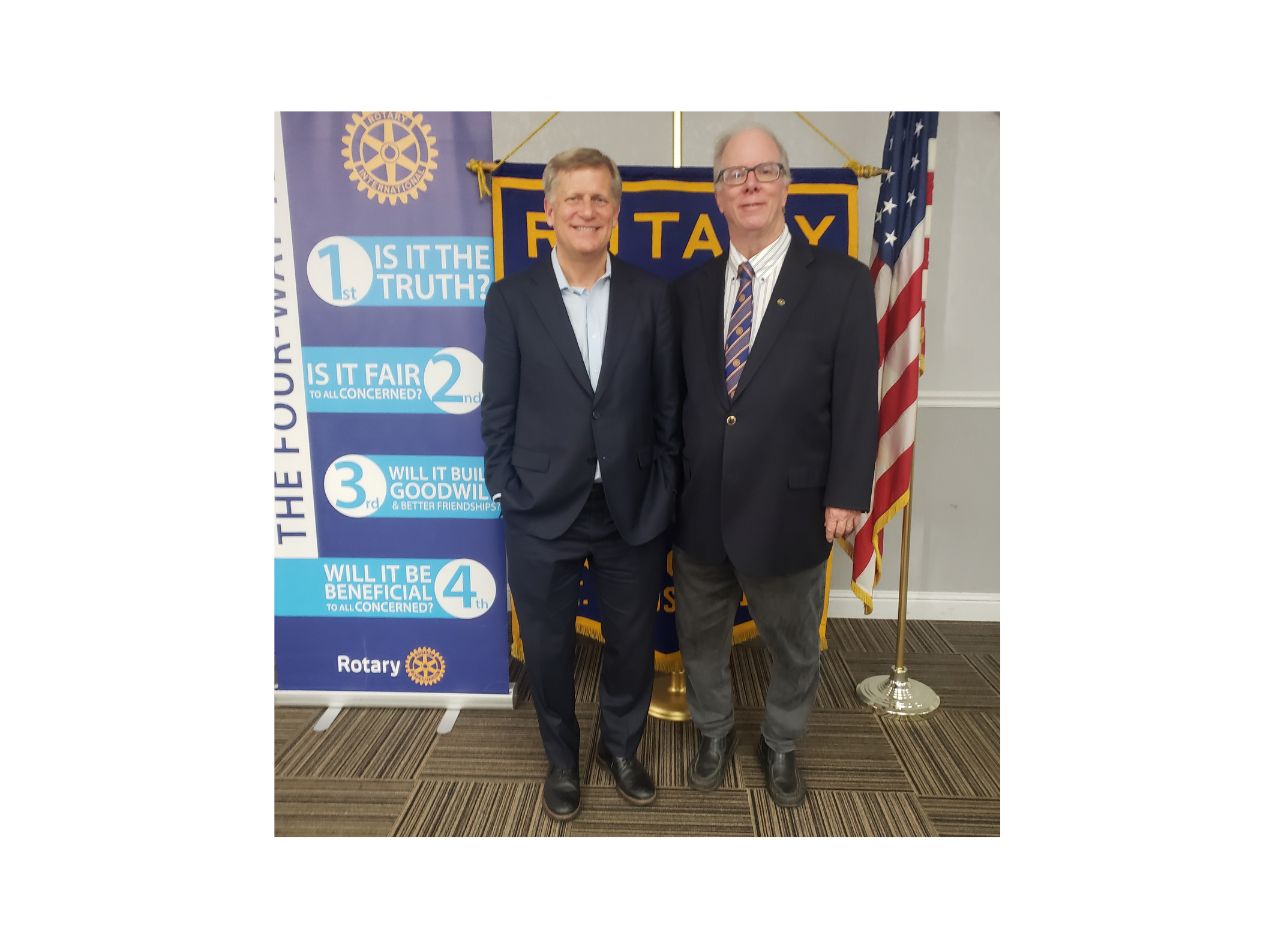
Last month, Santa Clara Rotary heard from one the world’s preeminent Russian foreign policy experts: Michael McFaul. The senior fellow at Stanford’s Hoover Institute and former U.S. ambassador to Russia under President Obama, packed much of his latest book, Autocrats vs. Democrats, into a 45-minute talk.
Rotary enjoys a special place in McFaul’s heart. He speaks regularly at Rotary Clubs, including at the first Russian Rotary Club when he lived in Russia in 1991.
Speaking to Rotary, he said, was “a reminder of happier times. It was a wonderful time to be an American [in Russia]. At least we worked together. We’re in a different era. We’re now in the first conventional war in Europe since 1945.”
McFaul examined today’s global struggle between democratic and autocratic systems: similar to the U.S.-Soviet Union post-WWII Cold War, yet different. Understanding this world requires us to “embrace complexity and run away from bumper stickers,” said McFaul.

Different isn’t better, he warned. “Some elements make it worse.” These include: cyber warfare, internal political fragmentation, rising autocratic movements in democracies and the internet’s exponential power to spread propaganda and disinformation.
“Debate over policy is healthy and necessary,” he said. “It’s part of democratic discourse.
However, debating fundamental facts or democratic institutions is dangerous.” For example, “changing rules midstream because you don’t like the outcome and undermining democratic institutions with election denialism and attacks on electoral integrity.”

U.S. success in this cold war would require avoiding the mistakes and copying the successes of U.S. policy in the old Cold War.
Mistakes included overestimating adversaries’ strength, pointless resource-draining and credibility-damaging military interventions, and supporting ‘friendly’ dictators at the expense of democratic principles.
American success came from military alliances like NATO, economic prosperity from national investments and free trade, and active promotion of democratic principles through institutions like USAID and Radio Free Europe. Immigration, too, played a role by bringing the brightest and best scientists and scholars to the U.S.
Other than increasing military investment, the U.S. has turned its back on those winning strategies. Trump has undermined U.S. alliances — particularly NATO and traditional European and Asian partnerships. His trade policies are undermining global capitalism. Foreign aid and investment rollbacks are damaging the U.S.’s role as the leader of the global economic order.
“I don’t think JFK was ‘woke’ when he created it [USAID],” McFaul observed. “Foreign assistance isn’t about political correctness, but about strategic national interest. If we don’t get back to engagement, we will lose the 21st century.”
Responding to questions about the Ukraine war, McFaul was unequivocal.
“When historians write about this Ukraine war, they will write ‘Ukraine won.’
“Putin’s objective was regime change in Kyiv,” McFaul continued, “to install a puppet government and eliminate Ukrainian sovereignty. This goal failed completely. Instead of regime change in Kyiv, Ukraine now has the strongest fighting force in Europe and NATO. Finland and Sweden have joined NATO.”
McFaul ended on a hopeful note.
“Nine out of 10 countries in the world are democracies. Collectively, democracies possess the greatest military resources and technological capabilities. This concentration of power and innovation is a strategic advantage.
“History is on the side of democracy, not autocracy,” he concluded. “Human desire for freedom, innovation, open societies, all favor democratic systems.”
Democrats vs. Autocrats is available at Santa Clara Central City library.
For 90 years, the Santa Clara Rotary Club has served the community. Its annual events include Steps 4 Success, Christmas for Kids, scholarships and support for community events like Parade of Champions and Santa Clara Showtime.
Santa Clara Rotary meets on Thursdays at 12:15 p.m.at American Legion Post 419, 958 Homestead Road, Santa Clara.
Carolyn Schuk can be reached at carolyn@santaclaraweekly.com.







0 comments