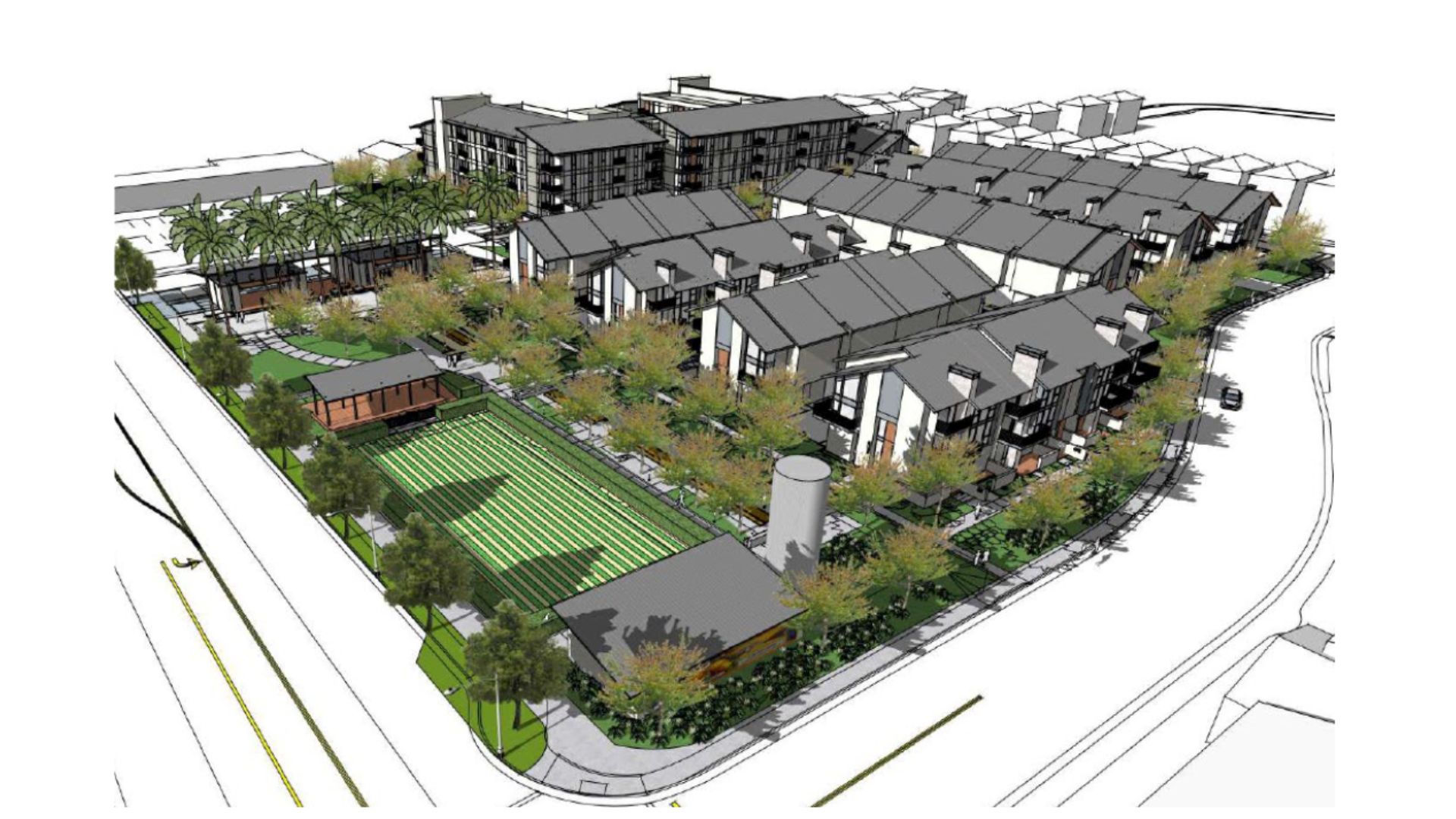
On Oct. 7, in a 6-1 vote, the Santa Clara Planning Commission denied Core Companies’ request to change the final piece of the Agrihood project. The change would replace 160 apartments with 44 townhouses. The denial was recommended by city planners.
In 2019, the city approved a deal with Core for a development with 361 units: 160 mixed-income apartments, 165 senior affordable apartments, 36 townhomes and a 1.5-acre working farm. All but the 160 apartments have been built, and that part of the land is a vacant lot.
2019 Plan No Longer “Pencils Out”
Last month, Core Companies requested a change in the plan to build 44 townhouses in place of the 160 apartments, reducing the total housing units on the site to 245 from 361, and affordable units to 171 from 181.
Core’s justification for the change, explained Core President Chris Neale, was that the plan for the 160 apartments was “the definition of financial infeasibility” because the market value of each apartment is less than the cost of building it.

Further, the site isn’t designated a Qualified Census Tract (QCT) or Difficult Development Area (DDA) by HUD, and isn’t eligible for increased tax credits. Selling these tax credits partially funds construction costs. Interest rates have increased, and all the county Measure A housing money is already allocated. Core received $23.5 million from this bond measure to build the senior apartments.
The townhouse project could be built quickly, increasing both housing and city property tax in six to nine months, said Core VP of Development, Vince Cantore, and finished units can be occupied immediately. The apartment building would take at least two years or more to build he said.
“It’s gotten worse and worse, so it basically cannot be built in today’s market,” said Cantore.

If the city denies the townhouse project, Core will hold on to the land for at least a year. The city can’t force them to sell it. Core bought the land from the city for $15.7 million, which the city lent Core for the senior apartments and the Agrihood project’s farm.
Developer Financial Problem Isn’t City’s Problem
Planning department staff said the commission’s duty is, “to weigh not the market conditions … [but] the impacts to our adopted housing element and what it would mean if we are challenged by the state.” When reviewing development proposals, the applicant’s financials aren’t among the city’s considerations. Although staff noted that the city has helped other projects by deferring due dates and fees.
The 160 apartments are already part of the city’s housing inventory and count toward the city’s obligation for 2023 to 2031. Reducing that number would reduce the city’s inventory and underuse vacant land near transit.
Lower density would require findings to justify it, said Assistant City Attorney Jessia Byer. The city has more housing on the books than the state requires — a “surplus” — but would have to show another place for the rest of the 160 apartments.
“We fought hard to get our housing adopted and we do not want it to become challenged,” she said.
State challenges can include revocation of the city’s housing element, eligibility for housing grants and vulnerability to the Builder’s Remedy, which allows developers to bypass zoning codes in cities without compliant housing plans (“elements”).
Commissioners’ Thumbs Down
The commission voted 6-1 to recommend the city council deny the project (i.e., approve staff recommendation) and Core Companies’ proposed zoning map for the Agrihood project, with Commissioner Mario Bouza opposing. However, the commission did recommend that the city council approve the amended EIR.
Commissioner Priya Cherakuru questioned whether it made sense to approve the amendment when they were denying the change, but the city attorney answered that it would be needed in case the council chooses to approve the project.
Cherakuru said she was divided about the proposal. Approving the 44 units certainly provides a certainty that development would proceed.
“It does put housing on a vacant lot. It uses for-sale ownership as financially [achievable] under current market conditions,” she said.
“Denial carries a real risk that the property remains [vacant] and we do not get any additional housing in the near term,” she continued. “That said, we also have to weigh the long [term] consequences. The proposal reduces the site from 160 apartments to 44 townhouses, eliminating 116 units, or more than 70 percent of the planned housing capacity for this project.”
It would “lock in” a permanent loss for the city, and not what the city “trusted the Agrihood to deliver.”
Other commissioners questioned Core Companies about the financial analysis, challenged Core’s math, and asked what guarantee would the city have that the townhouses would get built.
Saying that he didn’t like California’s one-size-fits-all approach to housing policy, Commission Chair Eric Crutchlow said that this project wasn’t the place to “fight that fight … I’m trying to work with people at the state to see what we can do to change that … If this were the first time the commission talked about the project, it might be a different story. But now, we have to live by [the] history.”
Bouza was the only commissioner who supported the project, pointing to the increased traffic and noise at an already very congested part of the city, and the lack of for-sale housing at the lower end of the market.
“With these 44 units established, people are going to be moving in there,” he said. “They’re going to be part of our city. I’d like to see 44 families coming in there for the future.”
The project is almost certain to be appealed to the city council, said Crutchlow.
Other Business Planning Commission Business
The commission unanimously approved a commercial condominium development at 3501 and 3511 Thomas Road, and continued consideration of 590-unit residential development at 2610 El Camino Real.
Carolyn Schuk can be reached at carolyn@santaclaraweekly.com.








0 comments