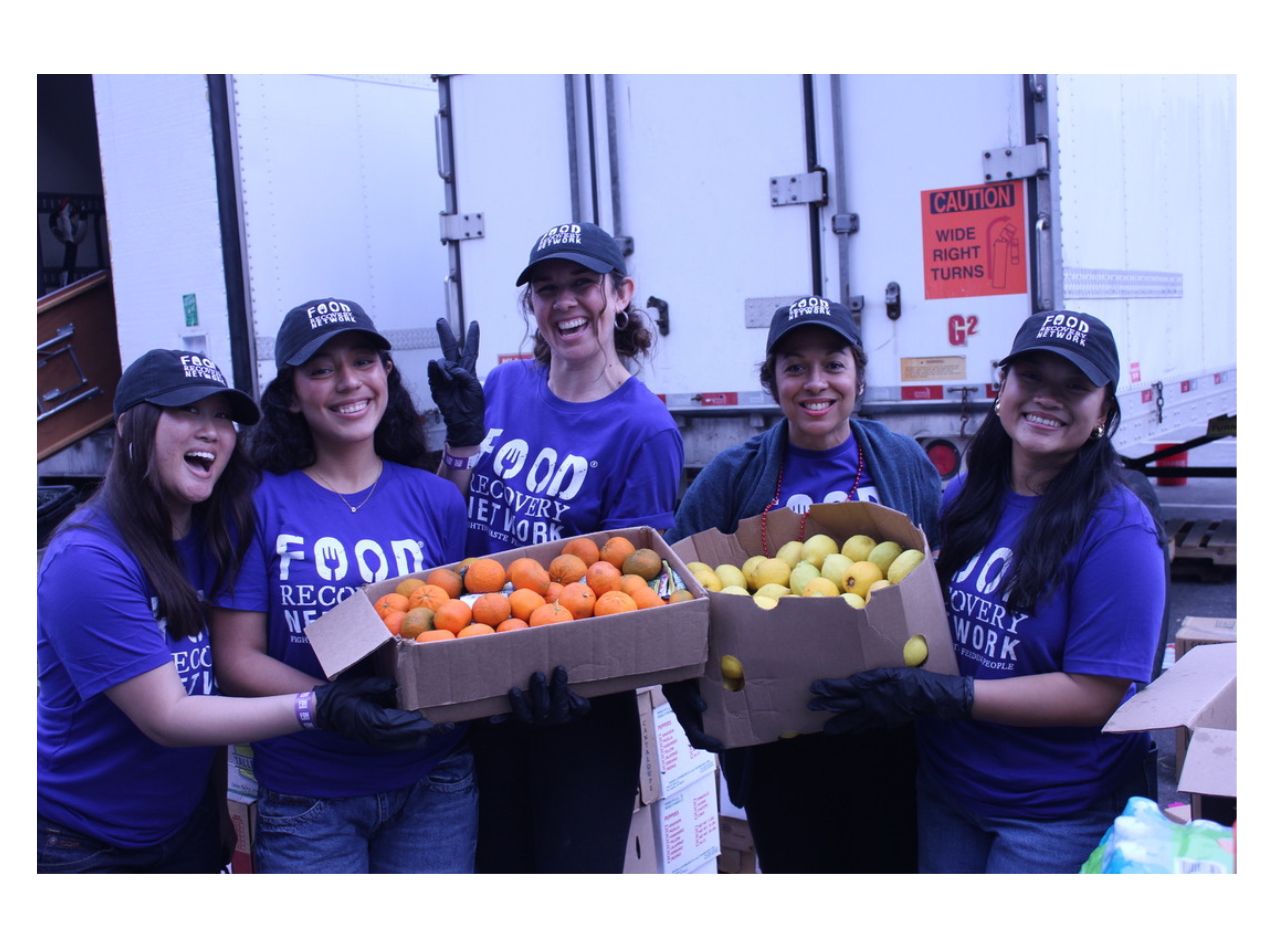
No matter what Super Bowl team you supported, one score that everyone can cheer is the Food Recovery Network’s (FRN) rescue of usable food from pre-game events.
As fans watched the 2026 Super Bowl coin toss, college student volunteers got to work behind the scenes collecting 14,000 pounds of usable food from the 2026 Players’ Tailgate in Santa Clara and Guy Fieri’s Flavortown Tailgate at the San Francisco Cow Palace. That perfectly good food is feeding hungry people in the Bay Area instead of going to landfills.
“At the Super Bowl there are a lot of celebrity chefs [at pre-game events],” explained FRN CEO Regina Harmon.
“At the end of the pre-game activities, when they shut down, we are already on the ground, with trucks and volunteers. In the central storage for these events there’s unopened food. Not only can we recover shelf-stable food — tortilla shells, for example — there are also unopened raw ingredients. In the chefs’ area, they’ll still have food in coolers.

“There’s also prepared food that hasn’t been put out,” continued Harmon. “One location was a sandwich shop with premade wrapped submarine sandwiches that never left the refrigerator.
If we weren’t there, that food would be thrown away.”
How much impact will this have? This food will serve up about 12,000 meals, keep 9 metric tons of CO2 out of the air, and save nearly 2 million gallons of water, according to FRN.

The FRN was founded in 2011 by students at the University of Maryland. A year later the program expanded to colleges in half a dozen states. Today, the FRN is a national leader in diverting eatable food from landfills, with 250 U.S. chapters.
Among the group’s partners are Bullseye Event Group, which produced many of the Super Bowl events, and Hellman’s. Food donors are verified by the organization and receive training and support from FRV. The World Cup is the next event on FRN’s calendar, and FRN hopes to be working at those events in the Bay Area, as well, said CEO Harmon.
“We work with 400 nonprofits across the U.S. that accept the food,” said Harmon.
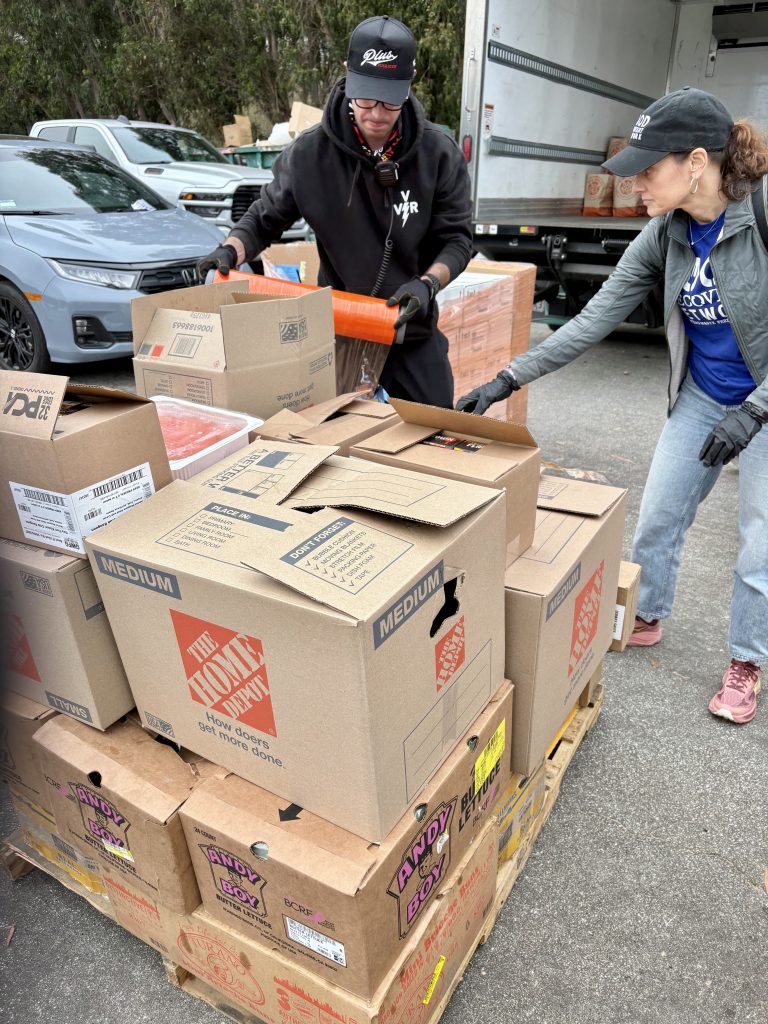
Loaves & Fishes’ A La Carte food recovery program was one recipient of the Super Bowl surplus.
“People ate well that day [after Super Bowl],” said Loaves & Fishes Director of Marketing & Communications, Stephenie Medina. “Everyone was very impressed about the quality of the food and the high-value items — for example, some wonderful brisket.”
Loaves & Fishes’ A La Carte program is a major area food recovery program in its own right, and partners include Meta, San José’s Mineta airport and Levi’s Stadium. Last year A La Carte recovered 800,000 pounds of food, serving 700,000 meals from that, and keeping over 900 tons of greenhouse gases out of the atmosphere, according to Loaves & Fishes’ Medina.
Literally none of the food ever enters a landfill. Instead, unusable food goes into a biodigester — a system that breaks down organic matter without oxygen — that turns it into “soil enhancers” that goes to community gardens.
“This is part of an ecosystem that feeds people, and keeps tons of food out of landfills,” said Medina. “It’s a truly virtuous circle.”
Even though the Super Bowl is in the rearview mirror, people can support food recovery efforts at www.foodrecoverynetwork.org/donate and tinyurl.com/loavesfishesdonate. Businesses interested in working with these groups should visit www.foodrecoverynetwork.org/frv and www.loavesfishes.org/food-recovery-2025.
Carolyn Schuk can be reached at carolyn@santaclaraweekly.com.






0 comments