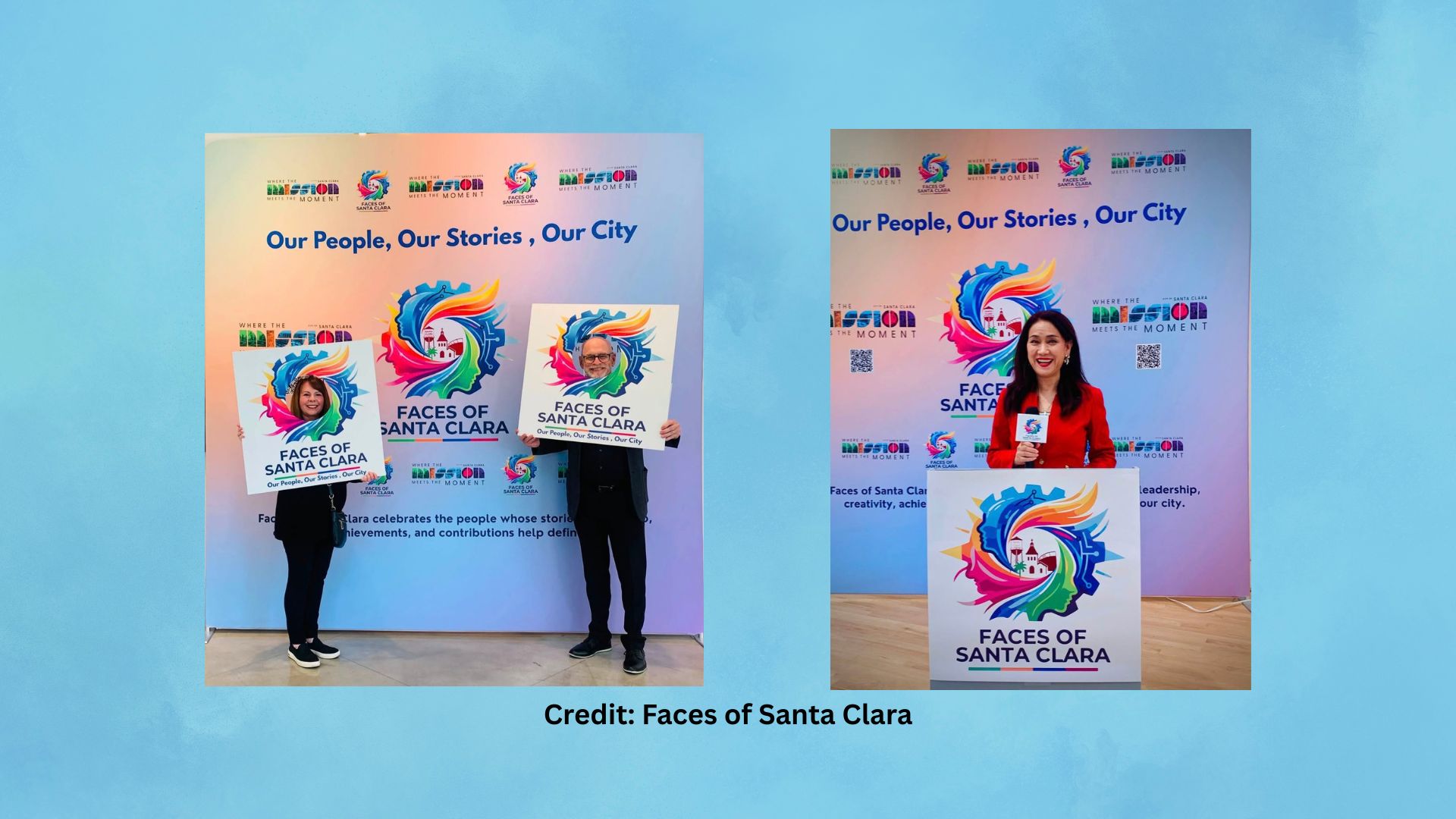
A town is its people and the sum of their stories. That’s what Faces of Santa Clara organizer Diana Ding set out to capture at a Triton Museum event last month, featuring the first of a series of films focused on Santa Clarans and their stories.
“The face of Santa Clara doesn’t need to be famous,” Ding said. “Just someone ordinary, but quietly makes our community a better place.”
Her team combed through more than 1,000 photographs and 200 video clips, she said, and presented this first effort, “so our next generation will know what happened in Santa Clara and who made these things happen.”
One of those stories is that of Triton Museum Executive Director Preston Metcalf. He was only seven when a stranger there changed his life by introducing him to art.

It was the early days of the museum, before the current building and the original octagonal “pavilions” were under construction. Metcalf lived nearby when he and his brothers saw a large statue being lowered into place — he called it “the big green horse.”
The boys decided someone should ride it, and boosted him onto it. He was barely on when a woman ran out of a museum building, yelling, while his brothers ran for home.
She got him down, asking if he knew what the building was. He didn’t. She explained it was a museum and asked if he’d like to see it.

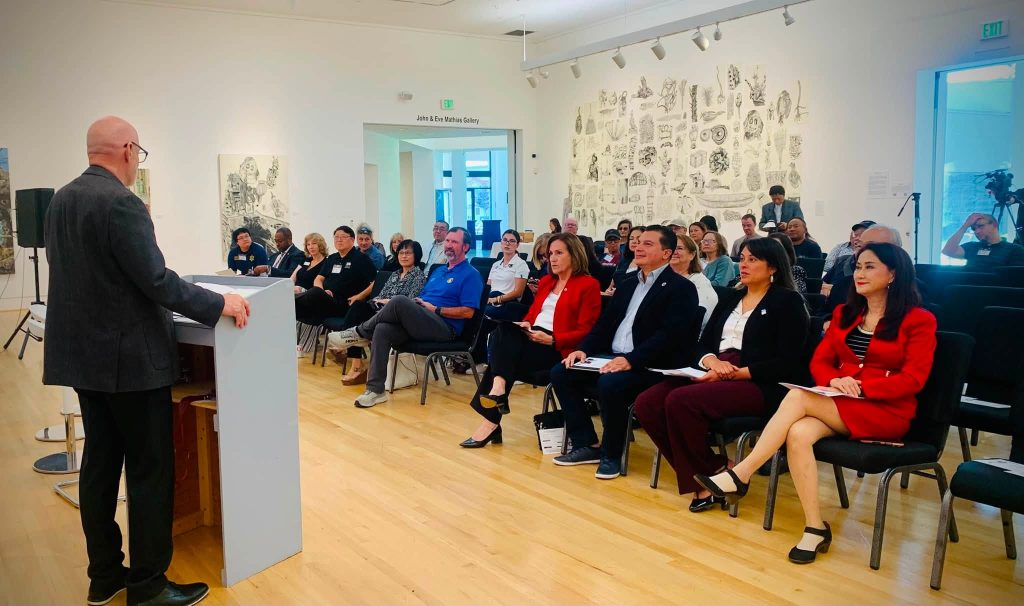
“She brought me into this weird little room that had paintings on the wall and no furniture,” Metcalf said. For years afterward, he stopped by after school. She’d talked with him, helped with homework, and gave him “a safe place.” And along the way making him an art lover.
Decades later, Metcalf returned to the Bay Area and was hired at the Triton.
“I was tasked with speaking to the docents, and I thought I wanted to tell my poor story,” he recalled. “In the back row, this little white-haired lady started laughing, and she said, ‘Preston, it’s me.’ We had a wonderful reunion.
“She didn’t know she was changing a person’s life,” Metcalf continued. “She didn’t know I would come back and be in the right place at the right time to institute programs … that would reach tens of thousands of our children, providing them with art education.”
The evening’s other personal recollection came from Mayor Lisa Gillmor, who grew up in Santa Clara when it was still mostly orchards. Her mother died when Gillmor was seven, and her father, alone with four children under 10, brought her along everywhere rather than pay babysitters.
“I was constantly at the International Swim Center getting autographs from all swimmers,” she said. “I was here at the opening of Great America. I was so lucky to have a front row seat to all the big moments in Santa Clara.”
“When I graduated from college, I thought everybody got involved in their community,” she continued. “It was not only an honor but a responsibility. My first appointment was on the Parks Commission when I was 22; that’s where my career started. This year in Santa Clara, 2026, it’s been just incredible. I’ll always be part of the community.”
These stories were the heart of the event, but the video also toured Santa Clara’s marquee names and moments: the International Swim Center, NVIDIA, Intel, AMD, Levi’s Stadium, two Super Bowls, the 2026 World Cup, and the city’s 130-year-old electric utility, Silicon Valley Power.
Some in the audience commented that the faces in the film were hardly the faces of the diverse community people see on Santa Clara streets daily.
A longtime resident active in the local Muslim Community Association noted, “we have the largest Muslim community here … I don’t see a single face there [in the video]. So that says that our own community, a big community, are not involved. It’s a beautiful city to call home, and we are a large community that wants to engage.”
Ding acknowledged the criticism, saying this was the first chapter.
“You’re welcome to come to talk to us and join us and share your ideas about how can you be part of the stories. I would love to listen and work with you,” she said.








0 comments