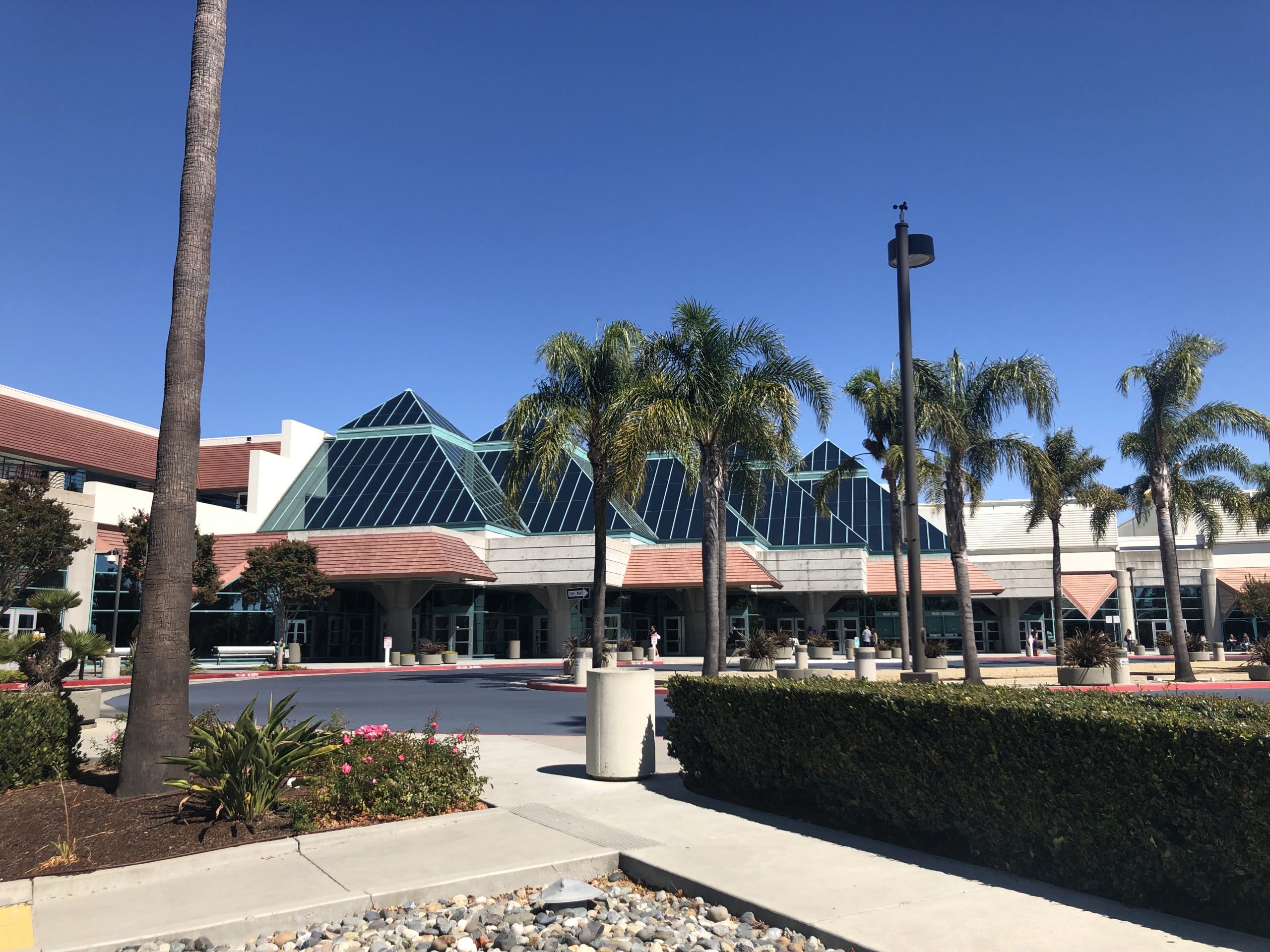
The Santa Clara Convention Center is hemorrhaging money, revealing a pattern of mismanagement that calls into question why the city isn’t pressing for answers.
Oak View Group (OVG), a private event management company, manages the convention center, a 302,000 sq. ft. venue at the heart of the city’s tourism economy. The city’s destination marketing organization (DMO), Discover Santa Clara, is responsible for marketing it.
The city maintains a tourism improvement district (TID), a collection of hotels near the convention center. Hotel taxes the city collects through the TID fund the DMO.
OVG last reported to the Santa Clara City Council in June 2024.

The DMO’s board meeting packets reveal that in 2024/25, the organization booked a meager $478,761 in convention center revenue against a target of $1.9 million, just 25% of its goal.
That nearly two-year gap coincides with a period of significant underperformance, a federal indictment of the center’s management company and a California tax authority suspension of the DMO — a suspension kept quiet from the public.
Unexplained Reporting Gap
For years, the convention center’s financial performance was public record, presented quarterly to the council as a routine agenda item. But, that hasn’t been the case since the city formed the DMO.

The most recent report covered the third quarter of fiscal year (FY) 2023/24, through the end of March 2024. It showed the convention center on track for a profitable year, with gross revenue of $13.3 million year-to-date against a budget of $10.7 million.
But the reports have since dried up.
In an email, Janine De la Vega, the city’s public information officer, explained that the convention center has had a “major shift in management.” In April last year, the convention center’s finance manager resigned. Then, two months later in June, the general manager also resigned from OVG.
In October, OVG hired Raul Gutierrez as general manager and replaced the finance manager just last month. Since then, De la Vega wrote, the team has been “working hard to update the quarterly reports.”
While that upheaval would understandably throw a wrench in the works, it only accounts for the reporting gap from June 2025 onward. It fails to explain the more-than-a-year gap in reporting prior to that.
Although the convention center is a public asset, OVG, a private Los Angeles-based venue management company, manages it. Because OVG is a private company, without the quarterly reports, the public lacks the means to evaluate its performance.
A Troubled Parent Company
In 2015, Tim Leiweke and Irving Azoff founded OVG. Backed by $1.34 billion in private-equity money, OVG has since grown into one of the largest venue management companies in the country.
In July 2025, the U.S. Department of Justice (DOJ) indicted Leiweke, OVG’s CEO, for arena management industry bid-rigging. He subsequently resigned. President Trump later pardoned Leiweke.
The indictment isn’t an isolated incident. In Connecticut, the Capital Region Development Authority (CRDA) found that OVG steered a contract to Ticketmaster without the required bids or board approval, and that OVG lined its pockets with Ticketmaster bonuses earmarked for CRDA that weren’t disclosed to competing bidders.
Such conduct at a publicly-owned venue is strikingly similar to what federal prosecutors alleged in Leiweke’s indictment.
Terms of OVG’s contract with the city are confidential, including what oversight the city exercises over OVG’s financial arrangements at the venue. Given that two people in management positions resigned right around the same time other OVG officials were implicated in chicanery is perhaps coincidental but telling.
This presents a problem since the quarterly reports that would illuminate the center’s performance have screeched to a halt. And what the DMO packets show is unflattering.
Built to Drive Business, Struggling to Do It
In 2019, the city created Discover Santa Clara, a nonprofit. The DMO’s stated purpose is to drive business to the convention center by marketing the city as an event destination.
By its own documents, it has largely failed at that core mission.
In addition to only achieving 25% of its revenue goal in 2024/25, the DMO also failed to book any Priority 1 events — i.e., events with 700 or more peak attendees and at least $650,000 in building spend — falling short of its goal of two. Throughout the year, the DMO lost 68 Priority 1 and Priority 2 leads to competing cities, representing an estimated $4.7 million in building spend and nearly 179,000 room nights that went elsewhere.
In a presentation to the city council last month, Christine Lawson, Discover Santa Clara’s CEO, touted a 40% increase in sales leads.
“We’ve started this momentum, and it is really important that we continue it,” she told the council.
However, leads are one of the least meaningful metrics for determining an organization’s financial health. Leads are meaningless if they don’t convert to sales. Using them as a metric is activity masquerading as productivity.
In addition, Lawson said, the DMO shifted how it spends its money, upping the percent of its budget dedicated to marketing from 20% to 70%. To do this, it funnelled money from sales and incentives.
Market efforts often include establishing a social media presence, brand awareness, visitors’ guides and promotions — efforts difficult to quantify or tie to revenue. Sales, by contrast, are highly measurable. So, the DMO is shifting how it spends its money from demonstrable, measurable metrics to ones that are more fuzzy.
A Suspension, Quietly Mentioned
Another fly in the ointment is that while the DMO was falling short of its targets, it was also operating under a legal cloud.
California Secretary of State records show that, in April 2024, the California Franchise Tax Board (FTB) suspended the DMO. A suspended nonprofit loses the right to conduct business and enter contracts in California — a significant legal disability for an organization managing millions in public money.
The suspension wasn’t publicly disclosed or reported to the council. It appeared in the public record after-the-fact in a single sentence, buried in the minutes of the DMO’s July 17, 2025 board meeting, where Lawson noted that “the DMO’s FTB suspension status has been lifted.”
No suspension date, duration, cause or explanation of how the matter was resolved. Typically, the FTB suspends entities for failure to file required reports — a finding consistent with the DMO’s sparse public filing record.
What the Tax Records Reveal
IRS filings for Silicon Valley Santa Clara DMO Inc. reveal a pattern that raises governance questions.
The DMO has had at least two CEOs in five years.
Eron Hodges served as founding chair and de facto leader in 2019/20. Matthew Stewart was CEO through 2021/22, earning $71,667 in his final year.
In 2022/23, Lawson took the helm, collecting a $50,670 salary. The following year, Lawson’s pay skyrocketed to $278,915. No public explanation for that increase exists in any document reviewed.
In its founding year, an independent accountant compiled the DMO’s financial statements. Then that practice stopped. Since then, the DMO’s operations haven’t been subject to independent compilation, review, or audit. An organization receiving approximately $3 million annually in tourism money has only had its books independently verified once.
Every year of the DMO’s operation has shown substantial management fees paid to non-employees. From 2021/22 to 2022/23, those fees ballooned from $163,113 to $204,739. Public filings don’t detail who received that money.
From the start, OVG has been embedded in governing the DMO. Kelly Carr, who the documents identify as an OVG360 representative, served on the DMO board from its founding year. By 2022/23, Carr held the position of treasurer — controlling the DMO’s finances — while simultaneously representing the company whose venue the DMO was charged with independently marketing. Carr resigned from the DMO board in July 2025, the same month the DOJ indicted Leiweke — yet another OVG top brass distancing itself from the city.
The DMO’s site no longer lists an OVG representative on its board of directors.
Years after the fact, the DMO also filed an amended return for 2020/21, noting it was correcting multiple items including government grant revenue from the city “that was not previously reported.” Although Santa Clara’s hotel-room tax — channeled through the TID as grants — fund the DMO, its IRS filings show no sponsorships, program service revenue, or membership income, pointing to minimal engagement with the industry it serves
Failing to disclose public funding sources on a nonprofit tax return is more than a minor administrative error.
The City’s Role
In IRS filings, the DMO acknowledges that “the corporation’s performance of its stated purpose is subject to review by the Santa Clara City Council.” That review has been largely absent.
De la Vega wrote that the DMO intends to come to the council “soon” with the delinquent reports — implicitly acknowledging their absence. No timeline was given.
Since neither the DMO nor OVG have reported to the council in a long time, it is unclear whether the city is aware that the convention center is floundering.
However, Reena Brillot, the city’s director of economic development and sustainability, sits on the DMO board.
Further, Mayor Lisa Gillmor, who has been publicly associated with both the decision to create the DMO and the OVG management arrangement, was a panelist at a DMO-hosted event alongside OVG’s convention center general manager and Lawson — the two principals whose performance the missing reports would illuminate.
Emails to Lawson and Gutierrez went unanswered.
Several things remain unclear. Why have the convention center reports stopped? What has the convention center’s financial performance looked like for the nearly two unreported years? Who received the management fees disclosed in the DMO’s tax filings? What caused the FTB to suspend the DMO? For how long was it operating in a legally suspended state? How does a CEO whose organization hit 14% of its revenue target justify a $278,915 salary?
The city has offered no answers. The reports that would provide them are still missing.
Update: This article has been updated to reflect clarifications and 3 inaccuracies in light of additional information provided by a public relations firm hired by Discover Santa Clara following its publication.
Contact David Alexander at d.todd.alexander@gmail.com








Does the four years or so of “social distancing” mandated by government to “fight” (or pretend to) the China virus, aka Wuhan Virus and/or covid 19, have anything to do with this? Oh, include the ineptness of the Biden cartel.
Mayor Gillmor has had it as her priority to destroy as much of the entertainment district as possible. All because the stadium is there and she wants nothing to do out there so the stadium can fail and so she can look like the hero who saved the day.
Gillmor has had it out for this convention center since she was on the city council. She had it out for this land in that area where she wanted the Oakland A’s or San Francisco Giants to play, not a Golf Course. She had it out for the Chamber who managed it. Gillmor would always call out things like the convention center or the golf course as “money losers”. The northside entertainment district is what Gillmor feels is her inheritance and her birthright to decide what goes on out there. A lot of ties to her father and his many years of influence is important but this is a vengeful Lisa Gillmor, something Gary was not. Gary was business Gillmor was scorched earth politics. While both can be shady, Lisa Gillmor takes the cake. As heir to Gary’s empire, Lisa is terribly managing. Her properties are examples. In reality anything Lisa Gillmor touches is a “money loser”.
Hearing now that the Convention Center is hemorrhaging money and showing patterns of mismanagement sounds like deja vu all over again. Mayor Gillmor has effectively been in charge since the purge of the previous management, so where are the concerns she raised back in 2018 when she accused the Chamber CVB of mismanagement. Where is the crusade to get answers now? This failure happened under her watch, just like much of what has happened in the Entertainment District. Tourism is down, events are down, revenue is down. Gillmor claimed the previous management was the problem, yet the current management structure is failing at a rate even worse than what she accused the former group of doing. As Gillmor herself once called it, this is now a “money loser.” Based on her record, she herself has become a money loser for the City of Santa Clara. Gillmor broke something that did not need fixing eight years ago, and between political purges, consultant culture, and post-pandemic failures, the city has destroyed what was once a reputable institution.
What makes all of this timely with this article is what happened Tuesday night at the City Council meeting. Near the end of the meeting, Mayor Gillmor and Councilmember Suds Jain had a tense exchange after Suds pushed for a 030 for a sustainability manager. Gillmor appeared visibly irritated and defended Reena Brillot as already serving in that role. Reena Brillot also runs the Marketing and Economic Development Committee meetings, where Gillmor now serves as chair of a committee that conveniently did not meet for years when Gillmor lacked control of it. The committee suddenly resumed once Gillmor became chair again, and now Brillot serves as the staff liaison. Interesting coincidence. It is also interesting that Jovan Grogan promoted Reena into the powerful role she now occupies. Suds’ motion passing seemed to frustrate Gillmor, and the timing of all this alongside the latest Convention Center issues is hard to ignore.
In 2018, Gillmor fired the Convention Center CVB. Gillmor’s controversial four-member majority cut ties with the Chamber of Commerce and its Convention and Visitors Bureau (CVB) after Gillmor and Deanna Santana launched audits and became involved in political disputes over the management of the Santa Clara Convention Center. Gillmor pointed to alleged conflicts of interest, questionable discounting, self-dealing, and weak financial oversight, ultimately voting to end the Chamber’s decades-long management contract.
However, some saw this as déjà vu. In the 1990s, Gillmor had previously pushed for investigations into the Convention Center’s operations. After significant controversy in 1993 and 1994, a grand jury report concluded that the allegations did not match the level of concern being claimed. The grand jury found little justification for the often heated debates over the Convention Center during Gillmor’s earlier time on the council. Although that 1994 report effectively undercut Gillmor’s position, she was seen by some as carrying that dispute forward until 2018, when she ultimately ended the Chamber CVB contract with the assistance of City Manager Deanna Santana.
While audits did raise concerns about the CVB’s financial controls and conflict-of-interest practices, they also noted that the city itself had failed for years to properly oversee the contract, resulting in what one account described as a shared failure in management. Still, Gillmor moved forward in reshaping the Convention Center structure.
Following that, Santana and Gillmor began changing how operations were run in 2019, with Santana implementing Gillmor’s approach and taking over Convention Center management. This ultimately led to JLL and Dan Fenton becoming central to operations. In 2021, when a new City Council was seated, members debated whether to continue the relationship with JLL and Dan Fenton. Councilmembers Raj Chahal and Kevin Park strongly questioned JLL, with Chahal pointing to a defined project that had not been completed but had still been renewed twice despite shortcomings. Kevin Park also referenced the history of JLL and Dan Fenton, as well as what he described as Gillmor’s 2018 vendetta.
Former Councilmember Becker brought up the 2007 grand jury report regarding Dan Fenton and JLL from his time overseeing the San Jose Convention Center, which had criticized operational losses. However, at the end of the discussion, Councilmembers Suds Jain and Karen Hardy voted alongside Mayor Gillmor and Kathy Watanabe to extend JLL’s contract despite the concerns raised.
What stood out to some was the irony of Becker citing the 2007 grand jury report, given that a year later he himself became the subject of a report and investigation that some viewed as unusually timed for several reasons. One of the individuals involved in testimony was David Andre, a former CVB employee who had been fired by Gillmor and her majority. Andre had been a vocal critic of Gillmor and had supported Becker’s campaigns and assisted him on Convention Center matters while Becker served on the council. As a result, Andre was questioned about his relationship with Becker. Whether coincidence or political retaliation, the timing raised questions for some observers. Andre, for his part, reportedly held resentment toward Gillmor following his termination.
Since then, some have described a pattern of continued instability following Gillmor’s restructuring of the CVB system that once managed the Convention Center more effectively. Eron Hodges later served as founding chair in 2019 and 2020 while the Gillmor-Santana structure was being established. Hodges was seen as aligned with that leadership direction. Matthew Stewart followed but had a brief tenure, and by 2022 he became the subject of a Santa Clara Police review under PRA 21-367 involving allegations of fraud and domestic issues. While no formal outcome was publicly confirmed, Stewart ultimately resigned.
That led to Christine Lawson taking over. Lawson is viewed by some as politically aligned with Gillmor, and her significantly higher salary compared to previous years has been pointed to as evidence of that alignment. Even Stevie Wonder can see that.
Where is City Manager Grogan? Why is he dropping the ball on this? Is it incompetence, loyalty, or pressure from above? And on a side note, Janine De La Vega, much like Aimee Escobar at City Hall, increasingly appears to function as part of Mayor Gillmor’s public relations shield. Amazing how much these people get paid while constantly claiming to know nothing. People also forget Gillmor had a friendly relationship with De La Vega dating back to her FOX 2 news days. What exactly is going on with Grogan’s hires? Why are so many Santana-era people still around and getting promoted? Grogan did not clean house, he just changed the drapes and played musical chairs.