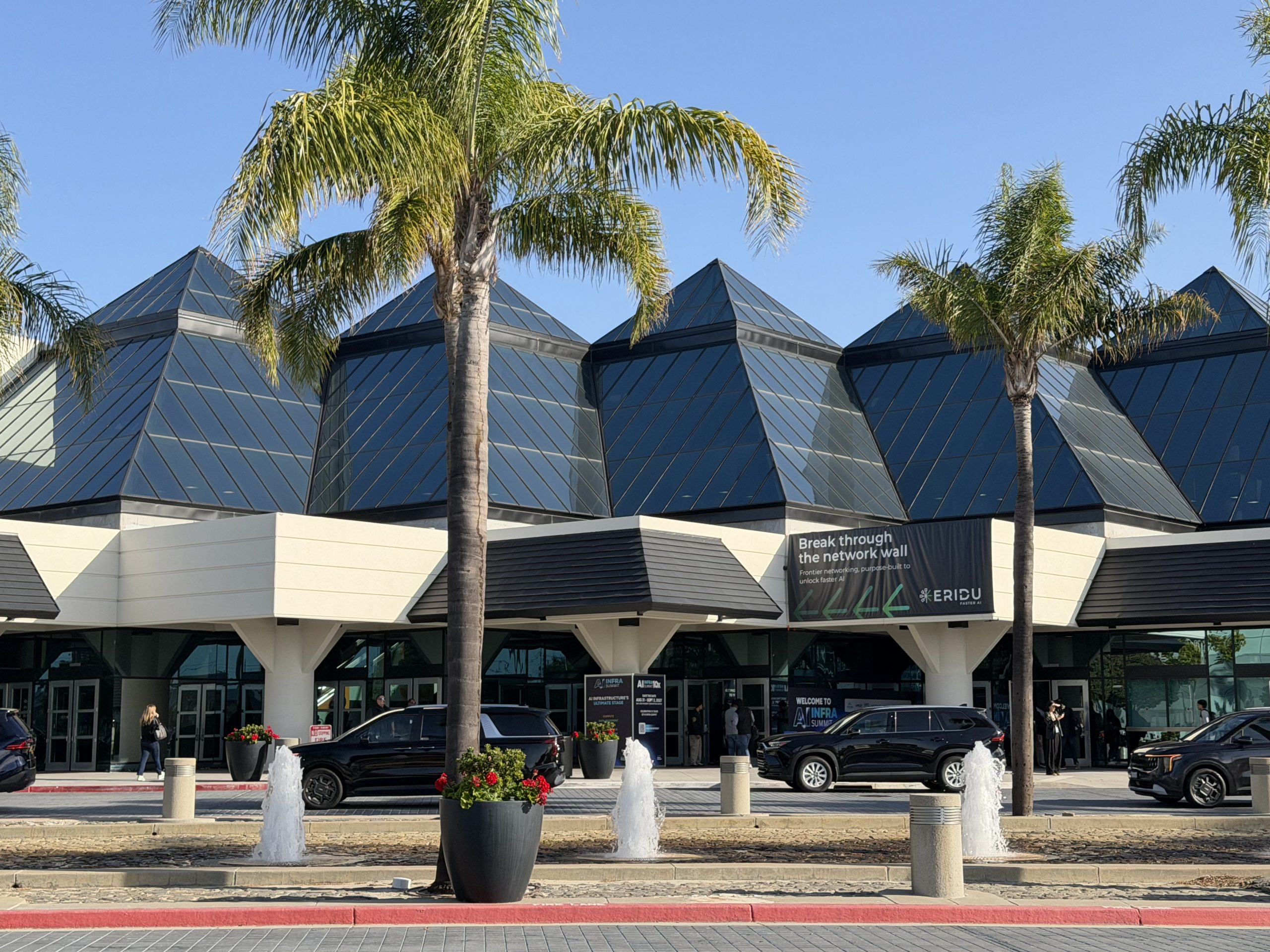
For more than a year, Santa Clara hasn’t gotten usable financial statements for its convention center, and the city won’t say how much it has withheld from the company that runs it.
The city’s contract with Oak View Group (OVG) requires far more than the city has received, and it is silent on withholding payment, according to city documents and written responses provided to The Weekly in October.
Because of the lack of financial reporting, the city stopped reimbursing OVG, the private company that manages the Santa Clara Convention Center, in October last year. Shortly after The Weekly’s May coverage, the city sent unsolicited information for “clarification.” That material repeated, nearly word for word, a June 4 email the city later provided.
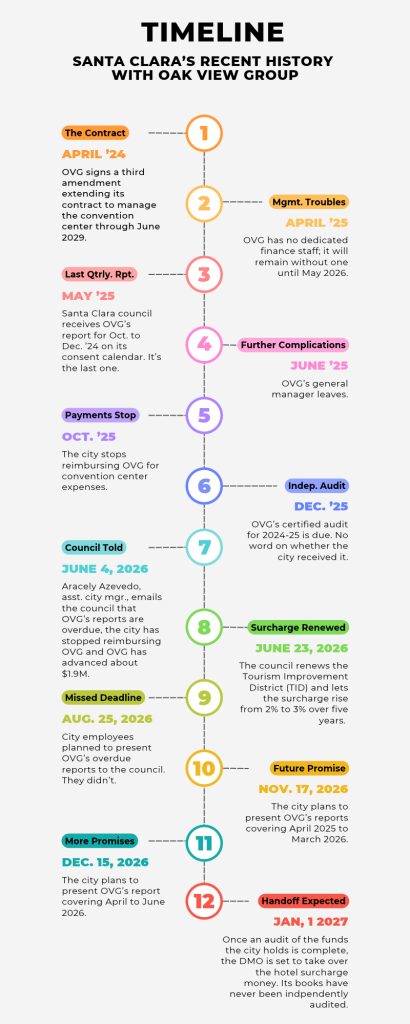
“The regular cadence of quarterly reporting to the Council was not maintained as consistently as it should have been due primarily to the transition in OVG staff,” Aracely Azevedo, assistant city manager, wrote in the email to the Santa Clara City Council.

In that email, she informed the council that OVG had advanced approximately $1.9 million to keep the building running. She told the council city employees intended to present OVG’s overdue reports at the council’s Aug. 25 meeting.
Those reports didn’t arrive.
Nobody from the city requested corrections, but Azevedo wrote that The Weekly’s article contained inaccuracies. Discover Santa Clara, the nonprofit destination marketing organization (DMO) the city created to market its convention center and drive hotel revenue, and OVG intended to address the article, she also noted.
Madden Media, Discover Santa Clara’s marketing agency, contacted The Weekly requesting 12 corrections. After The Weekly requested verification of several disputed points, the agency went silent. The Weekly then updated the story to correct three errors, including the convention center’s square footage and mistaking the city’s tourism improvement district (TID) for its transient occupancy tax (TOT).
A Moving Deadline
Appearing on the consent calendar, the last OVG quarterly report, covering October through December 2024, came to the council May 13, 2025. It approved that report, and the one before it, without discussion.
That report showed the center losing ground. Through December 2024, gross revenue totaled $7.13 million, down about 22% from $9.10 million a year earlier. OVG attributed most of the drop to two one-time events the prior year that brought in more than $1.6 million. OVG projected the center would finish 2024-25 with just $844 profit — $554,788 short of the budgeted $555,632.
Those reports contained errors. The one covering October through December 2024 says net income of $282,117 was “missing the budgeted target of $177,206.” It beat the target by $104,911.
In her email, Azevedo blamed turnover, noting OVG’s general manager left in mid-2025, and the center went more than a year without dedicated finance staff. As of June, OVG had submitted drafts for three quarters and hadn’t yet written two more.
“Unfortunately, they were not complete and the City has requested corrections on all three draft reports,” Azevedo wrote.
Janine De la Vega, the city’s public information officer, explained the delinquent reports.
“The reports were not ready for August 25 because the City’s review identified corrections OVG needed to make before the financial information could be presented to the Council,” De la Vega wrote in an Oct. 16 response.
In that email, De la Vega wrote that the city plans to bring the reports covering April 2025 through March 2026 to the council Nov. 17 — two weeks after the election. It plans to bring the report for April through June 2026 on Dec. 15.
In the same response, De la Vega offered a new explanation for the delay. In summer 2025, OVG switched its accounting system, which changed its chart of accounts, she wrote. Interim staff then needed to learn the system and the city’s reporting requirements.
In a statement to The Weekly, OVG offered a third explanation. The company described the delays as a matter of formatting.
“Additional adjustments were required to align the reports with the City of Santa Clara’s specific formatting requirements, resulting in delays,” OVG wrote.
The city described a different problem. De la Vega wrote that the city returned the drafts “to ensure the financial information is accurate and consistent.” In June, Azevedo informed the council that OVG couldn’t provide monthly financial statements. Since 2019, OVG’s contract has required reports “in a format approved by the City.”
Even before the turnover, reports took months to reach the council. OVG dated its report for July through September 2024 on Oct. 25, 2024. The council received it four months later, on Feb. 25, 2025.
The city’s reasoning has also shifted.
In June, Azevedo wrote that OVG advanced itself money as it worked to resolve “internal accounting issues.” However, in October, De la Vega wrote that “OVG has not reported any specific internal accounting issues to the City.”
What the Contract Says
De la Vega provided the city’s management agreement with OVG, which had not previously been publicly available. The agreement dates to 2019, when the council hired Spectra Venue Management after a 2018 performance audit led the council to fire the Santa Clara Chamber of Commerce. OVG acquired Spectra in 2021. In April 2024, OVG signed a third amendment that extended its contract with Santa Clara through June 2029.
The agreement requires more than quarterly reports. Each month and quarter, OVG is supposed to provide a report that includes performance indicators, a balance sheet, a profit-and-loss statement, a cash-flow statement and a forecast, according to the agreement. A monthly dashboard is due within 30 days of the month’s end. Those reports go to the city, not the council.
Nothing in the agreement requires the city to present them publicly.
The contract also gives the city “unlimited ‘real-time’ and ‘read-only’ access” to OVG’s accounting software, including each transaction’s source documents. Within 180 days of each fiscal year’s end, OVG must deliver a certified audit by an outside auditor the city approves.
De la Vega’s responses did not address whether the city received one for 2024-25, which would have been due in late December 2025.
The agreement is silent on withholding money from OVG, De la Vega acknowledged.
“The Agreement does not have specific provisions on withholding reimbursements or time limit caps,” she wrote.
The contract requires the opposite. The city must keep two months of budgeted expenses in the center’s operating account. OVG never has to advance money — “under no circumstances,” according to the agreement — and if it does, the city must “promptly reimburse” it. The contract provides a remedy for failure to perform: written default notice, 30 days to cure, then termination.
De la Vega wrote that the city notified OVG of the needed corrections, but didn’t write whether the city issued a default notice. Her answers didn’t specify how much the city has withheld, only that it last advanced money in October 2025. The city’s amended 2026-27 budget sets aside $4.5 million in a convention center reserve.
The city has paid OVG’s fixed management fee throughout, De la Vega wrote. The fee began at $13,750 a month in 2019 and rises with inflation. If OVG raises the center’s net operating income above the average of the last two years the chamber ran the convention center, it can also earn an incentive fee. But the city has not paid any incentive fees, De la Vega wrote.
The agreement allows the city to order a performance audit by the city auditor.
“The City has not referred either matter to the City Auditor and does not believe a referral is warranted at this time,” De la Vega wrote.
The Council Knew
On June 23, 19 days after Azevedo’s email, the council renewed the TID for five years. The renewal lets the surcharge on hotel guests’ bills rise from 2% to 3% of the room rate, phased in over five years.
The district’s money funds the DMO. Six days before that vote, Discover Santa Clara’s treasurer told its board of a significant, unresolved discrepancy in its quarterly financial reports’ beginning balance, according to the June 17 meeting minutes.
De la Vega wrote that the treasurer had informed city employees and that the city supplied the reconciliation. The Weekly asked whether the staff report for the renewal mentioned this. The two matters, De la Vega wrote, are unrelated.
“The DMO/Tourism Improvement District (TID) and the Oak View Group management of the Convention Center are two separate agreements for each entity. The OVG reports were not related to this agenda item to renew the TID,” she wrote.
While the chamber managed the convention center, reports came to the council each quarter as discussion items. Under the agreement the council approved June 23, Discover Santa Clara presents one report a year.
What Comes Next
The city plans to present OVG’s reports Nov. 17 and Dec. 15. De la Vega didn’t write when the report for July through September 2026, the quarter that just ended, will follow. Neither date covers January through March 2025. The city hasn’t presented that report.
OVG wrote that it “has implemented measures to strengthen management oversight and financial reporting capabilities to ensure timely future submissions.”
Discover Santa Clara expects to take custody of the surcharge money the city holds Jan. 1, after an outside audit of that money, Lawson wrote. The DMO has never had its books independently audited.
Several questions remain unanswered. De la Vega did not say how much the city has withheld from OVG, whether the city has verified the DMO’s booking figures or what consequences the DMO faces for missing its goals.
Contact David Alexander at d.todd.alexander@gmail.com
The next two parts of this series examine Discover Santa Clara’s finances and performance, including financial documents that disagree about how much money it has, performance targets that match business it has already booked and a $225,000 sponsorship. Christine Lawson, the DMO’s CEO, responded to questions for those stories.








0 comments