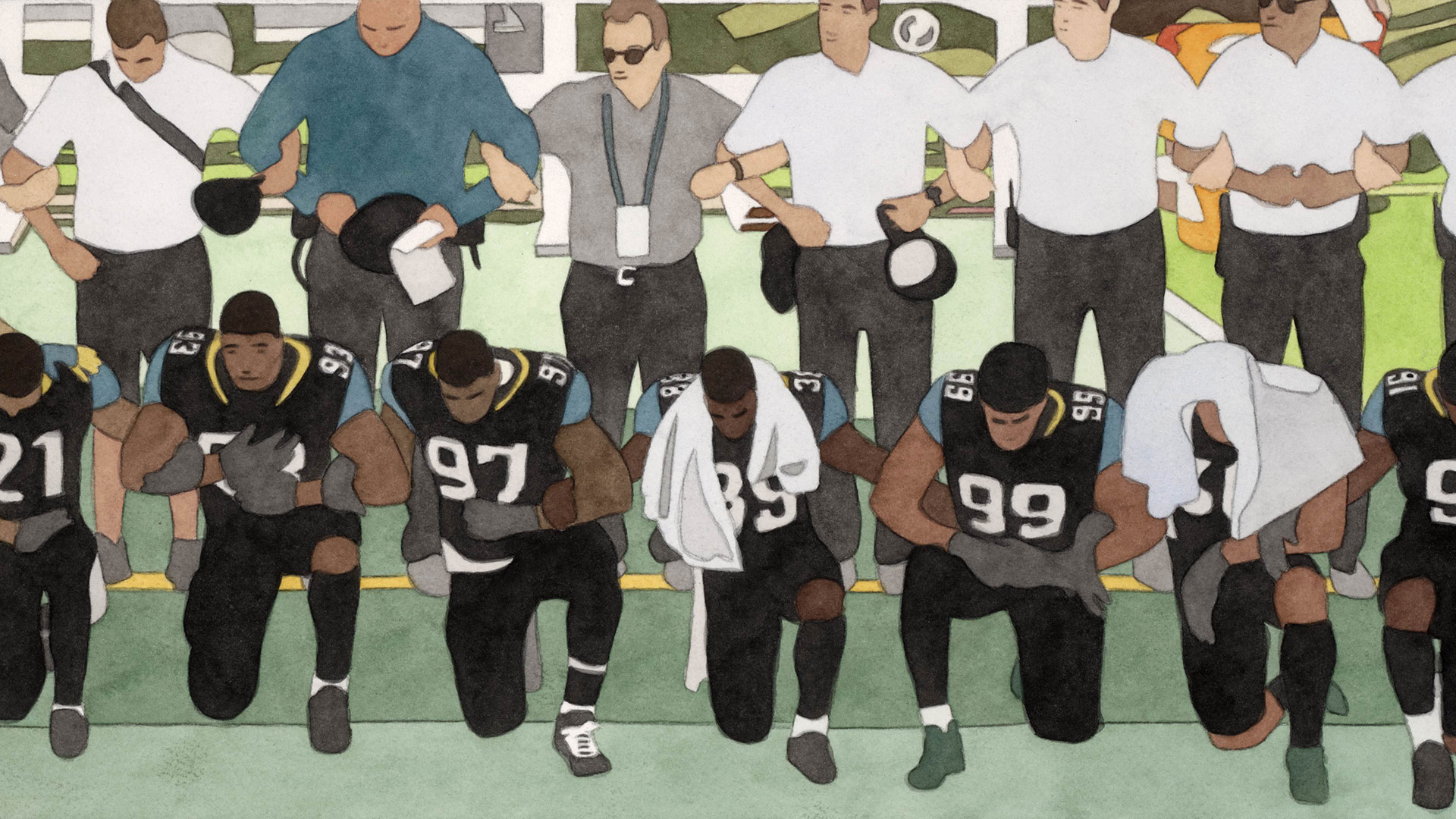
Art and football intersect at a one-day-only free showing Feb. 7 (the day before the Super Bowl LX game) of “National Anthem,” a two-minute video by Oakland-based artist Kota Ezawa at the de Saisset Museum on the campus of Santa Clara University.
“National Anthem”(2018) is an animation of more than 200 small-scale watercolors Ezawa painted, based on film footage of NFL players “taking a knee” on the field at the beginning of football games. In the background, a string quartet performs the American National Anthem—The Star-Spangled Banner, which opens every football game. Applause at the end of the anthem seems directed towards the defiant action of the players.
Former San Francisco 49ers quarterback Colin Kaepernick was, in 2016, the first player to take a knee, in peaceful protest of police violence and injustice towards people of color in the U.S. Other NFL players followed his lead, sparking national debate, until the NFL banned kneeling in 2018.

“I found the genius of his [Kaepernick’s] gesture is that it was nonverbal. It was just taking a knee. It said so much without saying anything. I perceived it as some unusual act of patriotism,” said Ezawa in a 2019 interview for the Whitney Museum of Modern Art in New York City, where his highly praised “National Anthem” was first exhibited.
Although not on view at the de Saisset, three watercolors—Buffalo Bills, Denver Broncos and Roar of the Tigers—are also part of Ezawa’s “National Anthem” series.

“I myself thought Kaepernick’s protest was a beautiful gesture, and my work was honoring this country,” said Ezawa, a naturalized U.S. citizen.
His father was a Japanese immigrant to Germany, where Ezawa was born and raised, eventually coming to the U.S. to further his art studies.
Ezawa said that he has developed a style of drawing that starts by him manually tracing over existing films, videos, photographs, and paintings to create a ghost image of the original.
“I find that these ghost images emit some kind of power that I’m trying to tap into,” he said.
The “National Anthem” video is on a continuous loop from noon to 4 p.m. on Feb. 7 only. Ezawa’s talk begins at 12:30 p.m., followed by a free reception, also at the de Saisset Museum.
“These national anthem protests somehow touched something in me where I suddenly felt very connected to the U.S. and to what these players were doing,” said Ezawa.
On Feb. 5, the de Saisset Museum is hosting a free artist lecture and reception for Bay Area artist Jonathan Calm, a native of New York. Calm’s exhibition “To Wherever, Forever: Archives of Absence & Sites of Passage”—presented in collaboration with the Department of Art and Art history—is on view at two campus locations.
At the Edward M. Dowd Art & Art History Gallery, “Sites of Passage,” which focuses on racial injustice, is on view Jan. 5 – Feb. 20. Calm visited and photographed locations listed in the Negro Motorist Green Book—a guidebook for Black road travelers, published 1936-1966, listing businesses that permitted non-Whites.
Calm uses photography, video, embroidery and installation to reflect on the politics of travel and belonging. He reveals the coexistence of beauty and exclusion within the same terrain.
At the de Saisset Museum, “Archives of Absence” is on view Feb. 5 – June 13. It addresses landscapes shaped by displacement and disappearance. “Drown Town,” for example, memorializes communities submerged by dam construction.
The Feb. 5 reception begins at the Dowd Art & Art History Gallery, from 4-5 p.m. It continues at the de Saisset Museum from 5-7 p.m., with an artist lecture at 5:30 p.m.
Related Posts:
Breaking Tradition: “The Plague Archives” at SCU’s de Saisset Museum
SOMOꙄ: SCU’s New Outdoor Art Installation








0 comments