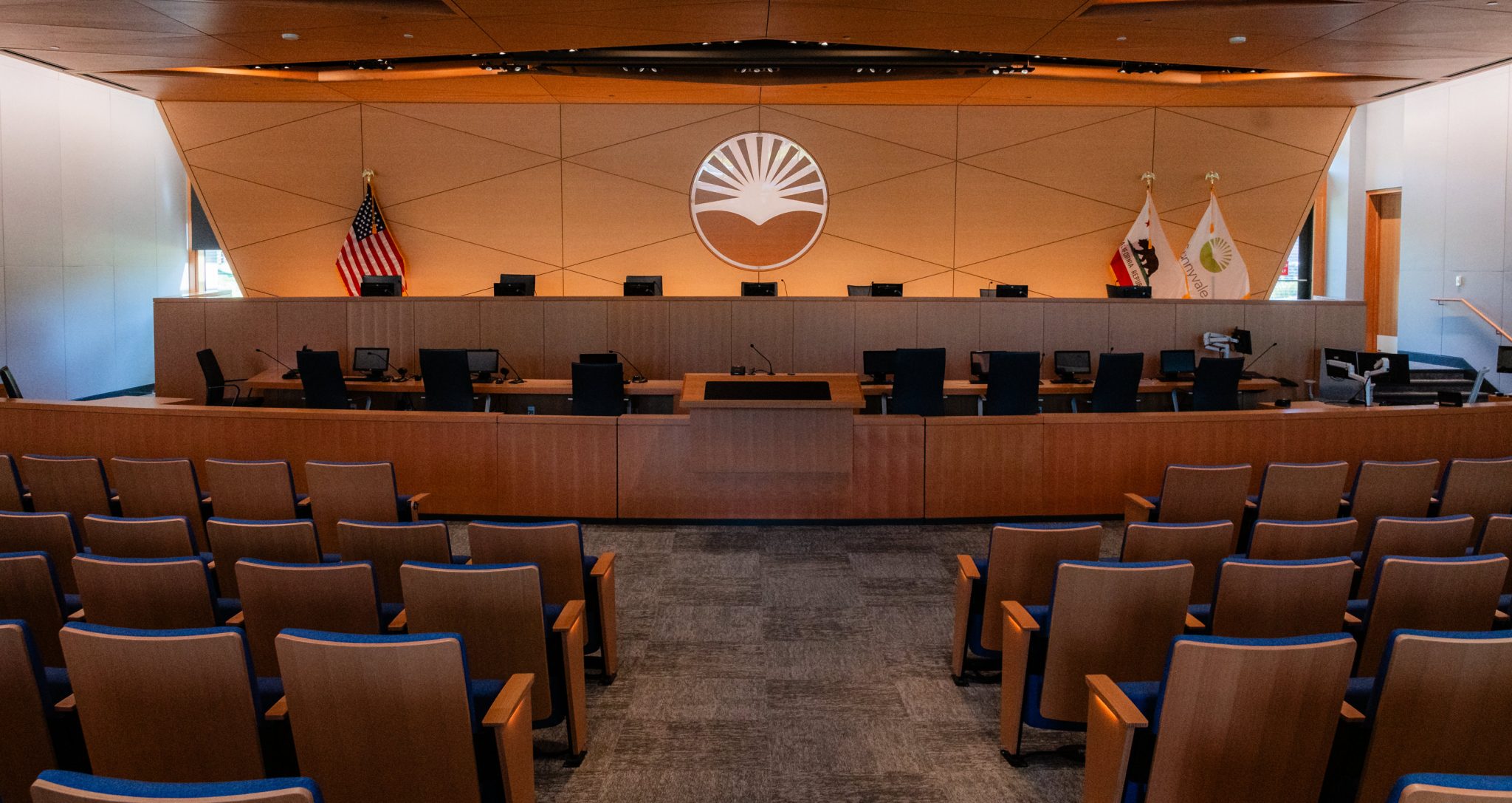
Vagueries in a proposed service worker retention ordinance have led the Sunnyvale City Council to bounce it back to city employees in order to clarify a couple of aspects.
At its most recent meeting Oct. 6, the council rejected an ordinance similar to the one Santa Clara passed in 2017, even though its members supported the spirit of what it aims to achieve.
The proposed ordinance would require a successor contractor for janitorial, security or food services to retain workers for three months after a switchover. Although the city would not enforce or even monitor whether businesses are following the ordinance, the intent would be to give workers something to point to during a labor lawsuit.
Such ordinances are typically found in cities with large convention centers or venues such as stadiums or arenas.

Christine Velasquez, the city’s economic development manager, told the council many businesses said the ordinance is, more or less, already common practice. Additionally, she added, criticisms of the ordinance included questioning its need, costs, operational compliance burden, legal risk, enforcement ambiguity and robbing small businesses of the ability to compete for large contracts.
Russ Melton, CEO of the Sunnyvale Chamber of Commerce and former council member, said when he sat on the dais, he used two governing principles to inform his decisions. The first was never introducing a local law that the city is unprepared to enforce.
“Proponents will openly acknowledge that the city cannot enforce this ordinance,” he said. “Instead, they want you to outsource municipal governance to private civil lawsuits and trial lawyers. Council members, please do not weaponize the Sunnyvale municipal code for private litigation.”

The second principle, he said, is when an outside advocate argues that Sunnyvale should do something because its neighbors have done it, it is an indicator that further thought is warranted. Voters elected the council to solve “problems that exist in reality,” not serve “outside agendas,” he said.
He said it is “a fact” that Santa Clara’s worker retention ordinance is a “big nothing burger.”
The ordinance permits for-cause termination but requires that the new contractor retain employees with satisfactory performance based on seniority if fewer workers are needed under the new contract.
As proposed, the ordinance would apply to businesses with 50 or more employees contracting over a three-month period for $50,000 or more.
City Manager Tim Kirby told the council there are roughly 170 businesses in Sunnyvale with 50 or more employees.
Velasquez said there have not been any documented issues of layoffs displacing workers but admitted that that perception is anecdotal. Further, the parameters of private contracts are opaque to the city.
Kerry Haywood, executive director of the Moffett Park Business Group, joined Melton in opposing the ordinance, saying it imposes significant obligations without evidence of a pattern of unfair displacement in Sunnyvale.
It “overreaches,” Haywood said, requiring incoming contractors to hire workers who may not meet their standards or the new contract’s requirements and creates “uncertainty” about who determines what is satisfactory.
Given that the industry standard is already in line with the ordinance, she said “voluntary practice should not become legal mandate.”
Ismael Islas, who runs a small janitorial company, said the ordinance hits small businesses the hardest. In this economy, he said, the city cannot afford to impose regulations that make it more expensive to do business in Sunnyvale. The government shouldn’t be telling businesses who they have to hire, he added.
“That takes away the one thing a small business has going for it: doing the job our own way and doing it better,” he said.
Proponents of the ordinance were mostly union leaders or members.
Sarah Julian, with Unite Here Local 19, challenged Melton’s characterization of Santa Clara’s ordinance, saying it has been working — for contract changes at NVIDIA, Levi’s Stadium and the Santa Clara Convention Center.
Arceli Rueda, with Service Employees International Union United Service Workers West (SEIU-USWW), said the security industry is growing rapidly and is facing many problems. Worker retention would give them more stability and a stronger voice, she said.
“We also must ensure that those workers we depend on to protect us also have enough resources to protect themselves,” she said. “Everything is interconnected. When workers lose good jobs and stable employment, the consequences affect their families, their community, Sunnyvale and the rest of Silicon Valley.”
Doug Bloch, also with Unite Here Local 19, countered the notion that his union was an outside influence, comparing the proposed ordinance to having car insurance that protects local workers from becoming “collateral damage” of contract changeovers.
Many proponents characterized the ordinance as a type of homelessness prevention.
“If a contract layoff leads to a mass layoff of one workforce and replacement of another, that is not business or job growth for Sunnyvale,” Daya Khunkhun, with Unite Here Local 19, said. “It can lead to large displacement.”
Because of the city’s inability to enforce the ordinance, Mayor Larry Klein proposed rejecting it, but his colleagues aimed to salvage the effort.
While the council had issues with the details, they each said they weren’t ready to give up on such protection.
“I am certain that we have a responsibility to people that are at-risk in our community,” said Council Member Alysa Cisneros. “If every service worker in this city had a union, I would agree — unnecessary.”
She was skeptical the ordinance would lead to frivolous lawsuits and said failing to pass it would shift burden to people with “the smallest voices, without access to power.”
Rather than attempt to wordsmith the language from the dais, Vice Mayor Richard Mehlinger proposed rejecting the proposed ordinance but with a provision that a revised version will return to the council in the future.
The rest of the council also had issues with the ordinance’s wording, opting to deny it but also direct City Attorney Rebecca Moon to clarify that the 50 employee threshold applies to the umbrella company, not to the contractor or any subcontractors.
“Ultimately, I ran for office because it is too hard for working families to make it here,” Mehlinger said. “I ran for office because of the housing crisis and the displacement of workers and the negative impacts that’s having.”
The motion to deny the proposed ordinance and return to the council with a more fleshed-out version passed unanimously. The council did not set a date for the ordinance’s return.
Sunnyvale City Council Consent Calendar Spending
The council approved the following spending in one motion via the consent calendar:
- Two one-year extensions and $160,000 increase to a purchase agreement with WSP USA Inc. The total purchase agreement is now $385,000.
The council meets again at 7 p.m. Tuesday, Oct. 20 in the Council Chambers at City Hall, 456 W. Olive Ave. in Sunnyvale.
To submit public comments ahead of the meeting, visit http://Sunnyvale.ca.gov/PublicComments; Meeting online link: https://sunnyvale-ca-gov.zoom.us/j/96111580540; meeting call-in telephone number: 833-548-0276, meeting ID: 961 1158 0540
Contact David Alexander at d.todd.alexander@gmail.com








0 comments