


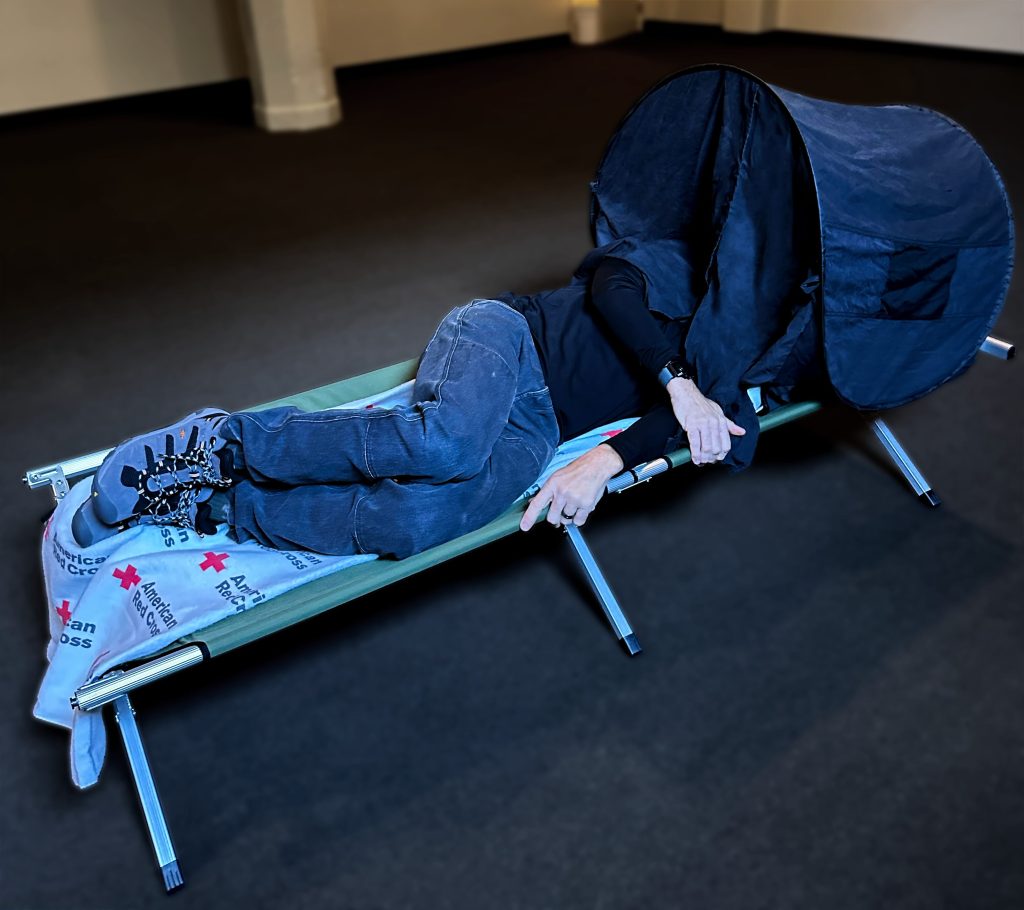
None of us is immune to the need for slumber—not even emergency workers.
In 2024, the Red Cross used zDen—a light-blocking sleeping den—in their shelters.
“I donated about 100 zDens to staff and volunteers last year during their Training Academy and when they supported those affected in North Carolina during the mudslides and flooding,” said Danielle Fujii, the inventor of zDen. “They purchased about 100 more from Amazon.


“The purpose is to provide privacy and darkness,” she said.
Fujii explained how the exchange began.


“I first shared zDen with a few local Red Cross staff members who felt it could help create privacy in staff shelters where men and women often share open sleep spaces,” she said. “Since many volunteers don’t know each other, comfort and privacy can make a big difference.
“The Red Cross typically doesn’t purchase supplies until they are needed, so I donated zDens to their Training Academy and later to volunteers and staff deployed in North Carolina after the mudslides and flooding,” Fujii continued.
“After seeing others use zDen in mass shelter settings, staff members requested their own, and the Red Cross purchased additional units through its partnership with Amazon,” Fujii continued. “Because zDen is portable and reusable, staff can bring it with them to future deployments, allowing continued use wherever they are stationed.”
When disaster strikes, those engaged in the safety of others may neglect their own health.
“During disaster responses, Red Cross shelters operate around the clock,” Fujii said. “Staff and volunteers often rest in shared spaces where lights stay on for safety, and activity continues day and night.
“Many are working longer hours than usual or adjusting to night shifts for the first time, all while supporting people under extreme stress from being displaced,” she continued. “It is emotionally demanding work, and quality sleep can be difficult to find for those providing care.”
The result is a vicious cycle where those helping the needy lack the means to also help themselves.
“Since shelters and operations run 24/7, their staff needs to be well-rested to provide support mentally and physically,” explained Fujii. “For safety reasons, lights are never shut off, even during nighttime hours.
“For Red Cross staff and volunteers, zDen helps create a darker, more private environment that supports better sleep and recovery so they can be more present and focused while caring for others,” she continued.
According to Fujii, zDen lets vulnerable segments of the population—such as the homeless—get quality sleep.
“Privacy and darkness are often taken for granted at home, yet in shared environments, those simple comforts are rarely available,” she said.
“For emergency workers, zDen supports recovery between shifts, while for those in transitional shelters, it can provide a more consistent and personal sleep space,” she continued. “In both cases, the shared need is dignity, rest, and a way to recharge mentally and physically.”
The response from Red Cross employees was very positive, leading to “zDen envy” among other Red Cross staff.
“It was very helpful when used while deployed with the Red Cross and sleeping in a room with other sleepers and lots of lights,” one employee said.
“zDen was a big hit at the Red Cross congregate shelters because of the privacy it offers,” according to another employee.
The environments in which zDen is used have gone far beyond what even Fujii imagined.
“It has been incredibly rewarding to see how something that began as a personal solution for migraine recovery has grown into a way to support others, from students and parents to frontline responders, as well as the Red Cross and children in foster care,” said Fujii. “Sleep is essential for everyone, especially in times of stress or crisis, and I am grateful that zDen can play a small part in helping people rest and recover when they need it most.”
Related Posts:
zDen: Sleeping Without Light
Maker Nexus Lets Imaginations Run Wild
Morgan Square: Startup Banker Starts Her Own Startup

