


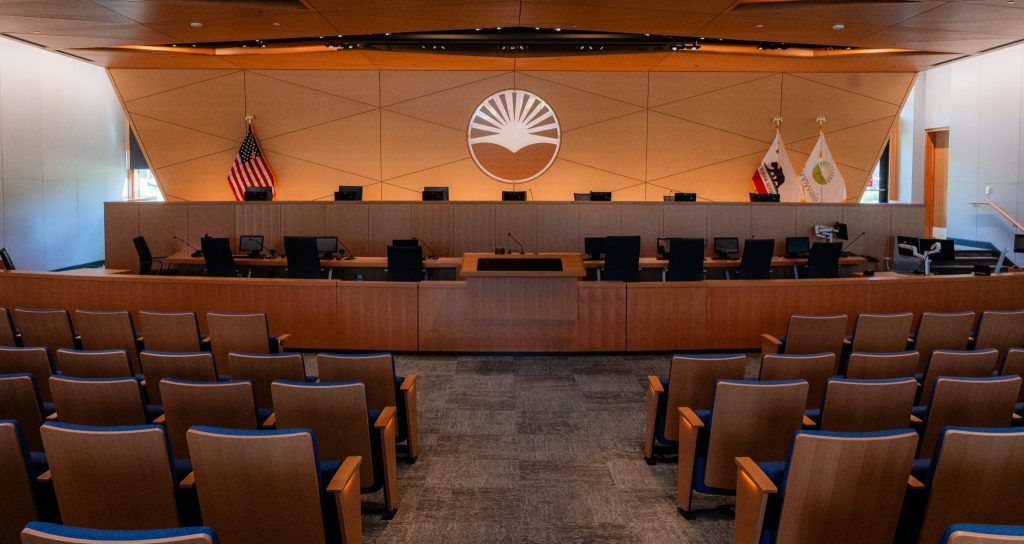
Sunnyvale is way behind on meeting its state-mandated housing numbers, but the city’s community development director characterized the requirements as “aspirational.”
At its most recent meeting, March 10, the Sunnyvale City Council approved its housing element. During his presentation, Ryan Dyson, the city’s housing specialist, told the council the city is “lagging” on meeting its Regional Housing Needs Allocation (RHNA) numbers — the number of housing units the state requires each city to produce each cycle.
The RHNA cycle goes through 2031, meaning the cycle is more than 40% complete. However, the city has only produced 16% of the required housing.


However, in response to questions from the council, Trudi Ryan, community development director, allayed concern about the likelihood the city will fall short of its numbers. She said Sunnyvale would likely need to be significantly lower than neighboring cities before she would anticipate a “stern remark” from the state.
“I am not aware of a lot of cities who’ve actually hit the RHNA number,” Ryan said. “The philosophy behind it for a number of years is to make sure that number is high enough to push cities to make sure they have the land zoned, should there be the market for it — make sure you don’t have barriers to development.”


Despite not being on track to meet RHNA numbers, Dyson’s presentation showed the city had a good year adding housing.
Nearly 4,000 units have been submitted for either preliminary review or have a planning application in. Many of those, 40%, would be deed-restricted below-market-rate projects.
The city has already entitled 400 units in 2026, more than all of last year.
Other highlights included the city’s pro-housing designation award, the allocation of roughly $3 million to address homelessness, the sale of 23 below-market-rate homes, the completion of the Village Center Master Plan to increase density and the accessory dwelling unit (ADU) toolkit webpage.
A new state law that enables ADUs for multi-family homes also played out with the city issuing 107 permits for ADUs.
Council Member Linda Sell called the uptick in ADUs a “ray of hope.”
Dyson said the city added the most housing since at least 2018.
“That is a substantial increase over what we’ve seen previously,” said Vice Mayor Richard Mehlinger. “Although I am somewhat pessimistic that we’ll be able to match that number again this year, but we will see.”
State law also added two new designations for housing allocations— acute and extremely low, at 15% and 30% area median income, respectively. For the current RHNA cycle, any units added in those categories will go into the “very low” bucket, but will have their own designations starting in the next cycle.
Himanshu Sethi, a resident, said the city has “clearly taken its RHNA obligation seriously.” However, he implored the council to look at location not just numbers. Development hasn’t occurred evenly, throughout the city, he said, with a disproportionate amount popping up on the north side.
“With this level of growth, it becomes even more important that housing and essential services are planned together,” he said.
He implored the council to prioritize preserving and adding city centers where housing is near grocery stores.
Marie Bernard, with Sunnyvale Community Services, echoed Sethi’s comments.
While the council expressed chagrin at the city’s progress toward its RHNA numbers, many said they were satisfied with Sunnyvale’s approach to housing overall.
Council Member Alysa Cisneros said the city’s diversity of housing and its varied strategies to provide them is one of its greatest strengths.
“In order to solve the housing crisis, it is spaghetti against the wall,” she said. “It is a yes and not an either-or proposition when it comes to the kind of solutions we need to look at.”
The council unanimously approved the housing element.
Cleanup
The council also cleaned up some items in its policy manual.
The most notable of these, said City Manager Tim Kirby, was an update to the policy regarding council positions on matters outside its “subject matter jurisdiction” — the list of topics the council is legally empowered to act on.
The change, Kirby said, “clarifies when the council may take official positions on matters outside the city.”
Mayor Larry Klein, who sat on the subcommittee to make the changes, said it “codifies what has been best practice” and gives council more direction on what it should be acting on.
The changes passed unanimously.
Sunnyvale City Council Consent Calendar Spending
The council approved the following spending via the consent calendar:
- A $90,000 increase to the construction contract with Vellutini Corporation for the SMaRT Station NexGen electrical upgrade.
- A $16,814 increase to a purchase agreement with California Department of Technology for Microsoft online subscription, increasing the amount from $2.23 million to $2.25 million, and a five-year, $5.42 million purchase agreement with them for the same service.
- A $478,078 purchase agreement with Safeware, Inc. for the purchase of a BearCat vehicle.
- A $115,000 extension to a contract with Goats R Us for vegetation control at the city landfill. The total contract amount is now $345,000.
The council meets again at 7 p.m. Tuesday, March 24 in the Council Chambers at City Hall, 456 W. Olive Ave. in Sunnyvale.
To submit public comments ahead of the meeting, visit http://Sunnyvale.ca.gov/PublicComments; Meeting online link: https://sunnyvale-ca-gov.zoom.us/j/96111580540; meeting call-in telephone number: 833-548-0276, meeting ID: 961 1158 0540
Contact David Alexander at d.todd.alexander@gmail.com
Previous Sunnyvale City Council Posts:
Sunnyvale Approves its Own Shuttle Program
Sunnyvale Establishes Stances on State Laws
Year-end Budget Shows Sunnyvale in the Black

