


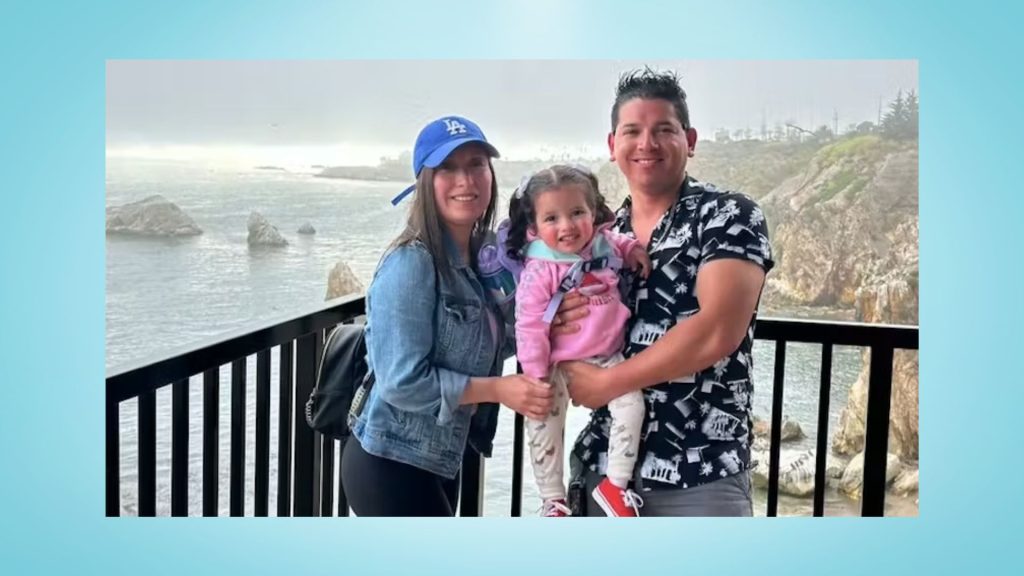
Alleging violent abuse and denial of medical care and disability accommodations, a Sunnyvale family filed a lawsuit in early July against the U.S. Department of Homeland Security, U.S. Immigration and Customs Enforcement (ICE) and two private prison corporations.
The case, Peña Lopez v. United States (Case No. 5:26-cv-06864-BLF), was filed in the U.S. Court, Northern District of CA, San Jose Division. In it, Ulises Peña Lopez; his wife, Aby Peña (a U.S. citizen); and their daughter (also a U.S. citizen) seek damages for Peña Lopez’s assault by the Department of Homeland Security (ICE) and two private prisons. Their second claim is for emotional distress they say resulted from witnessing the arrest and its aftermath.
The lawsuit brings 18 causes of action, including claims under the Federal Tort Claims Act, the Rehabilitation Act, the Administrative Procedure Act, the Fifth Amendment and California’s Unruh and Bane Acts. Plaintiffs are seeking compensatory and punitive damages, declaratory relief and attorneys’ fees.
After holding Peña Lopez for eight months, ICE deported him to Mexico in October 2025. He’s now living in hiding in Mexico, in fear for his life (the original reason he left Mexico), said Attorney Laura Murchie of Disability Law United. Many of Peña Lopez’s present medical conditions are direct results of ICE abuse, says the attorney, and he needs between $20,000 and $35,000 of surgery that he can’t afford.


A Day That Destroyed a Life
The story begins when ICE agents surrounded Peña Lopez’s truck outside the family’s Sunnyvale home on the morning of Feb. 21, 2025 as he was leaving for work.
“Multiple ICE officers grabbed Ulises when he voluntarily stepped out of the truck,” states the complaint. “One officer put a gun to his head. Others forced him to the ground. ICE officers then jerked Ulises up off of the ground and rammed him against the car while beating him with closed fists, striking multiple blows to his ribs and neck,” and calling him “f***ing immigrant,” “f***ing beaner,” and “f***ing Mexican.”
A second assault occurred minutes later, the complaint continues, after ICE agents pulled Peña Lopez from a transport van in an out of the way alley.

“Ulises, who was still handcuffed behind his back, tumbled out of the vehicle from a height of approximately four feet and struck his head on the ground. The ICE officers began kicking and beating Ulises, punching him in the ribs, stomach, arms, legs, and neck,” the complaint states, adding that Lopez lost consciousness twice and began convulsing. ICE agents eventually called paramedics.
Peña Lopez was hospitalized for one day and kept shackled in the hospital, where ICE agents constantly monitored him and obstructed confidential meetings with his lawyer.
Peña Lopez already had a vascular condition that he was being treated for, and the complaint alleges the beating triggered a medical emergency. Rather than being released to recover, he was transferred directly from the hospital into ICE detention, first at The GEO Group’s Golden State Annex (GSA) in McFarland, CA and then CoreCivic’s California City, CA detention center.
Denied Care Behind Bars
During the following months, the lawsuit alleges, employees at both prisons repeatedly denied Peña Lopez proper medical care and disability accommodations despite his deteriorating health, which included paralysis and numbness on his right side, vision and hearing loss and traumatic psychological distress.
The allegations paint a picture of systematic mistreatment and abuse.
GSA staff mocked Ulises for his manner of speaking, which was impeded by the numbness and paralysis in his mouth, according to the complaint.
They repeatedly told Ulises to “say it again” and got angry at him for his inability to hear well. The staff derided him, saying “mother****er, you don’t get to be asleep” and “you mother****er, you’re never gonna walk again,” and called him names like “Little estrellita [star].” When Ulises struggled to walk or stand, officers told him to “sit down on the stick,” referring to his cane.
At CoreCivic’s detention center, employees allegedly refused to move Peña Lopez from a top to a bottom bunk despite his impaired mobility. “Ulises coordinated an informal switch with another detained person in his dormitory, risking punishment [solitary confinement] for doing so,” the complaint says. Medication was supplied inconsistently.
Separate Lawsuit Substantiates Lopez’s Complaint
The Lopez complaint references a separate lawsuit, Ruiz v. U.S. Immigration & Customs Enforcement, filed in November 2025, making similar allegations against CoreCivic’s California City detention center. Ruiz alleged appalling conditions at the prison, including sewage bubbling up in drains, vermin, keeping people virtually incommunicado by restricting access to lawyers, and a medical care system that’s “broken at every level.”
A federal judge granted a preliminary injunction in Ruiz, ordering ICE to provide adequate medical care, appoint an independent monitor and ensure confidential lawyer conferences. The order took effect when Peña Lopez was held there. The prison was also under city investigation for alleged building, fire safety and health code violations, according to the complaint.
None of the defendants — the United States, DHS-ICE, GEO Group, or CoreCivic — had filed a response to the complaint as of press time. Private companies have 21 days and government agencies have 60 days to file their responses after the complaint has been served.
Other Silicon Valley Voice Posts:
A Year Later: Family Grieves, Nursing Home Drags Out Legal Fight, Denies Negligence
SCUSD Settles Caserta Lawsuit for Millions