


With nearly a million people expected to come to Silicon Valley between the Super Bowl and FIFA World Cup in 2026, preparations are underway to ensure the Bay Area is ready. One of the things that law enforcement agencies are looking out for is a potential increase in human trafficking.
“As we get ready for some of the state’s largest events next year, the Super Bowl, FIFA World Cup, we recognize that human trafficking is a problem and that public transportation venues could often be a vector for some of these behaviors,” said Aston Greene, VTA Chief for System Safety & Security. “So, as we engage with law enforcement, we recognize also that we have to engage our ridership, we have to engage our operators and all employees to be mindful of what these behaviors look like, so that we could stop it from happening.”
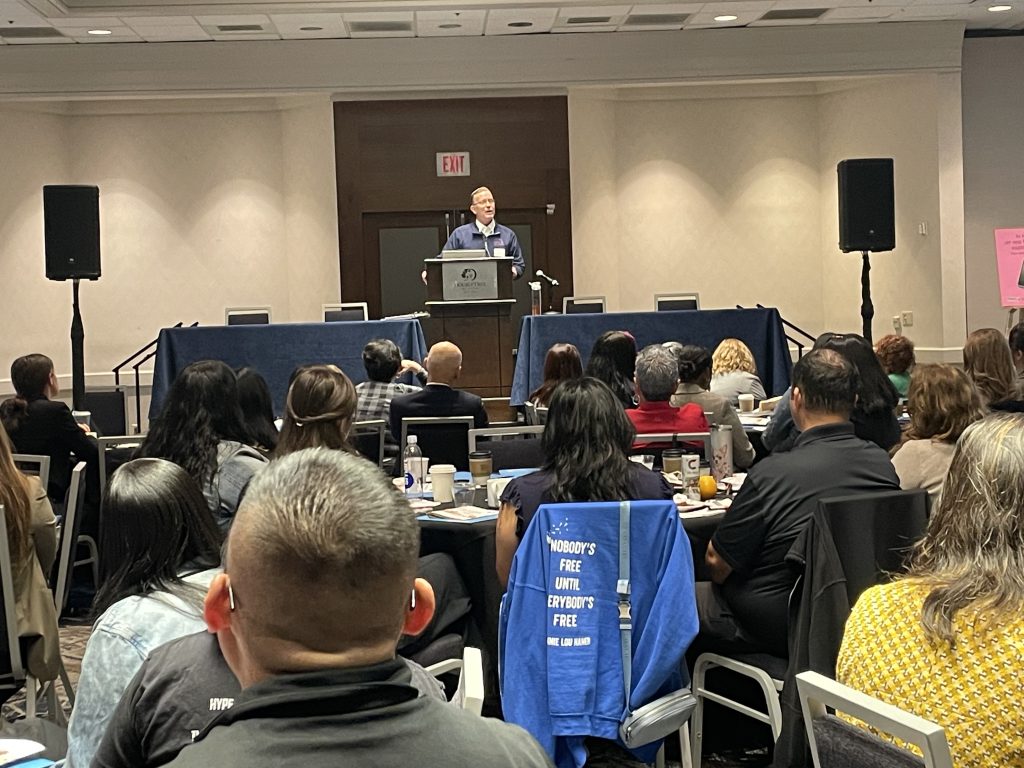
On Oct. 29, VTA hosted representatives from local law enforcement, the hospitality industry, transportation agencies and local district attorneys at the Double Tree Hotel in San Jose to discuss how to identify and combat human trafficking during major events. Among the attendees were representatives from the Santa Clara Police Department (SCPD), which is already taking steps to ensure the safety of visitors to Santa Clara.


“As part of the planning effort for the major sporting events in 2026, the Santa Clara Police Department established a planning sub-committee dedicated to addressing and mitigating human trafficking,” said Lt. Eric Lagergren, SCPD public information officer. “This sub-committee is led by the Santa Clara County Human Trafficking Task Force but has representation from members of the Santa Clara Police Department, as well as other local, state, and federal law enforcement. Local government leaders and NGOs also participate in regular sub-committee planning meetings on this topic, recognizing law enforcement is only one aspect of the mitigation and messaging effort.”
During the conference, officers got a look at different aspects of human trafficking, including ones that are not always obvious.


John Michael Lander is a survivor of human trafficking. He told his story about how, as a 14-year-old springboard and platform diver bound for the Olympics, he was trafficked not on the streets, but in the VIP sections.
“I want you to know that athletes are struggling too,” Lander said. “If it’s true that one in four females and one in six males are sexually abused before the age of 18, think of all the athletes that were at the Paris Olympics, [who] are going to be at the FIFA World game or Los Angeles Olympics, how many of them are still competing silently because we do not tell because we want to represent our country. And so many times when people have come forward, they’ve lost their place on the Olympic team, and they’ve lost probably sponsorship.”
Lander told the crowd he stayed silent for many years, and when he turned to the people he trusted most, he was not believed. It took him years to finally tell his story and talk about what happened to him.
“I did not see myself as a vulnerable. Now that I look back, I see I was in a vulnerable situation,” said Lander. “We got to be careful, because a lot of survivors don’t want to be identified as vulnerable because it makes them feel weak. If there’s a way that we can train a change and say, ‘Well, the situation you were in, you were vulnerable.’ If it takes off of us that we didn’t do something wrong, but we weren’t strong enough to fight back. That’s a big deal for a lot of survivors.”
The Super Bowl is Feb. 8, 2026, and the FIFA World Cup runs June 13 – July 1, 2026, in Santa Clara. VTA is expected to play a significant role in transporting people to and from the events. The agency will have public notices about human trafficking at local stations, on buses and trains. The VTA app will have a category to report human trafficking to a live person.
VTA also plans to re-emphasize its training with its operators on how to detect behaviors in trafficked victims and how to report incidents to local law enforcement. The training is one VTA has conducted for several years. It was a model State Assembly Member Ash Kalra used for AB2034 in 2018, which required transit agencies to train their employees on recognizing the signs of human trafficking and how to report them.
Related Posts:
Local Hospital Performs Emergency Disaster Drill Before Big Events at Levi’s Stadium
Levi’s Stadium Adds New Restaurants, Food Offerings in Preparation for Super Bowl
Santa Clara’s Amenity Problem is Bigger Than the Super Bowl and World Cup
49ers Unveil Levi’s Stadium Renovations Ahead of Super Bowl, FIFA World Cup

