


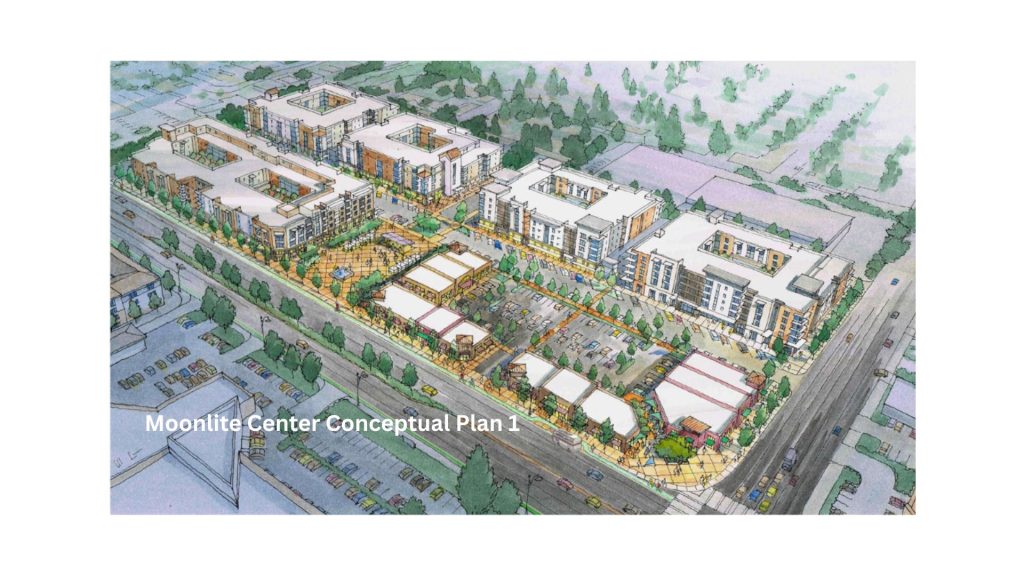
Santa Clara is reshaping its major activity corridor.
At a meeting earlier this year, the Santa Clara City Council adopted the city’s El Camino Real Specific Plan.
The plan addresses land use, infrastructure and transportation, goals, policies and objective design standards, identifies specific actions needed to achieve goals and environmental impact. Its goal is to reduce density and address concerns over impacts, aiming to concentrate highly dense housing in activity nodes.
Lesley Xavier, the city’s planning manager, told the council that approximately 70% of land along the 3.2-mile, east-west stretch along the western edge of the city to Lafayette Street is dedicated to surface parking. It also features 2.2 million sq. ft. of commercial space and 2,500 apartments.


The plan aims to refine and implement the general plan, addressing land use, infrastructure and transportation, goals, policies, objective design standards and identifies specific actions needed to achieve the city’s goals, Xavier said. The goal is to reduce density to address concerns over impacts by maintaining higher-density activity centers to support mixed-use development.
Alessandra Lundin, a designer with a city-hired consultant, Raimi + Associates, said the El Camino Real Specific Plan focuses on key development nodes. Doing so allows the city to respect the character of the neighborhoods, create memorable public spaces, enhance connectivity, improve multi-modal connectivity and safety, as well as promote a range of housing options.
One of the biggest changes is to the city’s land use designations, adding a lower density designation for townhomes, reducing density near single-family homes.

Designated activity centers — deemed regional mixed use — will host between 55 and 100 dwelling units per acre, mixed use between 45 and 65 with commercial frontage required for some, residential between 26 and 45 and limited to four stories and low residential between 12 and 25 and limited to three stories.
To address community concerns around transition standards, building setbacks and landscape buffers, the city added design standards, revised neighborhood transitions and required commercial activity in activity centers.
Libby Seifel, another consultant, said retail is rapidly changing, with hybrid work shifting demand toward workplace-adjacent homes.
“According to retail experts, today’s consumers are more intentional with their purchases,” Seifel said. “There is a growing preference for unique offerings, experiences and wellness-oriented goods and services. And consumers are consolidating shopping trips and placing more value on convenience and also on walkability and access to a multiple variety of retail offerings within a short driving distance or walking distance.”
The plan plays into Santa Clara’s budget as well.
Seifel said property and sales tax growth have been high, with 64% and 36% growth, respectively, since 2018-19. Residential infill is also helpful, she added, since residential tax is growing faster than commercial.
Manuel Salazar, with Silicon Valley At-Home, called the plan a “substantial improvement over the status quo.”
Council Member Kevin Park bemoaned the “loss of variety,” specifically grocery stores in retail areas. He said the city needs to make the city livable for low-wage workers by adding housing density at lower income levels.
“Density is kind of like an air mattress,” he said. “If you push it down in one place, it has to go up in others.”
Contact David Alexander at d.todd.alexander@gmail.com
Related Posts:
Will New El Camino Plan Make it Past the Goal Posts?
Approval of General Plan Zoning Changes Hit a Snag
Police Chief Gets Raise Despite Vice Mayor’s Objections
El Camino Plan and Sound Wall Revisited, Political Attacks Renewed