


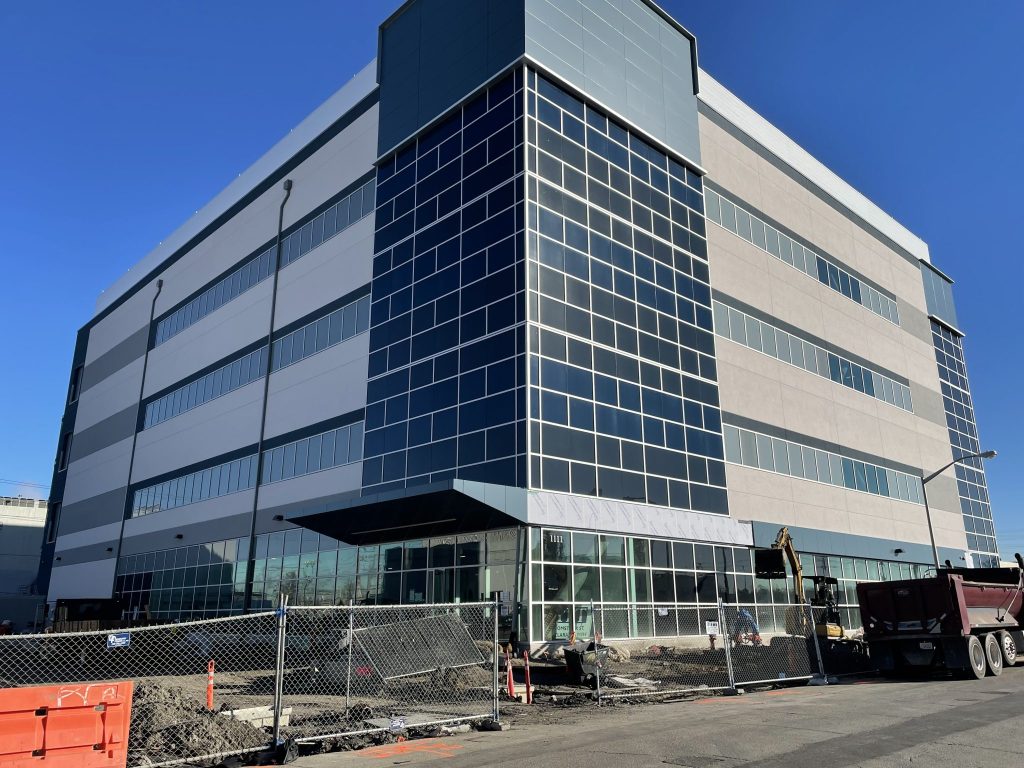
Last year, income from data centers displaced hotel tax as the Santa Clara general fund’s third-highest revenue source after property and sales taxes.
But some question the economic wisdom of the city-owned electric utility, Silicon Valley Power (SVP), investing in expanded electrical infrastructure that will largely serve data centers, suggesting that it seems like a zero-sum transaction.
Another way you could look at that is: If you’re a business that gets 60% of its revenue from one group of customers, it makes sense to invest in accommodating those customers’ growth.


Santa Clara has 55 data centers, with three new ones in the pipeline. Data centers buy 60% of the power SVP generates, and that load is expected to grow to 1,300 megawatts (MW) from 700 MW today. As such, data centers make a hefty contribution to the city’s general fund.
SVP pays 5% of its gross revenues into the city’s general fund — $34.5 million in the 2024-2025 fiscal year. That means that the more power SVP sells, the more money goes into the general fund. (Council Member Suds Jain has suggested raising that to 8% of gross revenues, which would boost that $34.5 million by another $2 million.)


Data centers also pay property, sales and use taxes, which added up to $10.5 million last year, according to an April 2025 report to the council.
All this added $45 million to the city’s bottom line in 2024-2025. That’s 13% of the city’s $342 million general fund budget, and nearly twice the $23 million Santa Clara collected in hotel tax last year. Data centers’ contribution to the general fund is now the third largest, behind only property and sales taxes.
Data centers also help pay for the infrastructure investment required by their massive appetite for electricity.
“We have a load development fee,” explained SVP director Nico Procas “It’s a calculation that assigns the costs of our system that’s, by and large, the expansion of the system. Of the $400+ million in [planned] spending, we assign a certain amount of that cost to new customers.
“For example,” he continued, “a new 50 MW data center would pay a roughly $30 million development fee.”
In addition, data centers contributed $3.9 million toward affordable housing since 2019, and three data centers that are in the pipeline will contribute another $1.7 million.
Santa Clara is among the top ten U.S. cities for data center location, and a key part of this is low electric rates, as well as SVP’s dark fiber backbone.* Being attractive to technology businesses has been a key revenue strategy for the city since the post-WWII period.
In 1960, that was the semiconductor industry. Today, it’s the data center industry.
Carolyn Schuk can be reached at carolyn@santaclaraweekly.com.
*A note on sources: The financial information about data centers comes from the city’s 2025-2026 budget and post-meeting material from the 5/20/25 city council meeting. The final contribution from SVP to the general fund exceeded the amount forecast in the May presentation.
Related Posts:
Related Proposes Displacing Retail And Office Space In Favor Of Data Centers
Council Approves Data Center In Spite of Planning Commission Objection

