


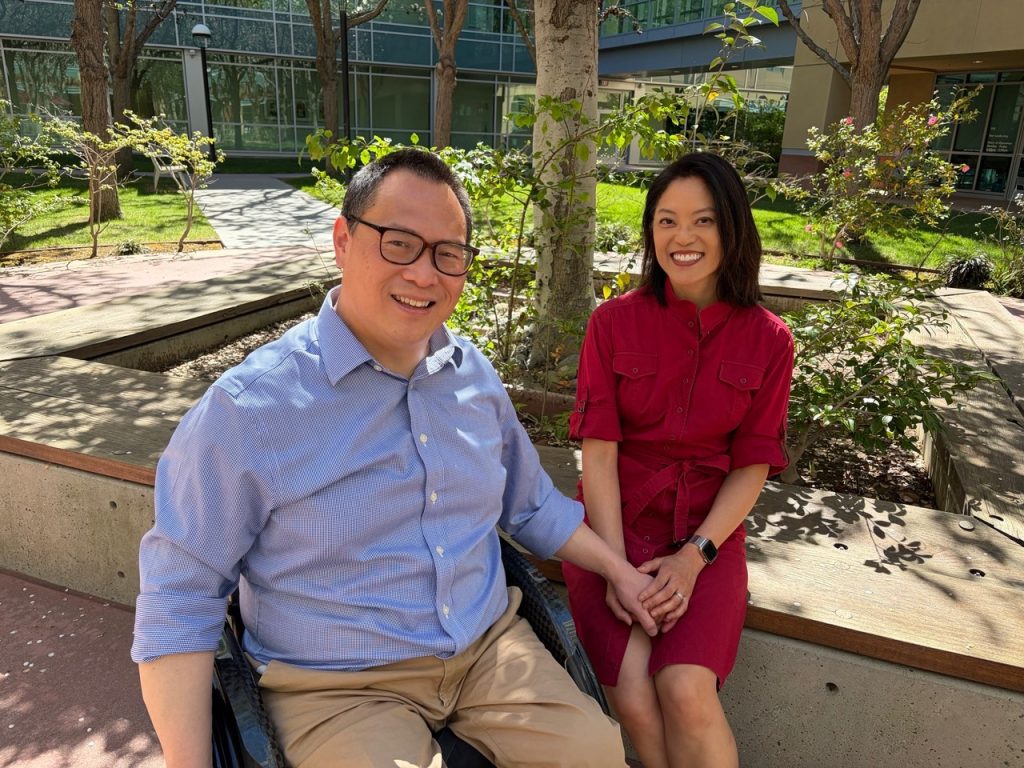
A surfing accident could have ended Dr. Hoa Le’s medical career. Instead, it became the cornerstone of a medical practice built on compassion.
It only took a few seconds for a surfing accident to change the entire trajectory of Dr. Hoa Le’s life. One moment he was 28 years old, in the middle of his residency at Loma Linda University — a newlywed enjoying his honeymoon with his wife Jennifer, also an MD. The next, he was a paraplegic with an uncertain future.
The accident happened during a surfing lesson. He fell, but kept going. Then, 45 minutes later, something felt wrong. “I remember that was the last time I had any sensation in my legs.”
By the time they made it to shore, he couldn’t stand up. He collapsed on the beach and was taken to the hospital. As he lay in the ER, hazy with morphine, he heard the doctor say that his neurological exam “didn’t look good.”


“I knew enough,” said Le. “I was like, shoot.”
Le could have let the injury define his future. Instead, he decided not to give up — and gave himself a deadline to return to practicing medicine. Today, 23 years later, Dr. Hoa Le is Kaiser Santa Clara’s GI oncology lead and co-founder of the Kaiser Santa Clara Disability Alliance. He plays wheelchair tennis and runs a nonprofit called REACH Career Mentoring for children with disabilities.
The Long Road Back
After spending time in the ICU, he flew back to California. Following six weeks of acute rehabilitation — “they teach you enough to get by and send you home,” as he describes it — he returned to a future that would be nothing like what he had planned.
For a year, Le says, his disability dominated every waking minute. Not just adapting to a wheelchair, but adapting to suddenly becoming someone different.
His marriage jumped into a new reality, and every step of the way Jennifer was at his side, even as she was building a pediatrics practice. “We went from 28 to 50 in one fell swoop.” What held them together, he says, was friendship. “When you first get into a relationship it’s all roses. But what really keeps you by someone’s side is that you’re good friends.”
His first anniversary became a turning point. “I remember thinking: it’s been a year. What now? Time is just going to keep flying by.” He made the decision to return to his residency on September 1st — no exceptions, no escape clauses.
“I made the deadline in my mind and in my heart,” he said. “[And told myself] you’re coming back on this date, no matter what.”
A New Identity
“I was a new me and I didn’t know how my friends and colleagues would perceive me,” he said. “I didn’t know how to perceive myself. When I looked in the mirror, I was finding a new identity.”
When Le told a Loma Linda rehab doctor that he intended to specialize in oncology, the doctor replied, “Oh, that’s good — you don’t have to be very physical to do that.” It was “incredibly insensitive,” Le says.
Returning to medicine meant relearning things he thought he knew. “How was I going to practice medicine and be a doctor? I remember thinking, there was no course for this, there was no mentorship for this.” Reinvention was constant.
“Now I had to scope out a room and say, ‘Can you put the exam table like this so that I can roll up?'” he explained. “Everything was trial by fire.”
“I’ve rolled into rooms and people said, ‘When’s the real doctor coming?'” he recalled. “My wife has told me women have similar experiences in medicine. Now, I understand.”
Lessons Only a Patient Can Teach
Being a patient taught Le an important lesson that no medical school teaches. “My very worst days — the days where I was angry and throwing things and didn’t want to see anybody — the only people I did want to see were my nurse and my physical therapist. It was how they cared for you as a person that counted.”
That experience led Le to co-found the Kaiser Santa Clara Disability Alliance with a cardiovascular surgeon whose daughter has a disability. His larger effort is REACH Career Mentoring, which connects people with disabilities to career mentors who share their experience.
Le and Jennifer return again and again to one question: how much of who they are is because of, not in spite of, everything they have been through?
“I absolutely think that I am who I am right now, today, because of everything — not in spite of, but because of,” Le says. “And it’s a beautiful thing.”