


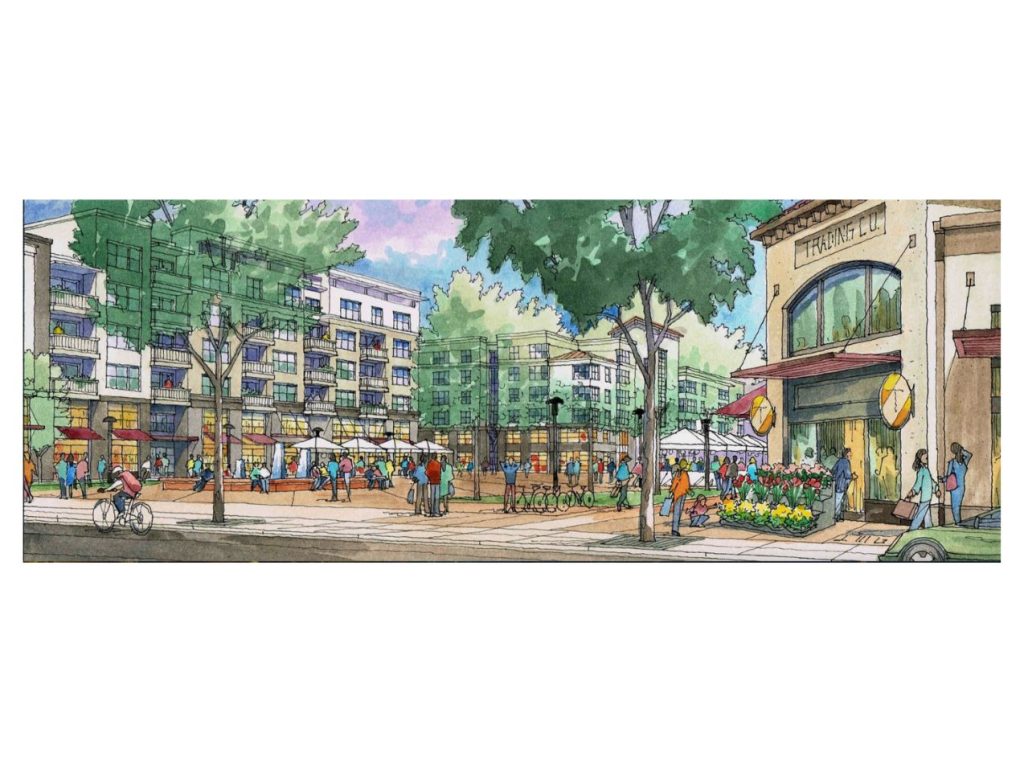
At its April 8, 2026 meeting, the Santa Clara Planning Commission approved a new El Camino Real Specific Plan, sending it to the city council for approval. The commission also voted against allowing signs covering building facades and discussed commission roles vis-à-vis the current charter review.
Santa Clara launched the El Camino Specific Plan in 2017 after a city council dispute about the architectural style of a proposed apartment building. The planning commission sent its first plan to the council in 2021. Since then, the El Camino specific area plan has outlived the tenures of two planning directors, gone through significant revisions and a complete redo, and likely consumed around $2 million in consultants’ fees, according to city agenda reports.
The latest revision reduces housing density from 6,600 units to 4,400, adds a new “corridor residential low” — no more than three stories — designation for townhouses, and specifies in more detail land use transitions near single-family neighborhoods — for example, limiting heights the closer they are to residential streets, called “daylight plane.” The plan doesn’t have a significant impact on city utilities, according to the staff report.
Some of the challenges for the plan lie in the fact that El Camino Real backs directly onto single-family residential neighborhoods.


“I would say property owners along this corridor are your primary stakeholders,” said resident Savina Cauci. “It seems to me that we [residents] don’t have much say in what happens, particularly, [when] a lot of these really huge buildings have come up right up against people’s property.”
She also noted parking problems. “I want to make [sure] that there’s enough parking — cars aren’t going away in any near decade.” Cauci also said that she didn’t “recall receiving any note to come to any of those previous meetings.”
Marketing consultant Leslie Stiefel estimated the plan could also lose nearly 290,000 sq. ft. of commercial space (roughly 10% of what exists now and current economic conditions may result in greater retail loss.

The commission approved sending the plan to the council with its associated General Plan and zoning changes.
Concern About Lack of Retail
Commissioners voiced concern that cutting retail can work against the city’s goal of creating appealing, walkable neighborhoods like Main Street Cupertino. The plan lacked a clear draw for residents, said Planning Commission Chair Eric Crutchlow, and compared unfavorably to Cupertino, Mountain View and downtown San Jose.
“If you’re going to have all those residents in there, what are you going to do for entertainment?” said Commissioner Mario Bouza. “We used to have bowling alleys, theaters, restaurants that had dance floors. I don’t see anything in that regard. When they did a study in the city, one of the things that they [respondents] mentioned is entertainment. We lacked entertainment for gathering and doing things.”
Commissioner Nancy Biagini reiterated the point.
“I miss that in Santa Clara. Why do I need to go out to Cupertino, Mountain View? There isn’t anything that really draws our residents towards a space. There isn’t even retail draw that allows people to sit down, have a cup of coffee, and just chill after work.”
No Supergraphic Signs
The commissioners also voted against a request from the city manager to allow temporary supergraphic signs — signs printed on flexible material that covers a building façade — for the World Cup. Santa Clara prohibits new billboards, so allowing them would require a new ordinance.
Not only would this create new work for the planning department on an accelerated schedule without making money for the city, it would also create legal hazards if the city tried to limit what signs could be put up, said assistant city attorney Xander Abbe. And finally, it turned out that nobody had actually asked for them.
The commission also continued its discussion of charter change recommendations — its role in policy-making and extent of authority, commissioner qualifications and what role the planning commission should play in policies about new technologies like autonomous cars.
The next Santa Clara planning commission meeting is May 20, 2026, at 6 p.m. in the city council Zoom: https://santaclaraca.zoom.us/j/9172920289802898.
Carolyn Schuk can be reached at carolyn@santaclaraweekly.com.
Previous Santa Clara Planning Commission Posts:
Planning Commission Discusses Charter Changes
Planning Commission: Smoke Shop Zoning Do-Se-Do
Planning Commission Green-Lights Design Standards, Historic Resources Update