


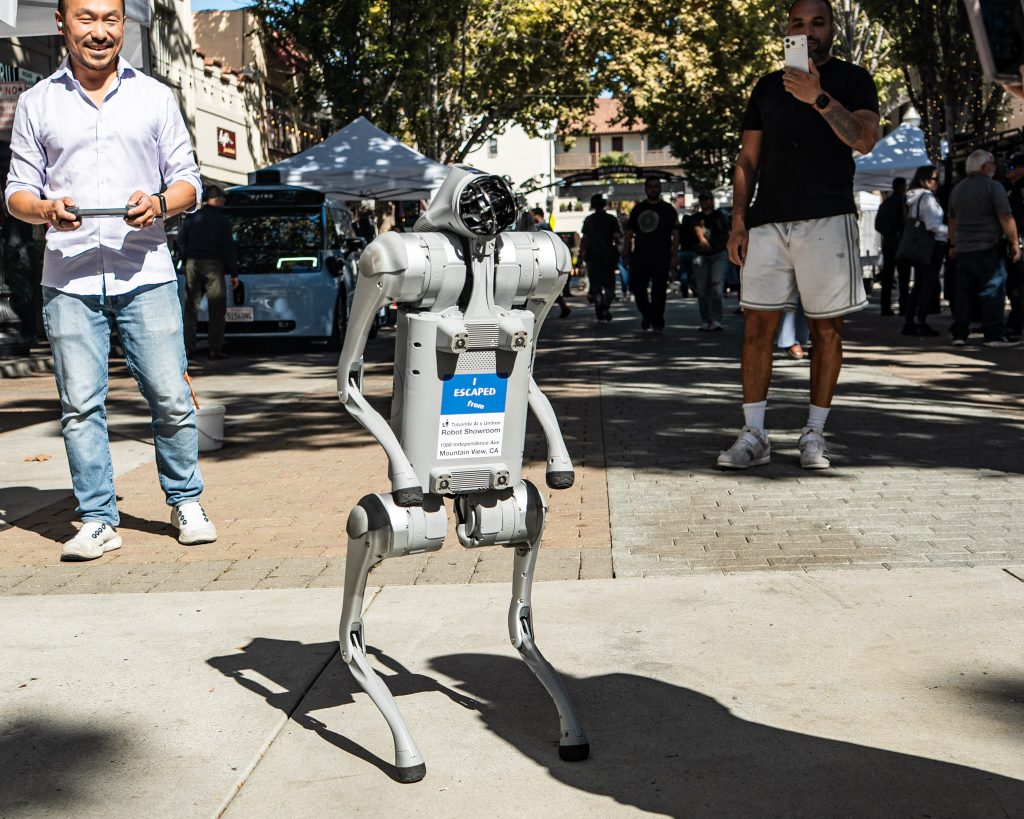
Sunnyvale businesses showcased emerging technologies to the community at the city’s annual Tech Business Expo.
The expo took place Thursday on Historic Murphey Avenue, starting at 11 a.m. and ending at 1:30 in the afternoon. Roughly two dozen businesses tabled at the city-organized expo, and dozens of community members turned out to see their work. City employees say the event has grown every year.
“Robots are all the rage,” said Mayor Larry Klein. “They’re changing the world.”

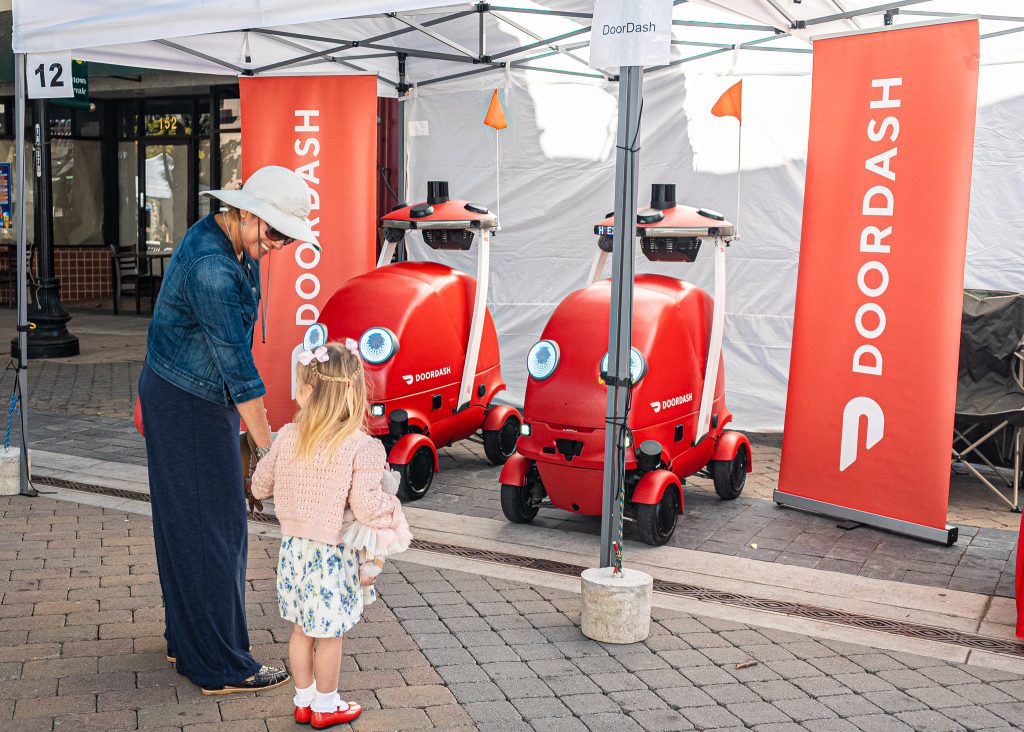
DoorDash presented Dot, an autonomous robot its operators plan on deploying across Sunnyvale next month. The robots aren’t ready to deliver orders yet — they require months of live mapping on sidewalks and bike lanes. DoorDash employees will trail behind Dots on bicycles, as the robots navigate the city.


Representatives for DoorDash project the robots will be fully operational sometime next year. Dot will handle short-distance, low-paying deliveries that traditional delivery drivers are less likely to take on. Dot will make deliveries ranging between 30 and 35 minutes.
“By combining autonomy and human delivery, we can meet growing demand and create new earning opportunities,” a DoorDash webpage for Dot reads.
NASA, which conducts research at its Ames Research Center on Moffett Field, shared work regarding its ARMADAS project. ARMADAS is short for Automated Reconfigurable Mission Adaptive Digital Assembly Systems — it’s part of NASA’s larger goal to build an astronaut base on the moon’s south pole.

The ARMADAS project will deploy robots on the moon, using voxel to build moon structures. Voxels are lightweight building blocks the robots will use to construct the moon base and other structures, such as communications towers. Voxels are made of carbon-fiber reinforced polymers and strengthen when combined with each other.
NASA representatives project a launch in 2028 to build something on the moon. NASA has yet to determine what it will build. The launch is part of the agency’s first phase in developing a moon base by the mid-to-late 2030s.
In non-robotic related news: Sunnyvale highlighted its BEAM transit service, which the city launched in August. The service caters primarily to senior residents and Sunnyvale students, who lack a school bus system.
BEAM’s ridership has climbed since debuting, so much so the service faces driver shortages during peak rush hours. Erik Trujillo, a transportation planner for Sunnyvale, said the average wait time for service is up to 20 minutes. That number increases during rush hour.
The city partnered with transportation-technology company Via to secure a $4 million grant from the state. That grant covers half of BEAM’s operations for the next five years. When the grant expires, Sunnyvale can reevaluate BEAM and potentially network across neighboring cities who also partner with Via, such as Cupertino and Santa Clara.
“We’re just really excited for the service to continue to grow,” Trujillo said in an interview with Via, “and for us to start to get some strong data around where there are any potential for expansion opportunities.”
Chris Ramirez is a California Local News Fellow.
Related Posts:
Santa Clara’s STEM Zone Draws Thousands to City’s Convention Center
Sunnyvale Tech Business Expo Features Variety of Innovations