


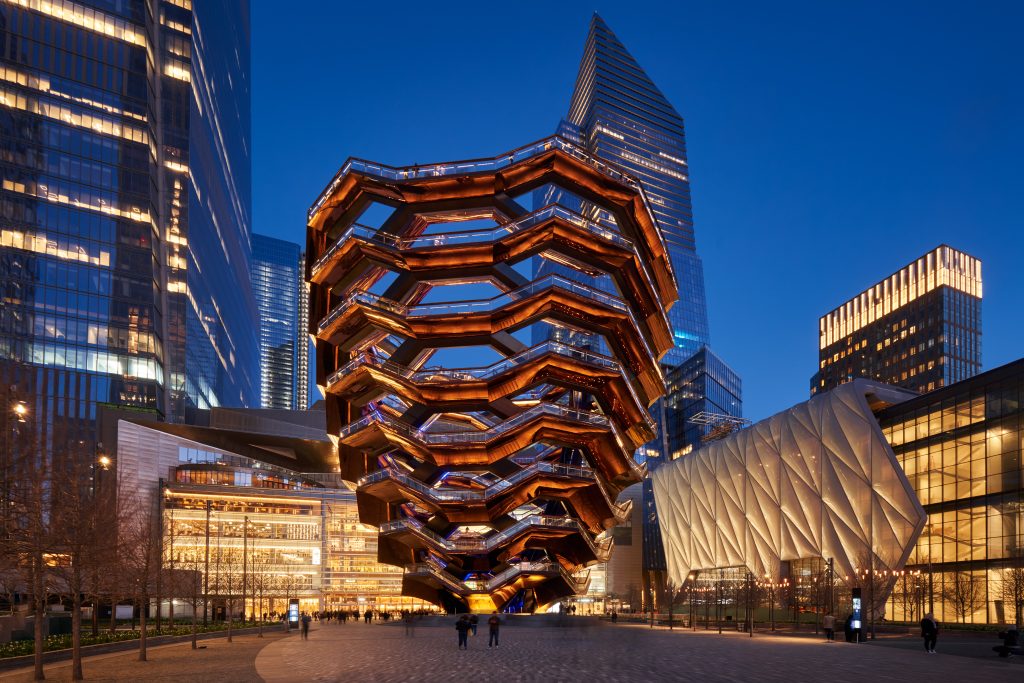
While Santa Clarans have been waiting more than a decade for their Northside Shangri-La, they can take a peek at the possible future. That’s Related’s $25 billion mega-development Hudson Yards in New York City — the most expensive real estate project in national history.
Like Related Santa Clara, Hudson Yards was designed to be built on stilts, albeit over an operating railroad yard instead of a defunct landfill. Hudson Yards Phase 1 opened in 2019 after seven years of construction. A second phase was scheduled to open in 2025.
The project received $6 billion in tax breaks and outright subsidies from New York taxpayers, including money that was earmarked for helping distressed neighborhoods.


“A private space masquerading as a public one …[that]…bears the same relation to New York City as a police-sketch artist’s drawing does to a face,” wrote one critic in the New Yorker.
The Gothamist called it “a dystopian outpost of Midtown.”


In “Horror on the Hudson,” the Guardian’s Oliver Wainwright called it “an architectural zoo of convulsing angles,” built of “bargain-basement building-by-the-yard stuff.”
“This para-Manhattan, raised on a platform … has no history, no holdover greasy spoons, no pockets of blight or resident eccentrics,” wrote New York Magazine. “In the renderings … just about every one of the digital people strolling through the virtual cityscape is young, thin, able-bodied, and white.”
This is now NYC’s most expensive neighborhood, with condominiums selling for an average of $7 million— with $5,000 in monthly maintenance fees.* Rents range from a $2,800 studio to a 2 BR/3B apartment for $25,000 a month (It has great views!) Exactly 324 of Hudson Yards’ 4,000 apartments are “affordable.”
Santa Clarans won’t be surprised to learn that the part of Hudson Yards that has been built doesn’t include the city on top of the railroad yard.
That’s the part that was supposed to include more housing, a park and a school, and was supposed to resign average New Yorkers to giving tax breaks and public subsidies to a private company; one estimated to have $70 billion in international real estate holdings.
Hudson Yards was back in the news last summer when Related proposed a mammoth casino-in-the-sky on the unbuilt part of the site, arguing that building costs were too high these days and only a more lucrative project would pencil out.
Sound familiar?
When even Mayor Eric Adams’ immeasurable corruption couldn’t push that over the finish line, Related returned with a new plan: Another $2 billion from New Yorkers to build 4,000 more high end apartments and condominiums, with another measly 324 units of affordable housing.
In other words, Related wants New Yorkers to pay $2 billion more to do what they contractually agreed to do more than a decade ago. The school and park are still on the books, but a smart gambler wouldn’t bet on them.
Again, sound familiar?
While Related hasn’t gotten any direct subsidies from Santa Clara, in a 2022 case concerning prevailing wage requirements, the California Department of Industrial Relations ruled that Related’s project was subsidized by the City in the form of artificially low rent increases and development fees, and a city-funded substation to serve the development.
There is another subsidy: lost opportunity cost. Had the City put this project out to bid in 2013, there could be a thriving development delivering sales, hotel and property taxes to city coffers. And Santa Clara could benefit from the tourism tsunami in 2026 from the Super Bowl and World Cup.
Of course, we’ll never know. But it’s something for people to think about when they pay the assessment for last year’s infrastructure bond.
However, Related is doing just fine. In March, the company announced a new data center business unit to handle $45 billion in new data center construction Related says it has in its pipeline.
*Prices come from current NYC real estate listings.

