


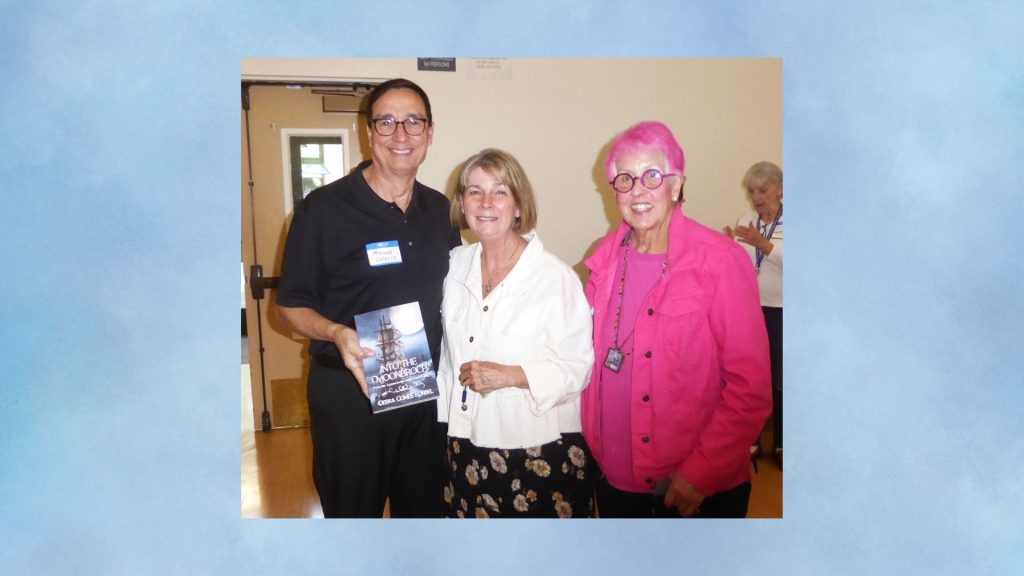
“Into the Moonbroch: From the Azores to the Santa Clara Valley” by Santa Clara native Debra Gomes Korbel resonates with the Bay Area Portuguese, history buffs and lovers of historical fiction.
“It’s a powerful immigrant story of survival, sacrifice and the pursuit of a better life,” said interviewer Logan Crawford on a Spotlight Network interview.
Korbel’s novel recounts the hardships, drama and hopes of a Portuguese immigrant family sailing in 1878 from the Azores around South America’s Cape Horn to the Hawaiian Islands—as did Korbel’s great-great-grandparents.


After working in the Hawaiian sugar cane fields to repay the cost of their sea passage, the immigrants then sailed onward to the West Coast—to the Santa Clara Valley.
The novel, which opens in 1902 in Santa Clara and flashes back to1878, is inspired and enriched by Korbel’s own Portuguese heritage and underpinned by her meticulous research.


Korbel, an English and history major in college, took seriously her responsibility to be historically accurate.
“I really believe in keeping the history correct,” she said in a book talk at a meeting of the Cupertino Historical Society & Museum (CHSM) last year.
Important to Korbel’s research was “The Portuguese in Hawaii,” a book from the private collection of the late Ray Gamma, a Santa Clara native of Portuguese heritage.
The voyage to America in modest sailing ships called barks took about 120 days and was so perilous that the immigrants would not risk a return trip.
“If we had known what this would be like, we would never have made the trip,” was written in one record, recalling the extreme hardships and risks of the treacherous sea voyage around Cape Horn before the Panama Canal was completed in 1914.
“Moonbroch”—from the title of Korbel’s novel—is a Scottish word for a luminous ring or halo around the moon; it is an omen of bad weather to come. Korbel uses “moonbroch” to foretell the hardships of the voyage to America.
“Her book resonates with me,” said CHSM Executive Director Manuel Valerio, a Santa Clara Valley native and past Sunnyvale mayor. Valerio’s family immigrated to the U.S. from the Portuguese Island of Madeira, but lived in Rochester, NY, before moving West.
“Many of the same things she mentions in the book are stories of my family. Stories about leaving their homeland and coming to America. My dad and granddad came first, for jobs,” said Valerio.
Korbel embarked on her own long, uncertain journey in writing a first novel. She explored the idea of writing her book for about a decade while working in high tech. After retiring, she dedicated three years to research and writing. It took yet another year to review and publish the book in 2023.
The resources of the Portuguese Historical Museum in History Park in San Jose informed her research. In the museum basement are books about Portuguese culture, history and celebrations and a large map of the Portuguese journey to America.
“Deb wrote the book I wish I could have written,” said Korbel’s aunt, Donna Gomes Austin, born in Santa Clara and now a Cupertino resident. “I’m thrilled because all these are stories and things I heard from my grandma. Deb somehow caught those stories and backed them up with research and made them fuller.”
“One of my ambitions in writing the book,” said Korbel, “was to really be able to appreciate why am I here, what brought me here and what were the sacrifices that were made by that previous generation.”

