


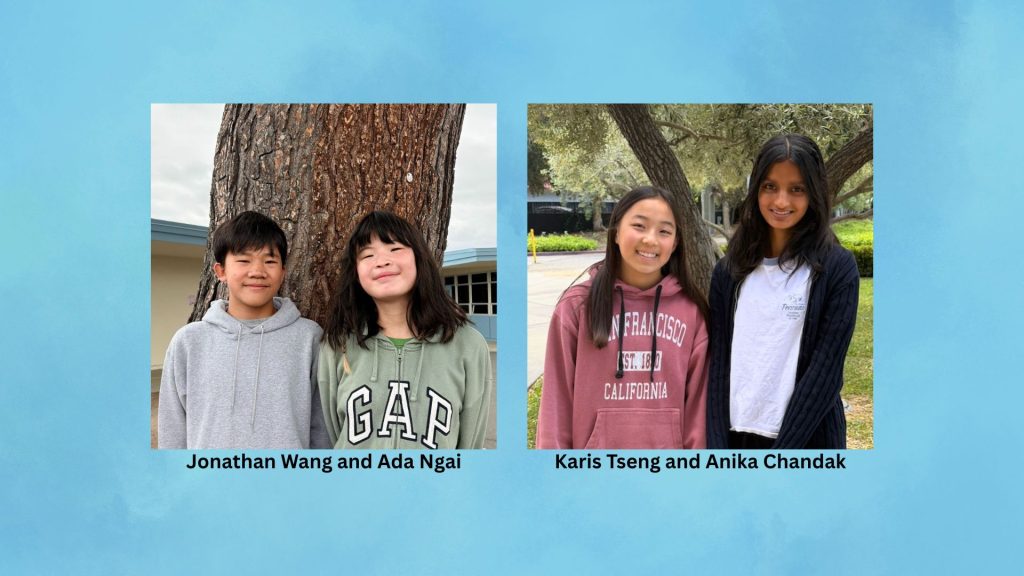
Four Juan Cabrillo Middle School eighth graders took home international honors this spring. Two teams of two students each placed second in a video competition aimed at raising social awareness for three global issues.
The competition, World of 8 Billion International Student Video Contest, is run by Population Connection, a nonprofit that advocates using resources at a rate that fosters population stability. The contest pulled in more than 3,000 entries from 63 countries.
John Seager, president of Population Connection, wrote in a press release that it takes a lot of skill to communicate a message in the video’s 1-minute length.
“These students explain complex issues clearly and think creatively about how we can build a more sustainable and equitable future,” he wrote.


This year’s contest asked students to connect population growth to one of three global issues: wetlands conservation, energy and economics. This year’s winning videos ranged from housing inequity and fast fashion to biodegradable textiles. Middle school winners receive $600 for first place and $300 for second.
Ada Ngai and Jonathan Wang, both 13, won in the economics category for their video on child labor and education. Karis Tseng, 13, and Anika Chandak, 14, placed second in the energy category for a video on “sand batteries,” an emerging clean-energy storage technology. Cabrillo science teacher Michelle Scilingo taught both teams.
For Anika, the idea started with a search for something the public didn’t already know much about.

“This competition is less about inventing new things and more about bringing newer technologies into public awareness,” she said.
She and Karis landed on sand batteries — devices that store heat generated from renewable sources in sand or other materials, like mining waste, and convert it into usable thermal energy.
The appeal, Anika added, was partly the novelty, partly that sand is an abundant resource.
Their research also revealed the technology’s limitations. Sand batteries depend on a renewable source feeding them, Karis said, and because they store heat, they’re less useful to people in already-hot climates. Instead, she pointed to places like Iceland where the technology could matter most — cold, and hard for other energy infrastructure to reach.
Ada and Jonathan’s project started from a different direction. Initially, the pair was looking for a topic in economics generally and kept running into research on forced labor. They wanted a topic centered on people, not abstractions.
Their video argues that child labor and poverty reinforce each other in a generational loop, and that expanding access to education is one way to break the cycle.
Much of what they found surprised them, Ada said — not the existence of child labor, but the scale and range of work children are doing. Jonathan described it as a kind of chain reaction: once child labor starts in a family, it tends to compound across generations, he said.
The project also left both more aware of what they have.
“Going to bed and having air conditioning, a comfortable pillow and mattress — it is so easy to take it for granted,” Ada said.
Jonathan pointed to smaller things: everyday electronics, free time as a “really big shock.”
Their video points to targeted policy — cash transfers to families conditioned on school attendance, for instance — as more effective than banning child labor.
“Simply banning child labor doesn’t help unless you educate them,” Jonathan said.
All four students said compressing it into a single minute was the hardest part — not the research. Karis put it bluntly: the format meant she “had to talk really fast.” Jonathan estimated that more than half of what the team researched never made it into the script.
Both teams emphasized time management and communication as important elements.
The experience left a mark beyond the contest itself.
Karis said it deepened her interest in green energy and the range of approaches people are taking to it. Anika said she plans to keep looking into other companies and materials working on energy storage.
Jonathan said he’d like to keep exploring solutions to child labor, while Ada said the project shifted her thinking toward wanting a career centered on helping people, not just economics in the abstract.
Asked what they wished more people their age understood, the students said it was mostly about awareness.
“I wish people would believe more in climate change,” Karis said. “Some people are aware of it, but they don’t do anything. I’m guilty of this too. We can’t just wait for other people to do stuff.”
Anika said she hopes more people recognize the environmental cost baked into the energy people already use and take encouragement from companies trying to change that.
Jonathan pointed to how many people, and how many children in particular, are denied a “real childhood.”
Ada added that she wants people to understand child labor isn’t a distant, historical issue.
“It impacts us directly. We need to actively work on [addressing it],” she said.
Contact David Alexander at d.todd.alexander@gmail.com