



A Santa Clara motel that housed hundreds of formerly homeless people is being rebuilt as permanent housing for some of the county’s poorest residents.
Earlier this month, Santa Clara County officials and nonprofit developer Resources for Community Development (RCD) broke ground on Clara Gardens, a $111.3 million project, located at 3550 El Camino. Renovation of the former Bella Vista Inn and the addition of a new seven-story building will provide 120 apartments. All are restricted to households earning no more than 50% of area median income (AMI).
A quarter of the development — 30 apartments — will be permanent supportive housing for chronically homeless people, with on-site services meant to help them stay housed. The rest will go to households earning up to 30% or 50% of AMI.
The project began as an emergency measure. When California launched its Homekey program to move at-risk homeless people into motels during the pandemic, the county and RCD saw the property as both a stopgap and a future redevelopment site. The county bought the motel with a $22.1 million grant and converted it to interim housing.


From 2023 to 2026, the motel housed 379 formerly homeless. Of those, 72% have since moved into permanent housing. Nine now live at Sango Court, an RCD below-market-rate housing development in Milpitas.
The interim program ended to make way for construction. Operators transferred the remaining residents to another interim site.
“The property didn’t sit unused while we were working on the financing,” said KJ Kaminski, the county’s office of supportive housing director. “It is really a great model for advancing two of our goals.”

Those goals, she said, are addressing homelessness in the short term and building permanent solutions. The county has used the same approach at a couple of other sites, Kaminski said, and motels lend themselves to it because they’re already set up to house people.
The county looks for sites near transit and services and in good condition, she added.
“We wouldn’t want to acquire a temporary hotel that needed a lot of rehab,” Kaminski said.
RCD Executive Director Dan Sawislak wrote in a statement that the project illustrates what happens when officials “refuse to let a vacant motel sit empty while people sleep outside.”
Assembling financing took several years, which, according to the county, is typical for below-market-rate projects.
Tax credits constitute the largest share of the budget at $41.9 million, followed by $37.9 million from the state’s Multifamily Housing Program. The county contributed $18 million: $12 million from its 2016 Measure A affordable housing bond and $6 million from a state program for supportive housing. Another $3 million in Homekey money goes toward construction.
The $950 million Measure A bond has now committed $715 million to 64 projects in 11 cities, according to the county. The bond is on track to help fund more than 6,700 units, well above the original estimate of 4,800, according to county figures.
At about $930,000 per unit, Clara Gardens falls within the typical range for affordable housing in the county, officials said.

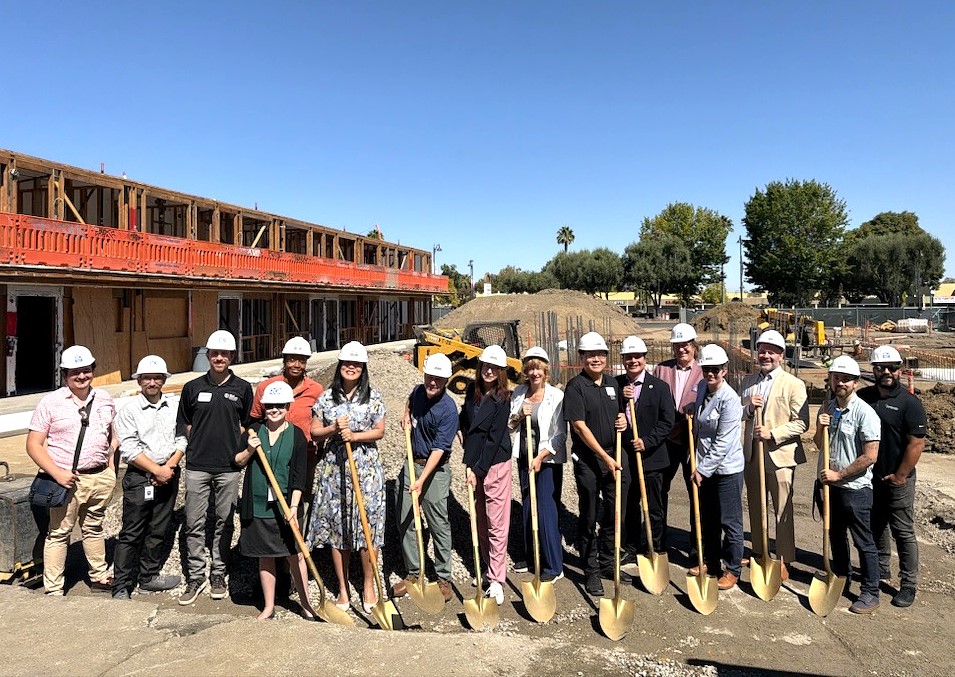
Santa Clara Council Member Kevin Park, who represents District 4 where the development is located, said the long timeline was offset by the people housed at the site in the meantime. He said projects aimed at the lowest income levels are essential in a county where median income is exceptionally high.
“It’s not really a housing crisis. It’s an affordability crisis,” Park said. “It’s not that we don’t have houses. It is that people can’t afford the houses.”
As El Camino Real becomes more walkable, the site will become more appealing, Park said. But he argued that the city should plan below-market-rate housing near what residents need, including retail and child care.
“We desperately need projects that target the people who are struggling,” he said. “People need a shopping mall, a retail center that has what they need.”
The development will include a community room with a kitchen and indoor bicycle storage.
The county will refer supportive housing tenants, prioritizing vulnerability and need, with referrals set to begin mid-2027. The county will contract with a service provider for case management, clinical care, education and job services.
The remaining apartments will be leased through an application process run by RCD, which is expected to open roughly 10 months before construction ends, which is scheduled for December 2027.
“We are very proud of the project and what we’ve been able to do,” Kaminski said.
Contact David Alexander at d.todd.alexander@gmail.com