


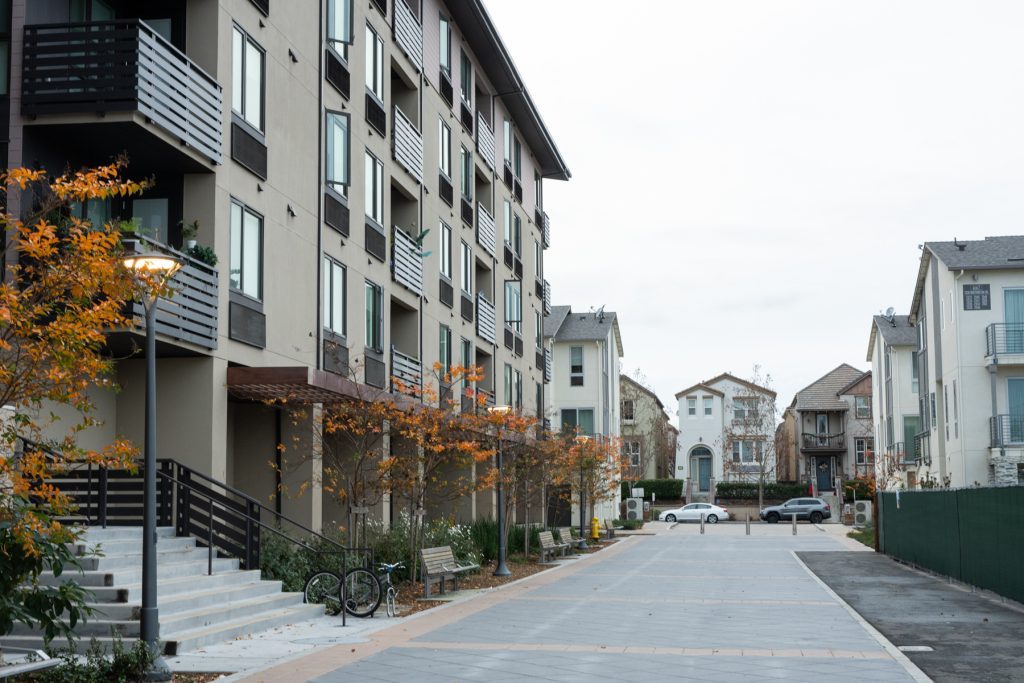
It was pitched as innovative. It was billed as a one-of-a-kind project. Its design was lauded as a paragon of placemaking.
Instead, residents said what Santa Clara got with the “Agrihood” is a haven for meth labs, drug trafficking, prostitution and a bicycle chop-shop.
Trash piles up, and urine soaks the common-area walls — creating a festering cesspool that’s a haven for gnats, rats and cockroaches.


Inadequate lighting and striping make the garages a falling hazard, especially for the elderly.
Doors and stairwells lack handicap accessibility. Elevators are unreliable.


Porch piracy is rampant.
Residents said management rules with an iron fist, running the complex like a prison.
Roughly two years after its opening, Santa Clara’s mixed-use urban farm development, often called the “Agrihood,” located at 76 N. Winchester Blvd., has become a parade of unfulfilled promises and resident frustrations.
A Toxic Environment
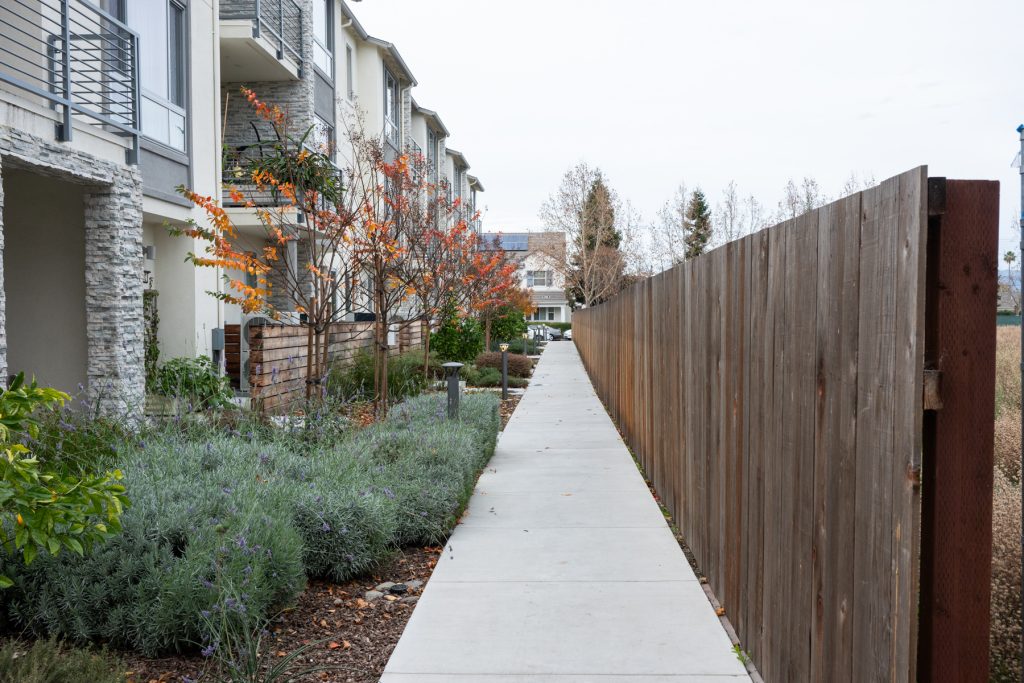
Just a stone’s throw from San Jose’s Westfield Valley Fair and Santana Row, the Agrihood is a mixed bag. Developed by The Core Companies, it features senior housing, a 1.5-acre farm, as well as housing designed to get the homeless off the streets, known as permanent supportive housing.
Several residents agreed to speak to The Weekly anonymously, saying they feared speaking out could jeopardize their housing.
Last year, a fire at the development left many residents with lingering health concerns. Sources offered several possible causes for the fire — an exploded battery on a stolen e-bike, unlevel stoves that cause grease to pool and catch fire, cooking meth gone awry.
The fire incident report lists the e-bike explosion as the fire’s cause, but myriad suspicions are a canary in the coal mine. Whatever the cause, the fire’s stalled remediation is symptomatic of something sources said is the heart of the matter: management doesn’t address problems.
Just before the interview for this story, one resident, who asked to be called Kiki, fell in the garage because of poor visibility, suffering injuries that caused her to seek medical attention.
“It has just been one problem after the next since I moved in. It is not just me. It is the whole environment — the structure, the rules, the management,” shesaid. “It’s neglect on the part of the management that makes my residency so miserable.”
Even with a doctor’s note, getting the most basic handicap accommodations, such as grab bars in the bathroom installed, was like pulling teeth, she said. Management gave her 19 pages of rules with an eight-page addendum.
Some of the policies were so stringent — such as only being able to have visitors two weeks a year — she thought they couldn’t possibly apply to her.
The John Stewart Company manages the property. Core Companies hired John Stewart Company.
Residents said the way the Agrihood is managed is inverted from how it should be. Model residents are bullied into following strict rules put in place for problem residents, but nothing is done about those problem residents.
“They don’t ever, ever get rid of any troublemakers. The management itself is in such denial. I shouldn’t have to lower my values or my needs to meet them,” Kiki said. “Living in this place is a downfall for me, and I try to be gone as much as I can.”
Carelessness
Multiple sources said managerial errors left them getting eviction notices, even though their rent was up-to-date. Management taped those notices to their doors like a scarlet letter — without an envelope — for everyone to read.
One resident who called herself Katherine said she was “surprised and shocked and embarrassed” at the notices being right out in the open for everyone to see, adding that it was especially egregious because they were a mistake.
To make matters worse, Katherine said another resident assaulted her, but nothing was done about it. Security cameras don’t work, and security at the complex is a joke, she added.
“You can’t be destroying people’s lives like this. This is ridiculous. Do I have to stay in my apartment now?” she said. “I was in a panic … I am so done with this. I want to feel safe, and I don’t. I don’t feel safe in our garage. I don’t feel safe in our building.”
Crime statistics for the Agrihood were unavailable from the Santa Clara Police Department.
Another woman, who asked to be called Delores, said management has a “cavalier attitude and disrespects everyone.”
“Me going out of my housing and feeling comfortable — that doesn’t exist. I am walking on eggshells,” she said.
Yet another source, who asked to be identified as Cindy, said many single women have left the complex because of “all the weirdos.” There are “bodily fluids splattered on the walls,” she added.
And that’s not the only sanitation concern. Garbage piles up in the parking garages, attracting vermin. The laundry rooms are filthy.
“We live with people who will wash dog poop with their blankets,” Cindy said.

Slipping Through the Cracks
Problems with bad actors and lackluster management are also hurting some of the very people the development aimed to help.
One resident who spoke to The Weekly asked to be called Eggshell. Formerly homeless, he secured an apartment at the Agrihood as part of its permanent supportive housing component. He said apartment management also taped notices to his door because of a mix-up.
Further, he said, management makes stringent rules. Many of the permanent supportive housing residents are not used to having rules, he said, bringing a “street attitude” to the complex, so they need time to adjust.
But it’s been more than two years.
Although he strives to be a model resident, he said management clamps down on permanent supportive housing residents, painting them all with the same brush.
Management makes people leave ID with the front desk, and sometimes security forgets to return them before they leave for the day. They determine who can visit and when, setting a curfew. Eggshell said the rules often change at the manager’s whim, and that she will alter paperwork after the fact to justify her actions.
Community Solutions handles case work for permanent supportive housing residents, but Eggshell said they feel more like stooges for management than advocates.
This all leaves him uneasy and feeling like he is being punished for the actions of a minority of problem residents, he said.
“Is this a jailhouse or an assisted living place?” he said. “I feel like I’m living in a jailhouse … it is a culture of fear.”
Management is quick to threaten eviction, many said. Eggshell said it feels like the complex is “under martial law.”
Committed to the Vision
In November, Core leadership detailed the company’s plan to convert the Agrihood’s unfinished portion into for-sale townhomes instead of high-density housing as originally proposed, slashing the number of units from 160 to 44.
At that meeting, Jim Sullivan, project manager of Sullivan Land Development, said Core “fully intended to build what was approved.” However, circumstances, including the pandemic, increased operating and construction costs, as well as rising interest rates, have made it “very difficult to build high-density housing and have it be financially viable.”
Vince Cantore, senior vice president of development at Core, said while Core was “disappointed” that it couldn’t make below-market-rate housing on the undeveloped parcel work, he is “incredibly proud” of what Core has delivered.
The site, Cantore said, doesn’t compete well for state money aimed at reducing greenhouse gas emissions, and its proximity to another senior housing complex in San Jose hurts its viability for more such housing.
The proposed change still needs planning commission and city council approval.
Core is still committed to the vision it proposed in 2019, Cantore said.
“We delivered the vast majority of the community benefits that we talked about at the beginning,” Chris Neale, president of The Core Companies, said.
Interview requests to Cantore and David Neale, owner of The Core Companies, went unanswered.
Unfulfilled Promises
It isn’t just residents who are being critical.
Kirk Vartan is a city council mainstay and Santa Clara business owner. Vice Mayor Kelly Cox, whose district the Agrihood is in, even named him District 6 resident of the year, despite him being a San Jose resident.
Vartan has championed the Agrihood for more than 20 years. In recent months, he has been vocal to the council that Core Companies has been derelict in its commitments. He scoffed at Neale’s claim that Core has delivered on what it promised.
While Vartan’s lens is several layers removed from the boots-on-the-ground experience of residents, even a bird’s-eye view is galling, albeit for different reasons.
The public space is “severely limited,” Vartan said. The community kitchen Core promised is absent. Originally, the for-sale townhomes were supposed to be affordable for teachers and workers, selling for between $600,000 and $800,000. They sold for upwards of $1.4 million.
The on-site farm was supposed to be for everyone, but is only for residents. Placemaking events were supposed to be a weekly occurrence, but only about a dozen have been held, despite the development being more than 100 weeks old.

The list goes on.
“The community benefits are being sacrificed with the proposal they put out there, which is a horrible proposal,” Vartan said. “They got approved for a development, not a section, not three or four parcels — the entire development.”
Fading
To make the Agrihood possible, Core leveraged money from various public-money buckets.
It got $23.5 million in Measure A money, a below-market-rate housing bond that Santa Clara County voters passed in 2016. Santa Clara contributed $15.7 million. Another $50 million in tax-exempt bonds from the California Debt Limit Allocation Committee also helped fund the project.
Given the mountain of tax money Core leveraged, many, including Vartan, say the Agrihood should be held to a much higher standard, or at least not be allowed to slowly be whittled into something entirely different.
“If they are so stuck, and nothing pencils or whatever, why aren’t we trying to do something better and more substantial?” Vartan said. “Where is the transparency? Where is the community engagement?”
Vartan even suggested the council use the space for community amenities, such as pickleball courts, until interest rates fall, making another proposal tenable.
Vartan has addressed the council on several occasions during the public comments portion of the meeting. That portion of the meeting is reserved for non-agendized topics, which means the council cannot address them.
Emails to the city council members and Cox individually, inquiring whether they intend to agendize the topic to address the myriad concerns, went unanswered.
Meanwhile, the vision of the Agrihood as originally planned is fading. Unless something is done to halt its devolution, it won’t be long before it disappears.
Contact David Alexander at d.todd.alexander@gmail.com

